
Tired: With millions of dollars in road damage a year, Spokane lawmaker proposes banning studs…
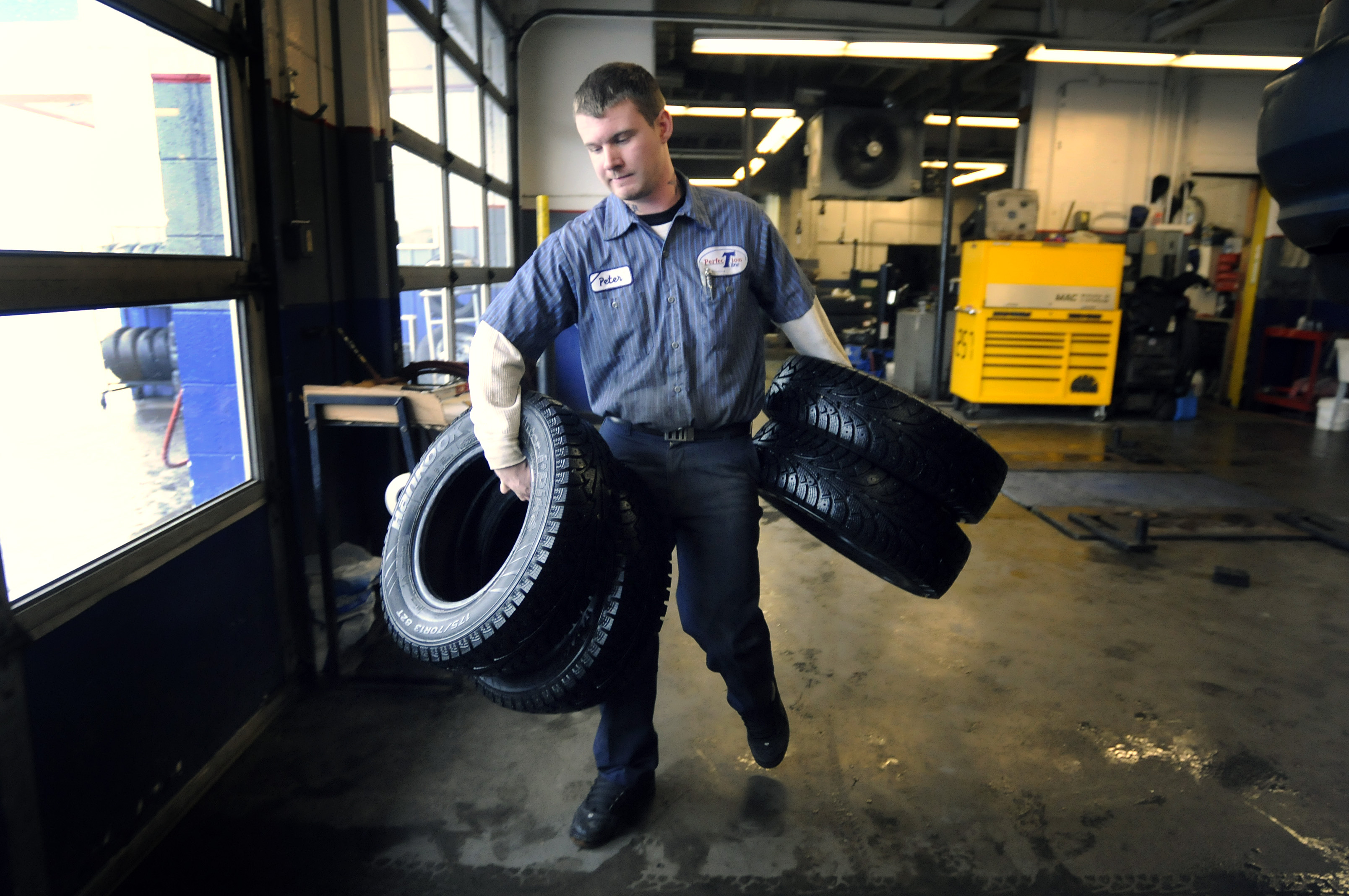
OLYMPIA – To state Sen. Chris Marr, it’s a simple cost-benefit analysis.
The cost: an estimated $18.2 million a year in state road damage from metal tire studs hammering away at concrete pavement.
The benefit: better traction only during a relatively rare driving condition: a roadway slick with sheet ice. Washington drivers, according to the state Department of Transportation, encounter those conditions only about 1 percent of the time.
With Washington facing a $500 million transportation budget shortfall, Marr, D-Spokane, thinks it’s time to ban studs.
“Before, we could view it as a price we pay to accommodate people’s insecurities about not having their studs,” he said. “Can we afford to throw those dollars out the window?”
His Senate Bill 6066 would ban the sale or use of the tires. The co-sponsors include Senate Majority Leader Lisa Brown, D-Spokane. Marr says he’s open to phasing out the use of the tires over several years to avoid penalizing people who just bought them.
Other Eastern Washington lawmakers say a ban would be a dangerous mistake.
“I’d invite Senator Marr to come visit me in January,” said Rep. Joel Kretz, R-Wauconda. “It’s a huge safety thing. I am not convinced that there’s any alternative that really works on ice.”
Maybe there’s a way to set up a geographic limit, Kretz said. He said he feels a little bad when driving around in Olympia, with his studded tires clicking away on roads that rarely see snow or ice.
“I am sympathetic,” he said. “There is a lot of damage done.”
According to legislative research, studded tire sales in Washington fell by half from 1997 to 2003. In 2003, the last year for which data was available, roughly 140,000 of the tires were sold in the state.
Marr’s not alone in proposing legislation to lessen the impact of studs on roads. State Sen. Rodney Tom, D-Medina, wants to establish a $100 annual fee for each vehicle with studded tires. His bill is Senate Bill 5859.
To defuse the argument that the bill puts an undue hardship on Eastern Washington, Marr’s bill would also set up a $10 million account for grants to cities and counties wanting to repair ruts or other damage from studded tires. Since such damage is likely to be worse in Eastern Washington, the money would largely stay east of the Cascades.
Studded tires were banned in Washington until 1969, when lawmakers voted to allow their use year-round. By 1971, with nearly a third of all the cars in the state having studded tires, worried state officials got lawmakers to limit their use to between November 1 and April 1.
In 1977, as ruts worsened, the state Transportation Department issued a report saying that studded snow tires give drivers “about a 10 percent advantage over conventional tires” for stopping on glare ice and hard-packed snow. The rest of the time, the department said, there was no advantage. On wet asphalt, studs were worse.
For the past 25 years, state transportation officials have been trying to convince lawmakers to
once again ban studded tires. After several failed attempts at a ban,
lawmakers tried in 1991 and 1993 to pass a law charging a $25 tax on
all studded tires. Later they proposed an annual “permit fee” of $8 per
tire.
In 1994, lawmakers in the House tried to outlaw studded tires west of
the Cascade Mountains unless it was snowing there. The bill died when
the State Patrol said that it would be extremely difficult to enforce.
In recent years, lawmakers have repeatedly proposed a $15 fee on each
studded tire, as well as shortening the five-month use period to three;
all of which failed.
Despite that history, Marr said he’s confident the bill will get a hearing.
But will it pass?
“I think it’s a conversation we need to have,” he said.
If not, he said, the issue may be taken out of the hands of lawmakers.
Western Washington voters would almost certainly back an immediate ban,
Marr believes.
“You could put this up as a ballot measure and it would pass instantly,” he said.