Curing Comeback
The art of charcuterie – the curing and preservation of meat – goes back decades, and seems to have been rediscovered locally
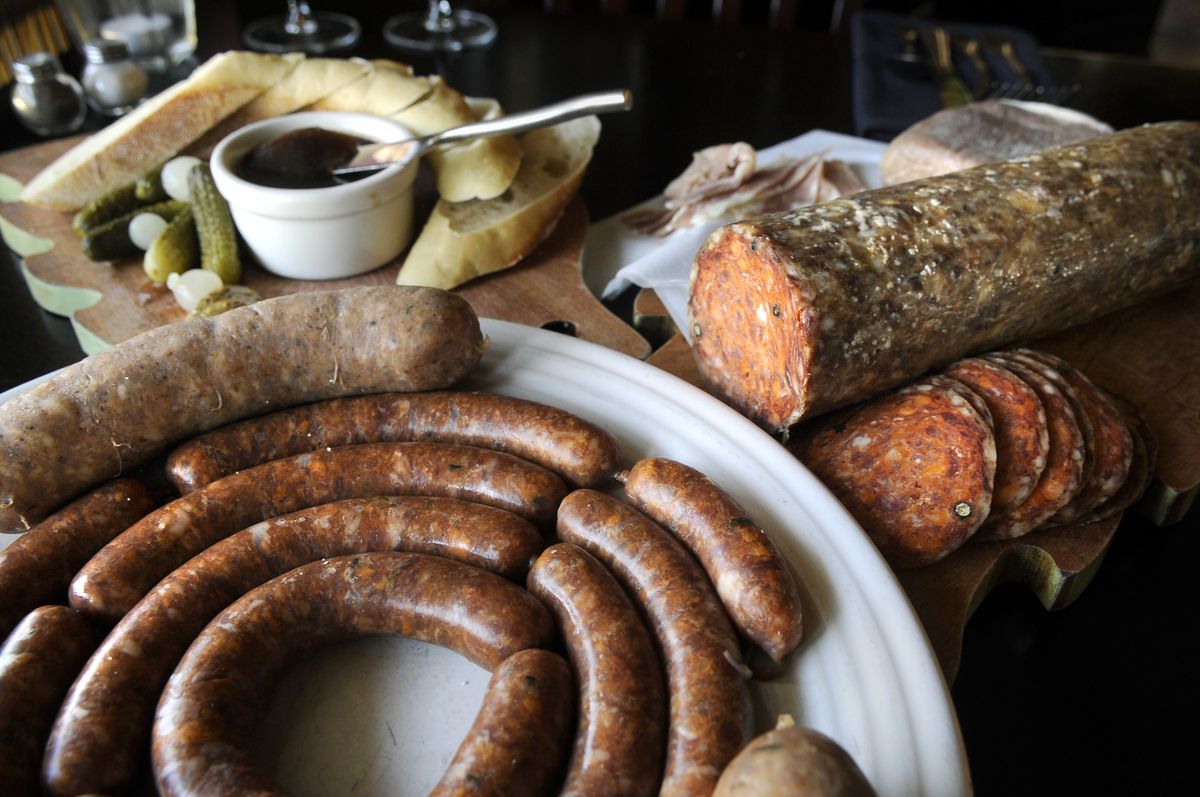
One word characterizes the modern American culinary psyche: Reversion.
After decades of industrialized alienation from the process of eating, it’s as if our stomachs are urging us to re-establish a hands-on, personal relationship with what we’re cramming into it.
As a prime example of this reintroduction to considered consumption, the art of curing and preserving meat is coming back on a small, local scale.
Whether in French (charcuterie), in Italian (salumi) or in American (Ball Park Franks), the art itself can best be described as a survivalist style of preparation that arose from the need to preserve meat to make it last through harsh seasons and times of famine.
And now – though their motivations aren’t quite as dire as those of our intrepid ancestors who invented the methods – increasing numbers of chefs are house-curing prosciutto, hanging their own dry-cured sausages and concocting duck confit in an effort to control quality, save money and, more simply, to reconnect with the instinct to create food from the ground up.
“This is the most ancient way of cooking known to man,” said Jeremy Hansen, owner of the forthcoming Santé Restaurant and Charcuterie in downtown Spokane. “Without these techniques and this style, who knows? Man might not have been able to live. It’s a big part of our human culture.”
Hansen, who hopes to open Santé in the Liberty Building in October with his wife, Kate Hansen, is one of a few local chefs who’ve decided to start delving into charcuterie.
The term itself acts as an umbrella for a number of foods, both exotic-sounding and familiar, including salami, prosciutto, andouille sausage, bacon and the aforementioned duck confit, which is duck that’s salted and stewed long and low in fat – usually its own – then stored in the selfsame stuff.
“They’re really simple and easy things to do, you just have to want to do them, and take the time to do them,” Hansen said. “I think it’s just awesome. It’s better than cooking up a steak and eating it. A steak on the grill is good. But something cured – that’s why it’s an art. You can take this and there’s millions of things you can do. It’s like painting a picture. You can do whatever you want with it and come up with your own flavors.”
Charcuterie is simple – deceptively simple – in its procedures. Take prosciutto, for example. The shorthand explanation for prosciutto says that all you have to do is rub salt on a pork leg and hang it in the corner for a year.
“There’s a lot to it, though, once you get down into it,” Hansen said. “You have to make sure you’re following the procedures to a T.”
When tackling something like proscuitto, Hansen and other charcutiers have to follow recipes precisely – using the right amounts of nitrite, or curing salt – and need to find the right place to hang the meat, usually a dark space with about 60 percent humidity and temperatures ranging from 55 to 70 degrees.
And that’s not just because of bacteria – though botulism is nothing to mess with – it’s to protect an investment.
After all, if you bungle something like prosciutto, you’re not going to find out until you’ve been salivating for a year while it ages.
“It’s one of those things that’s deceptively difficult because it’s so simple; anybody can do it, but the difficult part is getting really good at it,” said chef David Blaine of Latah Bistro, who makes his own prosciutto, confit, sausages and more. “When you’re doing it at home, how many batches can you get away with doing? I can do like five batches in a day (in the restaurant), and that might be five batches in a year for a person at home.”
For the fledgling charcutier, Blaine recommends trying out an old favorite: Bacon.
“It’s a really quick turnaround,” he said, explaining that a person can buy pork bellies and turn them into bacon in a week with little work. “There’s probably nothing in the world of food that has as good of an effort-to-reward ratio as bacon.”
Just be careful. Once a charcutier tastes success, it becomes a philosophy on life.
“I think you should make it yourself, man,” Hansen said. “You gotta make it yourself. You respect the food a lot more. You respect everything in the kitchen that you’re doing. You put a lot more care and time and effort into it, and you can really see that. … Without the food, what are you? You’re nothing. You can’t do anything.”