December 10, 2009 in City
Gregoire offers initial budget
She’ll seek new revenue later to save programs
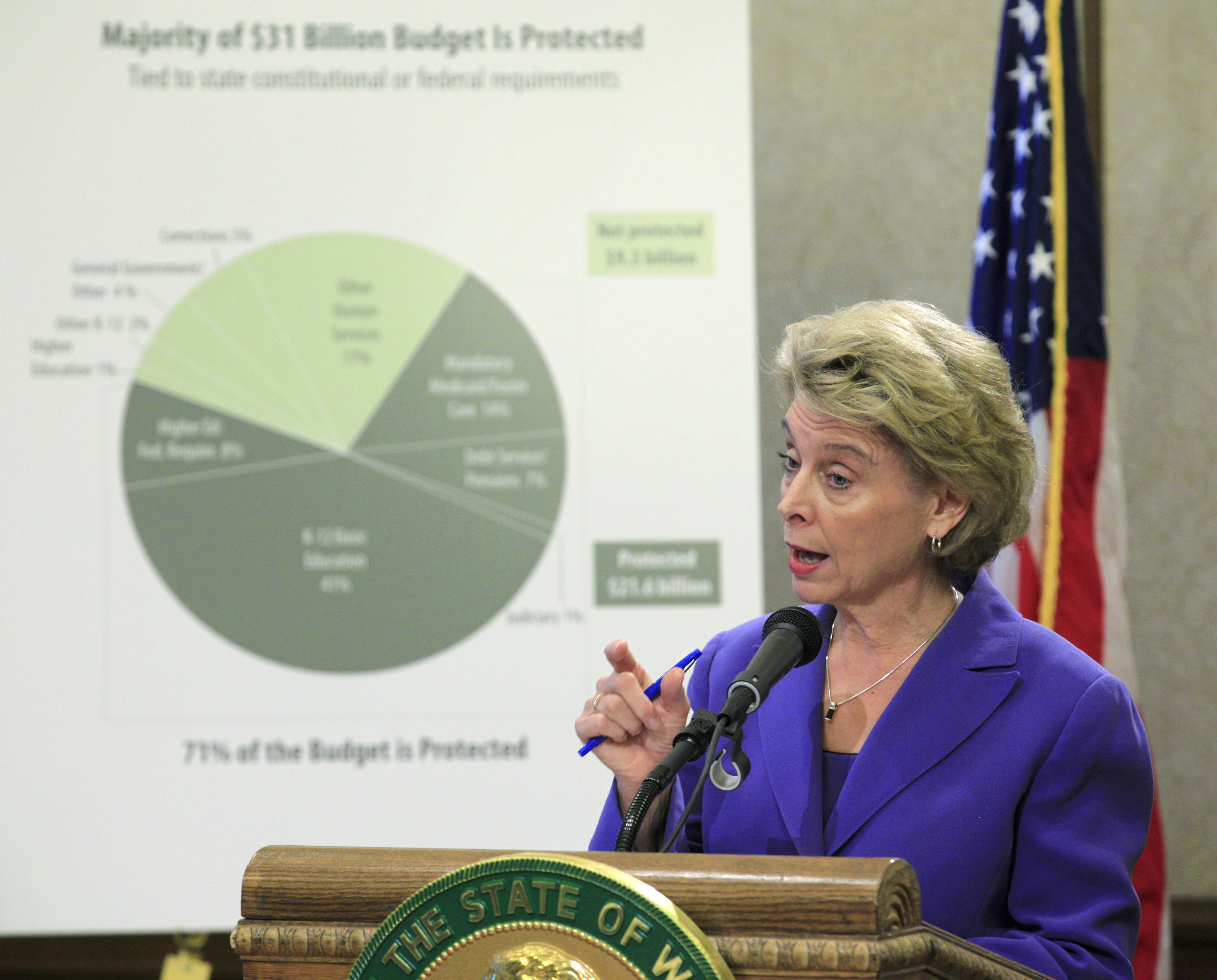
OLYMPIA – Making her case for tax increases, Gov. Chris Gregoire on Wednesday presented a bleak plan to balance the state budget by wiping out spending for health care, welfare and education programs – but vowed to restore some of that money in January.
As required by law, Gregoire presented a plan for balancing the state’s $2.6 billion budget deficit using only the state’s existing tax streams.
But in an open letter to Washingtonians, the second-term Democrat also said she can’t let those deep spending cuts stand. She plans to roll out a second budget proposal early next year when state lawmakers start balancing the books.
That second budget still will cut spending by about $1 billion, she said, but also will propose additional revenue to rescue about $700 million worth of programs from the chopping block. The balance would come from reserves and other one-time sources.
Programs likely to be restored in her second budget included:
The Basic Health Plan, which provides subsidized health coverage to about 65,000 low-income Washingtonians.
General Assistance, a state welfare program for people with disabilities who can’t work or qualify for federal disability payments.
Levy equalization, a system that gives money to school districts with lower-than-average property tax bases.
While Gregoire did not propose a specific way to finance those programs, she didn’t rule out an increase of the state’s 6.5 percent sales tax.
“These important and integral services do not come free,” Gregoire said. “No one likes to pay more taxes. And no one likes to raise more taxes, no matter the state of the economy.”
The decision to seek tax increases was not a surprise. Gregoire spoke repeatedly in recent weeks about her unwillingness to run with an all-cuts budget. But the move carries some political risks for the Legislature’s Democratic majority going into an election year.
Raising taxes would require changes to Initiative 960, the voter-approved tax-limiting measure passed in 2007. That initiative effectively kept a lid on any tax plans during the last legislative session, but a two-year ban on amending its terms expires this month.
After that, the Legislature can amend the initiative with a simple majority vote. Democrats have enough votes to take that step on their own, although threats to a rural-serving program like levy equalization could attract some Republican support.
“We would have to amend 960 immediately and the governor sign it before we could go ahead,” said Senate Ways and Means Chairwoman Margarita Prentice, D-Renton.
Republican lawmakers, however, said Democrats were reaching for revenue too quickly. They suggested alternatives that also would save or raise money, including reductions of state management staff and privatization of the state monopoly on liquor sales.
“In essence, the governor is saying that state government won’t live within its means even though the economy is forcing families and businesses to live within their much-reduced means,” said Rep. Ed Orcutt, R-Kalama.
© Copyright 2009 Associated Press. All rights reserved. This material may not be published, broadcast, rewritten, or redistributed.

Spokane7


Fuschia on December 10 at 5:28 a.m.
I wonder if she realizes that all that money that goes to what she is cutting… trickles down to medical industries and food/housing industries. People have to eat and by putting off medical care until later.. just makes it a lot more expensive.
She is faiing to understand the future results of her current uninformed actions.
I dont see her cutting the bloat she put in the state union workers pay increases so that she could get elected by them. Comes time to pay the piper and she’s going to faint over the bill.
Ninch on December 10 at 8:16 a.m.
Trickle down theory? The cuts in Basic Health Insurance are cuts in its former expansion,which was accomplished shortly before the recession hit, so essentially it was set back to the original. Notably, Basic Health Insurance is a good program, but it is only an “insurance” program… not a health care program. People can still get health care… the most vulnerable are eligible for Medicaid, yet many have not signed up. Clinics offer sliding scale payments, Emergency rooms/hospitals are not allowed to turn away the uninsured.
P.S. I am not a fan of unions, but the so-called pay increases for state workers were based on cost-of-living, some of it having been previously put on hold. And the major costs were NOT salary increases, but rather having the state pay a larger share of the ever increasing premiums for health insurance… so it kind of makes Fuschia’s exclusion of state workers in its “medical care” argument kind of ironic, or is that hypocritical?
lewis8457 on December 10 at 9:08 a.m.
how many private sector workers get a cost of living raise. none is my guess, but i am supposed to give my city, county, state federal workers cost of living raises, what gives?
Megan_B on December 10 at 9:38 a.m.
Ninch -
In order to qualify for Basic Health you have to first apply for Medicaid. It is for the number of people who still have low incomes, just not low enough to qualify for Medicaid (which, is a pretty low amount). And most hospitals will allow you to make payments on large bills - I have done so when I was a student and didn’t have insurance. however, it ends up being more expensive because they will charge you interest, more depending on how low you need the payments to be.
And because emergency rooms aren’t allowed to turn anyone away, the cost for health care continues to skyrocket. Each visit that goes unpaid has to get paid form someone. The price tag? Enormous. Forcing all of the people on Basic Health to turn to emergency rooms for basic health care needs will only end up costing us more in the long run.
lewis8457 on December 10 at 3:10 p.m.
Doubling the premiums on basic health during the Christmas season will have many people falling off the list. I for one, I can pay the double premium or heat my house hell of a choice. If they had doubled it in June I would have paid it. I think doing it now just shows how out of touch the state is.
Also I did not have to be on Medicare to get on basic health. I wish there was a health insurance that was only for hospitalization and was cheaper like car insurance. Paying several hundred dollars a month for something I have not used is well, stupid.
Ninch on December 10 at 4:22 p.m.
Why would anyone want to pay premiums to Basic Health if they are eligible for Medicaid? And notably, the adults may not be eligible for Medicaid, but almost all kids in Washington State are (i.e. SCHIPS) unless the parents have quite a relatively high income, which is plenty to buy insurance for the whole family.
BTW: My point was that many of today’s uninsured in fact could be covered by Medicaid and simply have not applied. The other point is that income limits for Basic Health were increased when Washington State was in better financial shape, and the recent major cuts in Basic Health actually reduces that income limit back down. And as for sliding scale, my local community clinic offers such an option based on income. Making payment arrangements for hospital costs is not the same as paying sliding scale for basic health care services.
soundbarrier on December 12 at 12:52 p.m.
If the State has a monopoly with the liquior stores, why wound the Republicans, who you would think would have better business sense, suggest GIVING UP A MONOPOLY???? Don’t they understand that the State needs revenue? Do they think they can run this State without any money? Is that the best plan they can come up with?