
June 5, 2009 in City
Delving again into nuclear generation
Former WPPSS mulls reactor construction
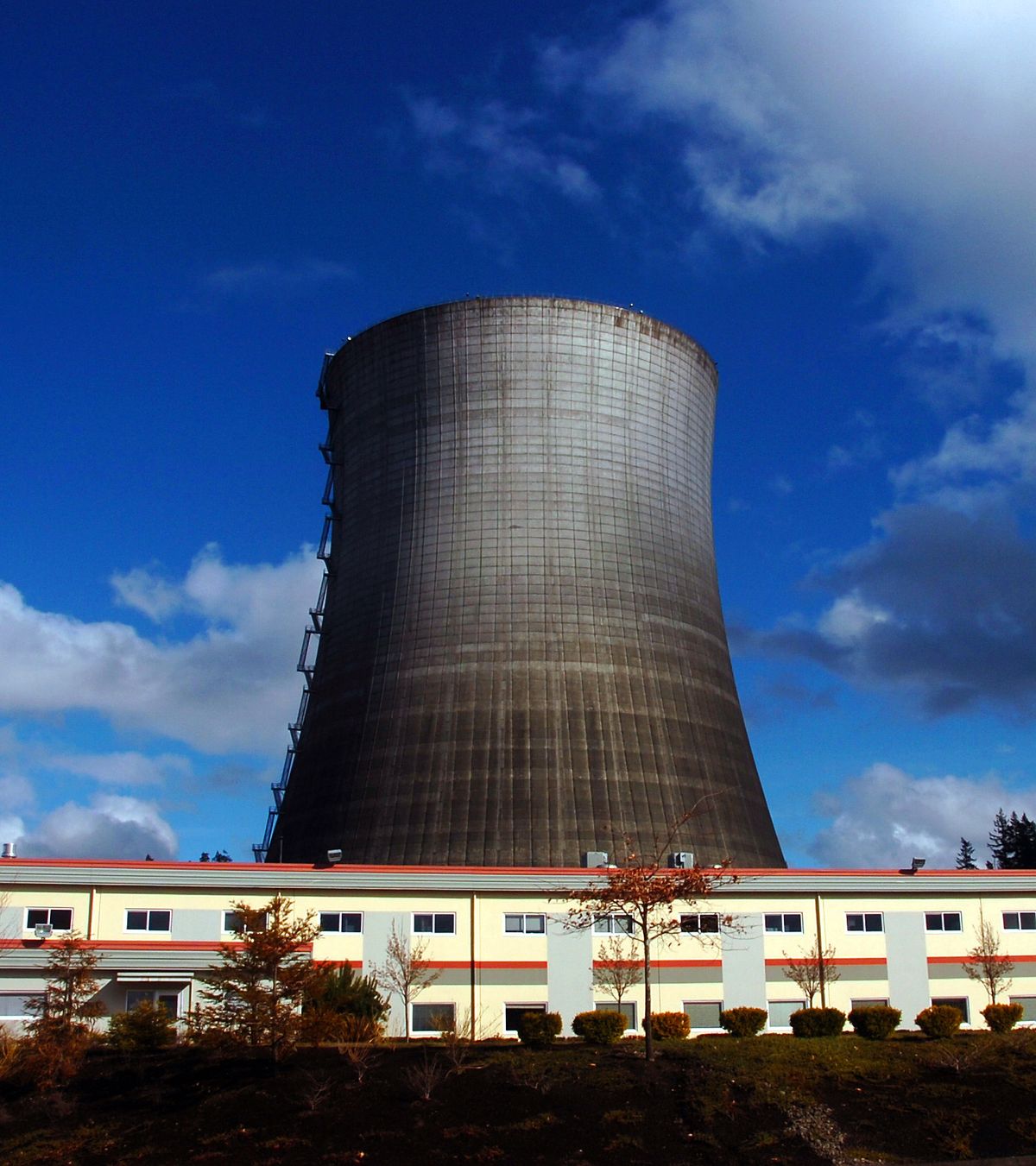
RICHLAND – A quarter century after its ambitious plan to build five nuclear plants crumbled into a punch line for government incompetence, a regional power consortium in the Pacific Northwest is quietly shopping the idea of building another reactor.
Energy Northwest, which is already expanding its wind, solar and biomass electricity generation, aims to satisfy increasing demand for carbon-free power in one of the country’s most environmentally conscious regions.
In a May 27 letter obtained by the Associated Press, the consortium asked each of its 25 member public utilities and municipalities to pitch in $25,000 for further research into building one or more small reactors. Those who pay would have first rights to any power produced if a plant is built.
But turning to nuclear power could be politically risky: Last time the agency went down this path, it successfully built just one of five proposed plants, spawning what was then the largest municipal bond default in U.S. history. Unused cooling towers still loom over the landscape, and consumers are still paying for the project’s collapse in their power bills. The fiasco forced Energy Northwest to change its name from the Washington Public Power Supply System, or WPPSS, which came to be known as “whoops.”
Exploring its options
Nuclear power already has proven to be valuable for the region, CEO Vic Parrish said in an e-mail. Recent national polls suggest the public supports nuclear energy development, he said, especially at locations where nuclear plants already exist.
Energy Northwest has spent the past year researching its nuclear options, including a 1,600-megawatt plant that would power more than 1 million homes, before deciding to gauge interest in a small project where 40-megawatt reactors can be added as needed.
The utility also recognizes the public relations problem new nuclear generation could pose. In the letter, Vice President Jack W. Baker said public and political support would be key to any project’s success. “It can be done but it will require effort,” Baker wrote.
Tyson Slocum, energy program director for Washington, D.C.-based Public Citizen, opposes such a plan. The high financial and environmental costs – combined with Energy Northwest’s spotty nuclear history – make such a project too burdensome for consumers when compared with renewable energy like wind and solar power, he said.
“There’s just too many hurdles to overcome for nuclear power,” Slocum said.
Seeking more sources
For decades, the Pacific Northwest has relied on relatively cheap power from hydroelectric dams, which produce about half the electricity for the region. But regional utilities have been working to broaden their electricity generation to meet increasing demand and renewable energy standards.
Energy Northwest abandoned its last proposed project, a coal-gasification plant west of the Cascades, after the state passed a tough new carbon-emissions law. In February, the utility announced plans to develop wood waste biomass power plants in four Northwest states.
The Richland-based utility already operates hydro, wind and solar projects, as well as the 1,150-megawatt Columbia Generating Station, the only working nuclear plant to survive the WPPSS collapse, which produces 3 percent of the region’s power.
The plant is one of more than 100 nuclear plants operating in 31 states. Licenses are being sought for more than 30 new plants nationally.
The plant has been an excellent resource for 25 years and plays a very important role in the regional power supply, said John Harrison, spokesman for the Northwest Power and Conservation Council, which was created after the WPPSS collapse to develop and maintain a regional power plan. However, more sophisticated and reliable electricity demand forecasts today point to energy conservation, then renewable supplies such as wind power, as the best ways to meet increasing demand in the years ahead, he said.
The federal agency that sells electricity wholesale to public utilities in the region, Bonneville Power Administration, must follow the council’s guidelines for buying power.
BPA still owes roughly the full $6.4 billion for construction of Columbia Generating Station and two unfinished plants. However, those bonds have been refinanced so that BPA could pay off other debt and borrow from the federal treasury for specific needs, such as new transmission lines, keeping rates lower for ratepayers, BPA spokesman Michael Milstein said.
About 30 percent of its standard wholesale power rates go toward paying the nuclear debt.
Milstein said any exploration of new carbon-free power options is positive. Nuclear power is in BPA’s mix of potential resources, he said, but low on the priority list.
Range of reaction
Decades ago, the city of Seattle directed its utility to pursue conservation measures rather than participate in the failed nuclear project, Seattle City Light spokesman Scott Thomsen said.
The utility, which serves 1 million people in the Seattle metropolitan area, wouldn’t support a nuclear proposal today either, he said. Nuclear power isn’t included among the options for meeting long-term energy needs, and conservation still comes first.
The Grant County Public Utility District, another Energy Northwest member, is still reviewing the request, but nuclear power is something it would consider, spokeswoman Sarah Morford said. “We’re looking at all options,” she said. “Our commission has passed a pro-nuclear position in the past.”
The problem with nuclear power 30 years ago was cost, waste and safety. Today, the problems are at least cost and waste, said Jim Lazar an economist and private energy consultant.
Lazar was the research director for the Don’t Bankrupt Washington Committee, the group that successfully pushed a 1981 voter-approved initiative requiring voter approval for public financing of power plants that generate 350 megawatts or more. A federal repository for spent nuclear fuel remains uncertain. Energy Northwest stores its spent fuel in dry canisters on site, with room for expansion.
Instead of costly large plants, the small reactors are promising, but unproven, Lazar said. “I don’t want to prejudge new technology. We need new technology to help us meet the challenges we’re facing. We need electricity and we need to reduce our carbon emissions,” Lazar said. “We should remain skeptical, but that doesn’t mean it’s a bad idea.”
© Copyright 2009 Associated Press. All rights reserved. This material may not be published, broadcast, rewritten, or redistributed.

Spokane7


RickS on June 05 at 2:48 a.m.
The environmental costs would be negligable if the president were not playing politics as usual with the thoroughly studied Yucca Mountain Repository. The fiscal costs would be negligable if the feds ever pull their heads out and pre-approve several plant designs for various plant sizes. The interruption in building plants was influenced primarily by false fears and nuisance lawsuits by activists, rather than any inherent costs of the plants.
Further, wind power is limited both in capacity and tenure as most projects have been built so close to E. WA communities to survive the next building boom; they will be buldozed to build homes (yeah, sorry Seattle but none of us like you enough to pre-empt our progress for yours). As for ethonal, its limitations are even sharper as even the biggest greenie still likes to eat and when all factors are considered the process produces more CO2 than gasoline.
If there is a genuine desire to reduce carbon emissions by any substantial amount, the only viable alternative is nuclear. Regulatory reform following TMI and modern designs have given us three decades without a significant incident at any of the hundred plants in the U.S. or similarly-designed plants worldwide. In fact, bird kills at wind sites have a greater environmental impact than nuclear and grain-elevator explosions (ethonal) pose a greater public hazard than nuclear production.
Unfortunately, the left-wing loonies in the NW have sufficient clout with the government that is nationalizing industries at a rate that compares to Hugo Chavez that we don’t need to worry about facts getting in the way of politics.
DAGarrepy on June 05 at 6:46 a.m.
The term “Spent Nuclear Fuel” is a misnomer. It still contains large amounts of usable energy but not in its present form and state. There are 104 nuclear powered electric generating plants in the US. Each facility has been storing “spent” fuel rods since the inception of this technology. And the inventory is growing year by year. How long do we continue to store this material on-site?? And what do we do with this material when the facility is decommissioned??
The current plan to haul it all to Nevada and store it permanently at Yucca Mtn is virtually dead. The people of Nevada and their elected representatives do not want this material brought into their state for burial. By the way, there are no nuclear power reactors anywhere in the state of Nevada.
Then what shall we do with the 70+ thousand tons of spent nuclear fuel currently being stored at our nuclear power plants?? Regardless of your philosophy about nucear power (for or against), the storage problem is very real and it must be dealt with. Maintaining this huge volume of highly radioactive material in so many areas throughout the Country represents a clear and present danger. We don’t have to worry about terrorists importing nuclear materials into the US to make a “dirty bomb”. All they have to do is tap into the nuclear material inventory already here in storage. A well trained and well armed group of terrorists (foreign or domestic) might very well be able to overpower the security force at many of our commercial nuclear facilities, especially if they were not concerned about their own well being, i.e., suicidal. And they would not have to steal the spent nuclear fuel stored primarily in pools. All they would have to do is bring enough explosives with them and the resulting detonation could spew radioactivity over a very wide geographic area. Note that the containment building housing the nuclear reactor itself would not even have to come into play.
My proposal is to set up reprocessing facilities at our existing government sites, such as the Savannah River Site, Nevada Test Site, Hanford Washington Site, Idaho National Laboratory, and some of our relatively large, under-utilized military bases. Clusters of reactors could be built at these reprocessing facilities which would produce huge amounts of electricity to feed into the national grid. This proposal would also expand upon the existing technological base of nuclear reprocessing. Technical universities and the technical community near these facilties would see substantial growth and advancement. Furthermore, we would be spreading the solution to an existing serious problem throughout the country rather than dumping the entire problem in a single area for someone else to deal with years later.
Perhaps the people of Nevada would be willing to participate in such a multi-state recycling program at the NTS where the re-processed nuclear material would be used to fuel clusters of next-generation power reactors that would go a long way towards weening us off fossil fuel plants with their resulting carbon dioxide emissions. Note that my proposal includes “clusters” of reactors. Such an arrangement allows for permanent staffing of operations, maintenance, refueling and testing personnel which could eliminate the need for temps, travellers and contractors.
This nationwide situation we are in, calls for a national solution. And the solution I propose calls for a rather straight forward, yet intense engineering and scientic effort. Some of the positive attributes of the Nevada Test Site, Hanford Washington, Savannah River and the INL being involved in this solution is that they encompass large geographic areas, they have already been involved in “nuclear matters”, they have some of the technical and scientic resources already in place, they have Department of Energy and State oversight, and they have large, well-trained security forces in place.
Donald A. Garrepy, P.E.
Ninch on June 05 at 7:31 a.m.
No more nuclear for the Northwest. It will only be used to send power elsewhere. We already experienced the boondoggle of WPPSS and are still struggling to get Hanford cleaned up…. so why should we risk our money and health again and again until they get it right?
Studies show that energy conservation will be much more effective in providing our regional needs then any new costly nuclear project.
And forget a freakin’ “national solution.” This idea that ‘one size fits all” is pure BS. And quit thinking ‘centralized’ power distribution. For example, east of the Cascades is ripe for individual buildings to be fit with solar power with the excess being fed back into the grid, which in the summer can be sold to the southwest to power their heavy use of air conditioning.
bumble509 on June 05 at 3:51 p.m.
When are they ever going to run a gas line to that monolith, it was in the planning 15 years ago and they are still sitting on their hands waithing for that side of the state to fall into the ocean or for Mt. Raineer to pop its cork. So lets get their heads together and get something done. I will probably be dead by then.