November 12, 2009 in City
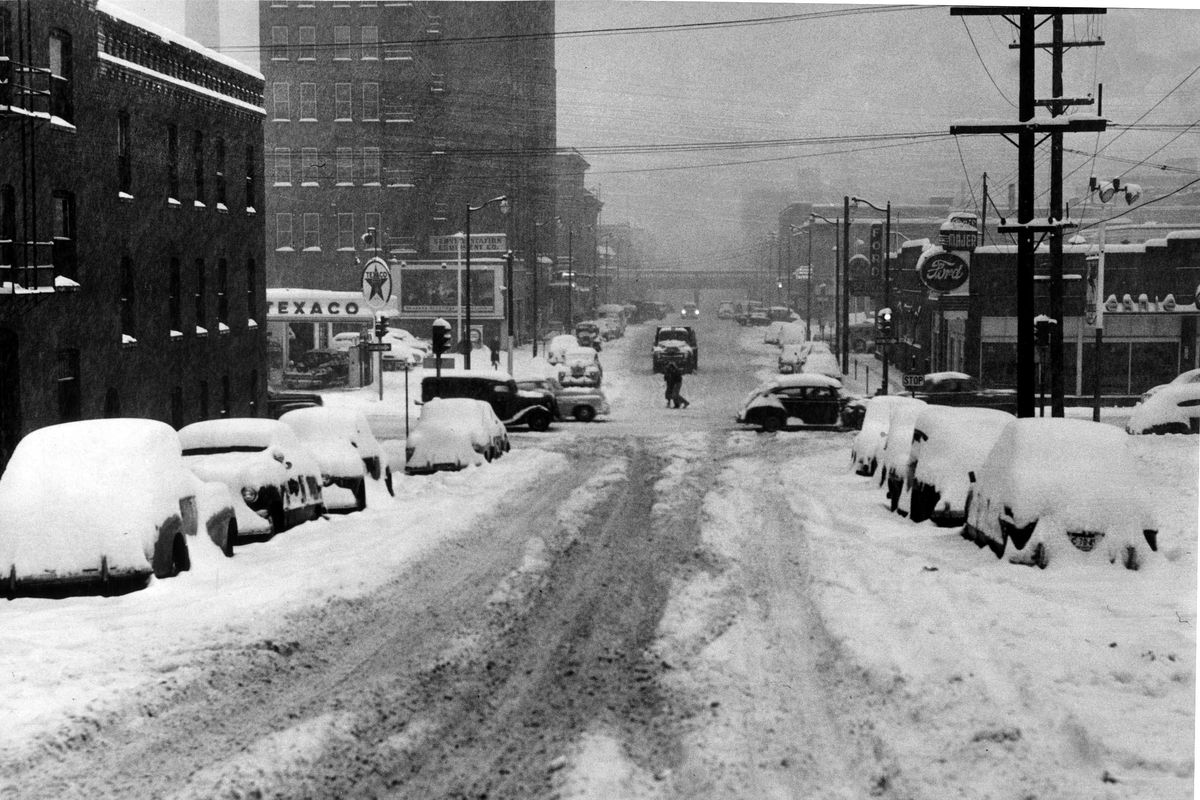
Snow-covered streets and cars make travel difficult in December 1951. This photo was taken on Post Street looking north between Fourth and Third streets.
Whitetail deer feed from a load of twigs brought in by pickup to a logging camp in this undated photo by Albin Nelson, of Curlew, Wash. Heavy snows at the time led the deer to follow logging crews and eat the tips of branches on trees that had been cut down.
November 12, 2009 in City
Deep snow doesn’t necessarily mean doom for deer populations.
People and pets play on Mount Spokane in this undated photo. William Harrison, 7, of Spokane, gets a lift on a sled pulled by two young Samoyedes. The dogs, Toska and Maulchek, were owned by James McGee and Albert Smith of Moscow, Idaho.
Mary Olsen tries to feed a moose calf trapped in the snow in Spokane Valley in January 1993. The animal later died during a rescue effort.
Janitor Leo Attebello leans against the Lincoln First Federal Savings and Loan Association building and watches the snow fall in this undated photo. Radiant heating in the sidewalk in front of the building allowed Attebello to skip the shoveling that occupied many downtown janitors that day.
Winter-clothes-clad shoppers walk by the Spokane and Eastern Building in downtown Spokane in this undated photo.
Scouts brought along skates, sleds, toboggans and skis for a campout in the snow in this undated photo.
After a day in the snow, scouts warm up in front of the fire in this undated photo. From left are Martin Saunders, troop 4, and Wesley Schmidt, troop 29, and Joe Drazan, troop 4.
This undated photo shows a snowy evening at the North Toll Plaza of the Maple Street Bridge. Time exposure shows streaks of snow.
Snow dots Latah Creek with white islands in this photo looking south from Highbridge Park.
About 300 people visited Mount Spokane to watch the beginning of operation of the new $175,000 chairlift in November 1956. Rides on the 4,400-foot lift were free.
Adoption of the one-way traffic systems on Second and Third avenues in Spokane left Geiger and Fairchild service members without a hitchhike waiting station in 1952. The headless model of a Fairchild airman, knee-deep in snow on the north side of Third near Monroe, was a remnant of what used to be a pick-up point, but the traffic was redirected in the opposite direction of the bases.
Mae Ann Huff, left, was the only woman on a five-day hunting trip in the Lake Pend Oreille area in November 1946 sponsored by the Sandpoint Chamber of Commerce and Kaniksu National Forest headquarters. She was also the only one to shoot any game, bagging a deer. The hunting party rode into the mountains at 6,500-foot elevations and experienced 36 inches of snow and biting winds.
“It’s the worst I’ve seen!” said Henry Lunn, a 24-year veteran mail carrier, of a blizzard in January 1950. Thirty-eight and a half inches fell. Lunn was stranded on Pine Street and fought his way home on foot and later on a bulldozer. He returned the next day on snow shoes to carry the mail.
Boys sled down the hill at Manito Park in December 1944.
Snowfall at the top of Mount Spokane ski area had risen to as much as 12 feet in March 1964. This scene at Vista House at the summit of the 5,878-foot peak shows so much snow that skiers can walk right up the side of the house and stand of the roof edge. Shown testing the packed snow are, from left, Bobby Holmes; Dick Lemmer, director of The Spokesman-Review Ski School; Ray Hathaway; and Al MacGregor.
Ice covered a low section of this wheat field on Highway 2, just west of Airway Heights, in early February, 1959. Snow gathered in the dip, then melted and finally froze over. Passing motorists stopped to take advantage of the wide, smooth, ice-covered expanse.
Robert Leuthy built this snow sculture of a pigeon in front of his home on North Evergreen Street in late January 1952. Two smaller replicas face other sides of his residence.
These children were photographed in 1952 while sledding on Monroe Street near 14th Avenue on Spokane’s South Hill. The street had been blocked of at the top and bottom.
People cut a path for snow plows in this March 3, 1937, photo. City plows were powerless against the frozen four-foot drifts on east 40th and 42nd avenues in the neighborhood of Crestline, Cook, Nelson, and Smith streets. There had been no deliveries of milk, fuel, or groceries for more than a month to the then-sparsely populated section of town.
Snow wrapped up this 1,600-horsepower diesel locomotive, which ran into 15-foot snowdrifts 45 miles south of Spokane on Jan. 11, 1952. The Great Northern locomotive turned back at Spring Valley, and the engineer called for rotary plows to clear the tracks of the Moscow, Idaho, branch line.
Morris Anan clears sidewalks along Madison Street north of Sprague Avenue outside Bill Brown Plymouth using his mechanized tractor-shovel circa 1960. Down the street, Charles S. Smith uses a hand-held shovel.
Traffic slowed to a crawl and pedestrians found footing difficult at midafternoon on Riverside and Wall during a Jan. 22, 1954, storm that began in the morning and continued through the night.
Spokane was well on its way to having a record snowfall in this January 1969 photo. On Feb. 1, The Spokane Daily Chronicle reported that Spokane led the United States in depths of snow with 42 inches. This picture was taken on Sprague Avenue facing east.
Workers trucked in snow to the Wandermere golf course in 1933 for the first annual Spokane Ski Carnival. The carnival featured ski jumping and attracted an estimated 22,000 spectators, who clogged the highway for hours on the way to and from the tournament.

Spokane7
Win big with the NEW Spokane7!
Celtic Woman is coming to Spokane