
January 6, 2010 in City

Red light cameras yet to signal safety

First year saw more collisions at monitored intersections
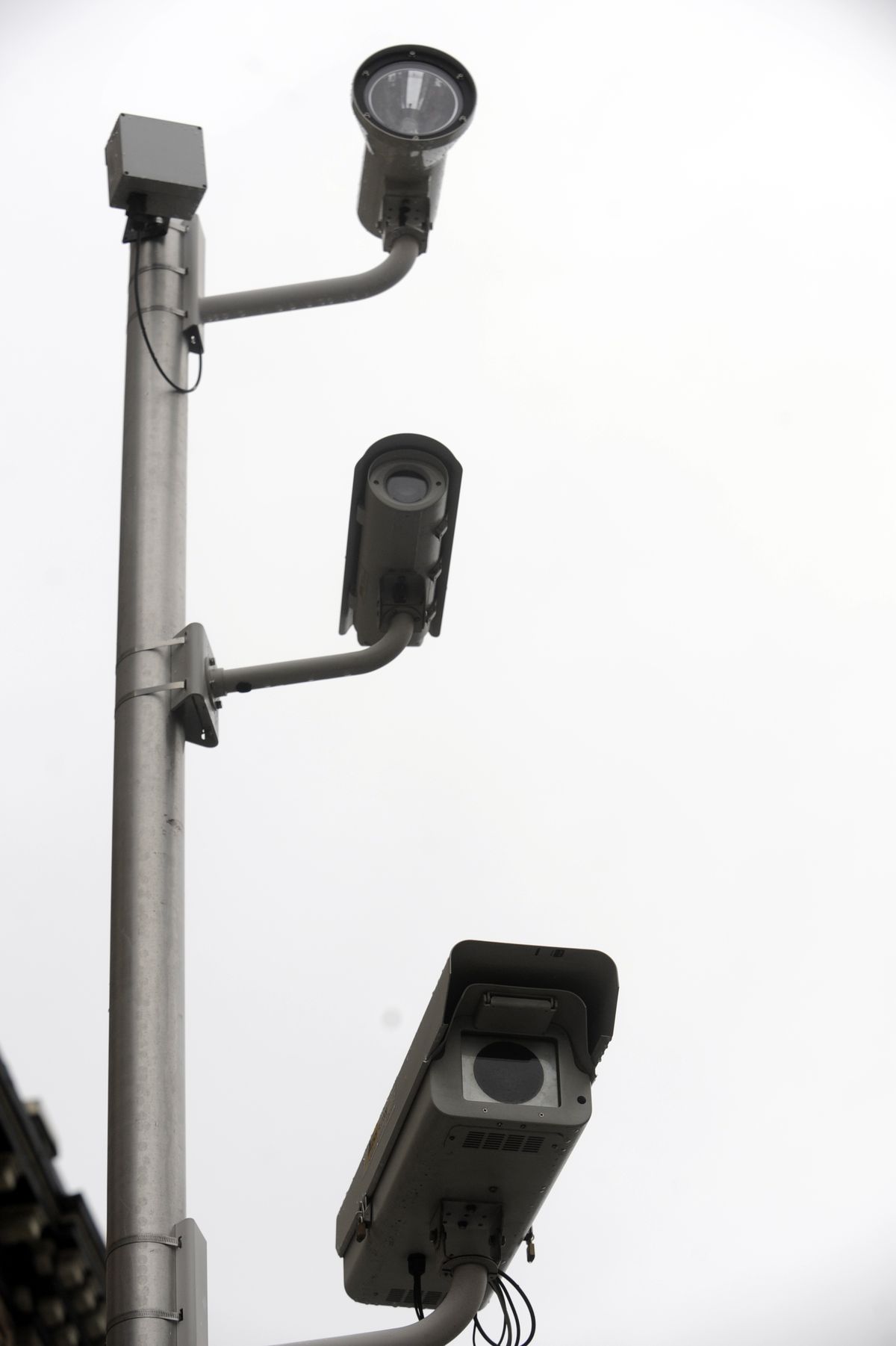
By The Spokesman-Review
 

The red light camera system has a control box to monitor the roadway and uses two cameras to videotape and photograph red light runners.
(Full-size photo)(All photos)

More cameras

Later this year, the Spokane Police Department plans to install photo enforcement cameras at the following intersections:

Northbound Division Street at Sprague Avenue

Westbound Second Avenue at Thor Street

Northbound Freya Street at Third Avenue

Eastbound Wellesley Avenue at Ash Street

Intersections where Spokane installed red light cameras in 2008 in the name of safety saw an increase in crashes and injuries in the first year of the controversial program.

There were 38 collisions at the three intersections the year after the city began fining violators caught on tape. That’s up from 32 the previous year, according to police collision reports provided to The Spokesman-Review.

Injury accidents at the intersections also rose from 11 the year before to 14 after.

Spokane Mayor Mary Verner called the data “interesting,” but cautioned that it’s too early to make a final judgment on camera enforcement.

“The program has been effective in that we seem to have caught a lot of people running red lights,” Verner said. “If we’re not seeing a decline of injury collisions, then we need to figure out why not.”

The numbers contrast with predictions made when the camera program was approved – that collisions and injuries would decline because drivers would be less willing to run red lights. In the first year of the program the number of crashes at the intersections that police blamed on running red lights held steady at 11.

Traffic safety experts caution that crash statistics fluctuate every year and that it’s difficult to prove cause and effect with only a year’s worth of data. Police say they’re confident that crash numbers will fall as the public becomes more aware of the cameras.

“Typically, there might be a slight increase (in the first year),” said Officer Teresa Fuller, who examines camera violations before tickets are issued. “But those go down in the second year of the program.”

The city began fining red light violators caught on camera Nov. 1, 2008. Two cameras are at Francis Avenue and Division Street. One camera monitors Sprague Avenue and Browne Street, and another is at Mission Avenue and Hamilton Street.

Fuller said the department expects to complete its examination of the program’s first year later this month. The department also plans to expand the program to four other intersections later this year.

About 80 crash records were provided to The Spokesman-Review through a public records request that asked for all collision reports at the camera locations for the year before the program started and the first year the cameras were in use. Of the reports provided, about 10 were not included in the analysis because they did not result in injuries or at least $700 in damage, or because they were unrelated to the intersections.

Councilman Bob Apple, who was the lone vote against the creation of rules to allow the program, said he’s not surprised by the numbers.

“I would like to see the council dump Photo Red,” Apple said. But in a year in which the city faces a $10 million deficit, “a lot of things are going to trump Photo Red.”

Camera enforcement has become increasingly popular throughout the United States, and proponents say cameras decrease injuries and crashes without the need to hire more officers. Some independent research, however, has shown they can have mixed results, and critics argue that the programs are motivated by officials looking to balance budgets.

One of the most comprehensive studies, released by the Virginia Transportation Research Council in 2007, examined seven years of crash statistics and camera-enforcement intersections and found that cameras generally helped decrease T-bone crashes based on a decline of people running red lights. But rear-end crashes increased, potentially as a result of drivers braking suddenly to avoid being caught by cameras. T-bone crashes are considered more severe than rear-enders.

Even so, the study said that the rate of injuries increased after cameras were installed.

The report also noted that collisions declined significantly at certain intersections, leading the authors to suggest that cameras can be effective – if intersections are researched before cameras are installed.

“You have to work very hard to decide the right locations where they should be used,” said John Miller, associate principal research scientist at the Virginia research council. Factors for choosing locations include ensuring that the intersection doesn’t already have a significant problem with rear-end crashes since they might get worse after installing cameras, he said.

While it may be too early to judge the effectiveness of the cameras in Spokane, they have succeeded in catching violators and raising revenue.

Spokane issued 5,690 camera tickets that resulted in revenue of $419,000, Fuller said. After the contracted camera company, Arizona-based American Traffic Solutions, is paid and other expenses subtracted, police estimate a profit of $103,000.

The Spokane City Council stipulated that camera fines be used only for traffic safety projects. Council members argued that doing so ensured that the aim of the program would remain traffic safety and that the city would not become dependent on the fines to balance the city budget.

City Council President Joe Shogan said he’s hopeful that the cameras will improve safety as drivers who receive tickets become more careful. He said the program may need to be re-evaluated if statistics don’t show declines in crashes and injuries after three years.

“If we’ve got 6,000 people running red lights in this city, it’s a concern,” Shogan said. “You never know if we would have had more accidents without the red light (cameras).”

Besides catching red light runners, police have seen side benefits to the cameras. Sgt. Eric Olsen said police have used the cameras to track down drivers who fled crash scenes.

The cameras also can help officers assign blame. In the program’s first month, John Grollmus, co-owner of the Elk Public House, was westbound on Sprague when he was hit by a southbound car on Browne. Both drivers told Olsen at the scene that they had had a green light, according to the accident report.

Three days later, the woman who hit Grollmus was issued a $124 ticket for a red light violation after Olsen viewed the camera footage.

“We are able to do follow-up,” Olsen said.

16 comments on this story so far. Add yours!
  • liarsinnews on January 06 at 6:45 a.m.

    ITS THE MONEY STUPID!!

  • gyrusx on January 06 at 7:06 a.m.

    Install the cameras on 10 more intersections and SPD has over a million in profits. Then fire 1 officer for every 5 cameras. Eventually we can have a bunch of geeks sitting behind computers guiding traffic and we can get rid of the amazingly competent police force.

  • madscientist on January 06 at 7:19 a.m.

    “We need to figure out why.” Duh, nobody cares if they run
    a red light.

  • PlanB on January 06 at 7:31 a.m.

    The data shows that these things do little or nothing to improve safety, and may just a likely increase accidents. Why they were ever approved is bizarre. And most of the revenue doesn’t even come back to the city, but an outside organization.

    What a stupid waste of time and resources.

  • ChefGus/ John Olsen on January 06 at 7:54 a.m.

    This is about cash flow of course as stated above… people Spokane are reticent drivers… and sometimes even stop in the middle of the street with traffic flowing to let some one in from a side street or business… they also start to slow down and stop before a light even turns yellow…. and there are three seconds minimum to get into and through the intersection at 30 mph and four seconds or more on higher speed roads….

    The fact that the lights increase property and physical damage must be cost accounted against the “income” from the lights and if it is a wash or costs the citizens more than it saves they should simply be scrapped.. but I’ll bet that the company that put in the cameras and was hired to monitor has a No Cut contract… anyone have any info on that?? john

  • spokanada on January 06 at 8:05 a.m.

    they will use the same excuse next year if the number of accidents increase to 48 in 2010. Then in 2011, accidents might decrease to 47 and they will hail the program as a success.

  • terrymr on January 06 at 9:28 a.m.

    John,

    When I quizzed them about it a while back i was told the company operating the cameras is paid a flat fee regardless of tickets issued.

  • lewis8457 on January 06 at 9:42 a.m.

    It has nothing to do with safety. If they cared about our safety we would have seen some accountability in the Zehm case. It has to do with money plain and simple. They will come up with many plans to make more money while telling us it is for safety.

  • bdr on January 06 at 11:28 a.m.

    These cameras dont work in Beaverton Oregon either. Beaverton installed hundreds of these cameras….due to the runners.
    (all their catching now is multiple abusers with no plates or DL)
    they drive crappy cars that are worth less than the fines they owe,
    and just blow the intersections while happily drinking beer in the cockpit.

    The new kids these days are just gypsy couch surfers no real address
    the only constant is their cell phone…which they reprogram numbers
    weekly for no charge.
    Try finding these kids( for a ticket)…….HA!
    The cops in Oregon are so fed up…..they quit…the kids are just laughing
    because the judge issues fines and no jail……(they had no intention of paying the first fine) their only penalty is losing a junk car.
    40-60 infractions with no jail time is a common.

  • Teseract on January 06 at 1:17 p.m.

    I’m waiting for the local teens to figure out if they get an enemy’s front license plate number, take a digital photo of a license plate, then hop on the Internet and download a license plate font (just Google it). Then all they have to do a little basic photo editing and print it on glossy paper, tape it over their own license plate, then drive merrily through a few red lights. Suddenly some nice big fines to show up at the front door of said enemy’s house. They might get dismissed in court — if you want to waste a day of your life and probably have the traffic judge ignore your arguments and fine you anyway.

    It’s happened in other states (Maryland), with both red light and speed cameras.

  • Barcroft on January 06 at 7:03 p.m.

    It’s all about the bucks, and Mary knows it; any remark in a storm. These silly camera laws are written for the same reason as ALL traffic laws: revenue generation.
    Reminds me of several years ago; remember “Where’s ChaChi”? This cop would hide somewhere in disguise and use a radar gun or look for seat belt violations and call ahead to some of the other revenuers so they could write tickets without too much effort.
    He was quoted in the paper: “I don’t know why people don’t wear their seat belts; they save so many lives.”
    So, I wrote to him asking “How many lives, and how do you know”?
    Never got a reply, but I think we both already knew the answer.

  • Spok on January 06 at 11:36 p.m.

    Something is wrong when the City sucks up $419,000 of citizen money to fund $103,000 of City budget, for whatever purpose, traffic calming or otherwise. This is not an efficient use of the region’s resources.

    Effectively that is a net negative stimulus or damper on the economy of this region, at least to the extent that $220,800* per year is shipped off to the camera company in another state.

    Spokane is strapped, but so are its citizens. This is no way for the City to treat its citizens.

    All that cost and no reduction in accidents. No reduction here in Spokane this past year and not in no reduction in other non-biased studies.

    *($4,600/camera/mo.) X (4 cameras) X (12 months) = $220,800 per year plus the additional officer at $67,000 => $287,000. All numbers from Jonathan Brunt’s February 23, 2008 article.

    BTW, the math does not work: $419,000 gross less $287,000 = $142,000, leaving unaccounted $29,000 ($142,000 - $103,000 actual net).

  • Verbal on January 07 at 8:37 a.m.

    So, will the council and mayor do the right thing for its citizens and public safety and remove the red light cameras, or will they keep the cameras up so they can get a few extra bucks?

    Any tally on the number of police cars that have been caught on a “rolling red”?

  • Vekleth on January 07 at 1:28 p.m.

    There is the same argument in Australia about Red-Light and Speed Cameras as being a revenue spinner for the Local/State Governments.

    People tend not to look at the bigger picture, and realise that they are actually encouraging the administrators to putting in/setting up more of the revenue spinners as the individual won’t slow down or not run red lights - thus increasing the revenue.

    If people slowed down, or stop running red lights, then the revenue dries up, and having the Red-Light Cameras/Speed Camera becomes less cost effective, and reduces the revenue.

    In short - people have the choice as to whether the camera actually raise revenue for the governments.

    Ven Grollmus

  • reppindude on January 09 at 8:18 a.m.

    $124??!! What a bunch of sissies!! Here in LA the last time I got a red light ticket by the time all the fees and other nonsense was tacked on it cost me $505!! Wimps, just one more reason I’m glad to be moving up there in the spring.

  • dougfresh on March 30 at 4:20 p.m.

    I can’t believe they only have a 25% profit margin on this.. those cameras cost $300,000!?!?! are you kidding me?

    If the city is that desperate why not try to raise taxes & get revenue for our fair city without giving 75% of it to an out of state company.

    Everyone put your visors down & sit up straight when going through these intersections so they can’t ID your face in the pictures.

You must be logged in to post comments.
Please create a profile or log in here.