
Party-line vote clears Hart of conflict of interest
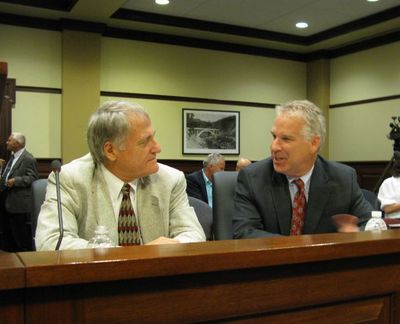
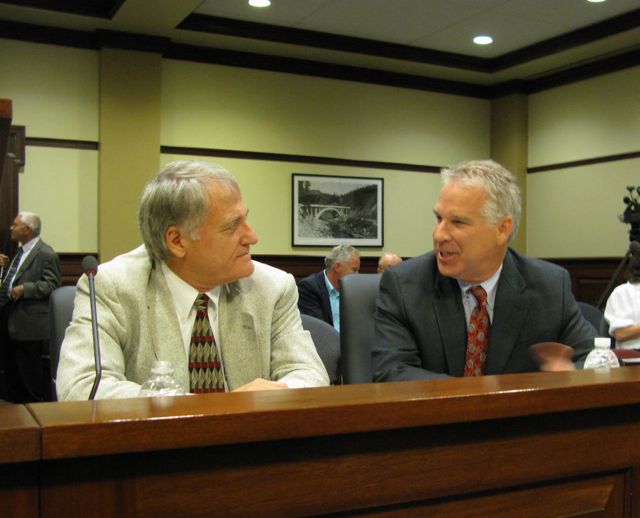
BOISE - A special House Ethics Committee has voted 4-3 along party lines to clear Rep. Phil Hart, R-Athol, of conflict of interest charges related to his ongoing fights over his federal and state income taxes.
“I don’t think that the allegations were specific enough,” said Rep. Rich Wills, R-Glenns Ferry. “I hope if nothing else that comes out of this, that it’s a wake-up call for all of us to be very careful about our appearances.”
The three minority Democrats on the committee said Hart’s actions showed a pattern of ignoring the House rule that requires conflicts of interest be disclosed before votes. They favored a motion to reprimand Hart and recommend his removal from the House Revenue and Taxation Committee, but it failed on a party-line vote.
“I think that the behavior does reflect badly on all of us,” said Rep. Wendy Jaquet, D-Ketchum. “It reflects badly on the credibility of the body. So I can’t vote to dismiss here.”
One ethics charge against Hart remains, that he abused the legislative privilege from arrest or civil process during sessions by repeatedly citing it to seek delays in his state and federal income tax cases. The ethics committee will take up that charge after the state Board of Tax Appeals rules on it in Hart’s ongoing case; its decision is pending.
The decision Thursday came even though the committee brought up a new conflict-of-interest allegation against Hart: That he voted against a Tax Commission bill that died on a tied vote in the tax committee - legislation that a Tax Commission attorney said could have directly affected his case.
HB 436 would have prevented taxpayers who hadn’t filed returns in a past year from filing later to address those years, starting whole new cycles of appeal deadlines and potentially extending their cases indefinitely. Hart failed to file state income tax returns for the tax years 1996, 1997 and 1998, according to the Tax Commission. Erick Shaner, deputy attorney general, told the committee, “This particular piece of legislation would have affected his ability to address those particular years in regard to his subsequent filing … on his behalf.”
Hart declined to answer questions from the ethics committee, instead letting his attorney, Starr Kelso of Coeur d’Alene, speak for him.
Kelso said of HB 436, “No 1, it applies to all Idaho taxpayers. It was a Tax Commission bill. And speaking with Mr. Shaner, I asked him specifically, was it the purpose and intent of the Tax Commission in putting forth this bill to address Mr. Hart? The answer was of course not. There are a number of people with situations like this.”
Plus, Kelso said the bill really was aimed at those who want to claim refunds. “Mr Hart probably would say to you he wished he was in a position where he was asking for a refund. It doesn’t apply to him at all.”
Rep. Dell Raybould, R-Rexburg, said in his view, a legislator can’t have a conflict of interest on a bill if it affects anyone other than the legislator himself. “I think we have to be careful here in terms of singling out a particular piece of legislation that Rep. Hart may be involved with, unless it pertains to him only,” Raybould declared. “I think we’ve got to be careful or we’re not going to be able to have anyone involved in our legislative capacity except people who don’t have family and don’t have jobs.”
His comment drew an appreciative mutter from Hart supporters in the audience, who wore pink paper hearts saying, “Protect Idaho’s Hart.”
But when committee members described the times they’ve declared conflicts of interest themselves, that wasn’t the standard they used. Raybould said he declared a conflict on a budget bill for a veterinary education program in which his grandson was enrolled. Wills said he declared a conflict on some bills that related to his long career as a police officer. Rep. Bill Killen, D-Boise, said he declared a conflict on a public employee retirement bill, because he receives a small retirement payment from past public employment.
Jaquet said it would have been easy for Hart to disclose that he was in litigation with the Tax Commission before voting on tax legislation, and to decline to serve on a subcommittee reviewing all new state tax rules.
She and other Democrats on the committee said they were concerned about how voters will view the Legislature if it condones Hart’s actions. “We have a representative who basically is not paying his taxes, and my constituents are paying their taxes,” she said. “I feel that he should not be on the Revenue and Taxation Committee because of the appearance of conflict.”
Kelso responded that that’s “a political issue - it has nothing to do with a legal issue of a conflict of interest.”
Rep. George Sayler, D-Coeur d’Alene, said, “In this situation, the perception up here for the most part is that Rep. Hart has behaved inappropriately. … It’s a pattern of actions involving taxes on all fronts.” Why, he asked, did Hart continually delay his tax appeals citing legislative privilege? How does he explain his overall behavior?
Kelso, after conferring with Hart, said, “Are we going to be involved in second-guessing how people operate under the rules and laws of our country when they do not impact the legal parameters of the Legislature? I think that the Legislature does not want to go there.” Kelso pointed Sayler instead to “the remedy at the ballot box. … If constituents are concerned and have issues, they vote.” However, Hart is unopposed for re-election in November.
At a press conference after the hearing, Hart said he wouldn’t declare more conflicts before voting. “I think that’s a troubling road to go down, to have a disciplinary action based on perceptions,” he said. “I think as citizen legislators, we all do something else for a living. I think we ought to have some flexibility and some deference to the members.”
Hart said he’s paid $120,000 in state and federal taxes in the past five years, and distributed a letter from a CPA saying that if the IRS hadn’t disallowed his business expenses for eight years, his tax situation wouldn’t be as dire. Public records show he owes nearly $700,000 in state and federal income taxes, penalties and interest.
Hart said, “I hope that we don’t have future possible candidates scared away from the electoral process,” because of the attention his case has received.
Because the panel voted to dismiss the conflict-of-interest charge, its recommendation on that goes only to House Speaker Lawerence Denney, rather than to the full House for a vote.