
March 16, 2010 in Business
Feds offer Sterling a break to help it stay in business
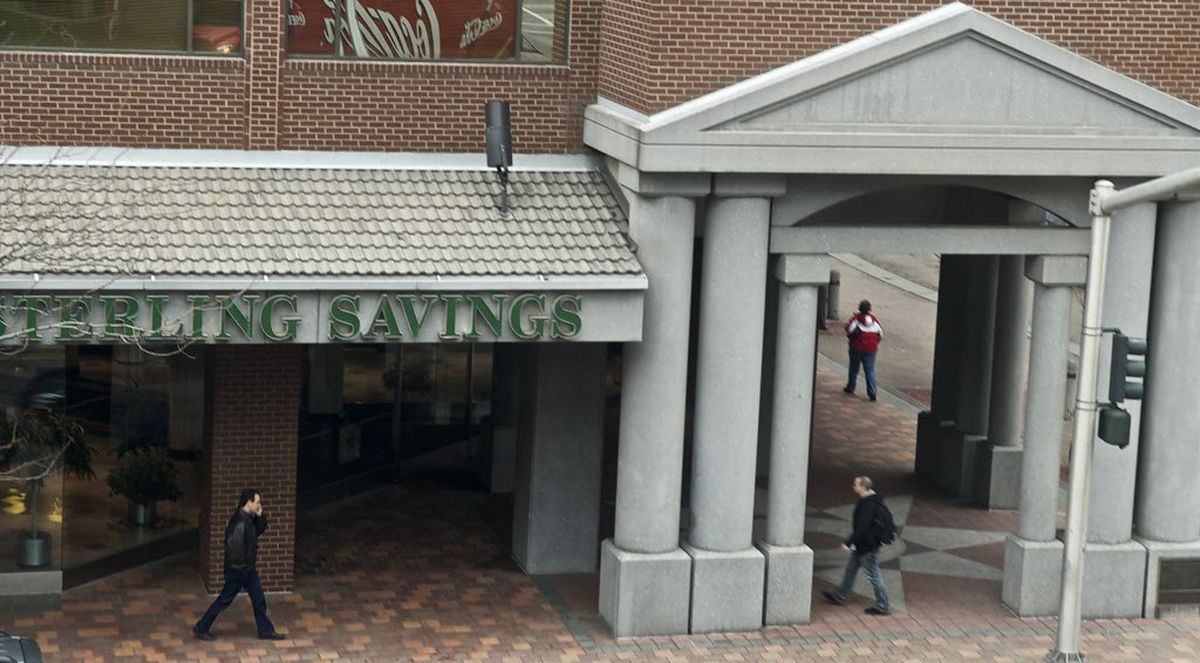
Sterling Financial Corp. Tuesday announced tentative agreements with the U.S. Treasury and a potential investor that will determine whether the bank holding company remains an independent Spokane business, and one of the largest financial institutions based in the Northwest.
In a complicated financial restructuring plan months in the making, Treasury would accept a steep markdown on the $303 million invested in Sterling only 15 months ago if the company can raise an additional $650 million in capital from new investors. Sterling must also repurchase $238 million in trust-preferred securities for which it is offering 20 cents per $1 face value.
Failure to complete the transactions, according to auditors, would raise doubts about Sterling’s ability to continue as a “going concern.”
The deal would all but wipe out present Sterling shareholders, who would own only a small fraction of the refinanced company. Customer deposits, however, are guaranteed by the Federal Deposit Insurance Corp., up to $250,000.
Sterling common stock closed at 77 cents Tuesday. But Treasury has set a maximum price of 20 cents on stock at the time the restructuring takes place.
Sterling Financial owns Sterling Savings Bank and Golf Savings Bank, its residential mortgage lender.
Alternatives to the proposed restructuring include the sale of the bank or some of its assets, or renewed attempts to raise equity to bring Sterling back into compliance with regulatory capital standards, which assure a bank has reserves in case of loan losses.
The bank received a cease and desist order in October from the Washington Department of Financial Institutions and FDIC, who wanted Sterling to raise at least $300 million in new capital by mid-December. The deadline was allowed to pass as officers negotiated with potential investors and developed the restructuring plan.
“We’re now getting to the point where proposals are coming in,” said Executive Vice President Dave Brukardt.
Sterling said it has entered into a non-binding letter of intent with one investor, and has received other non-binding proposals.
Owners of the trust-preferred securities have until the end of March to respond to Sterling’s terms.
Brukardt said he is optimistic about Sterling’s future, adding that the concerns expressed by auditor BDO Seidman LLC would probably not apply to a recapitalized company.
The Treasury offer to accept a deep discount on its investment, which would be converted into Sterling common stock, has been extended to only one other bank, Brukardt said.
The $303 million was provided under the Troubled Asset Relief Program intended to shore up bank balance sheets while they restructured loans and raised more capital. But Sterling’s loan portfolio continued to deteriorate, discouraging potential investors.
Last month, Sterling reported a $855.5 million loss for 2009.
Sterling operates 178 branches in five northwest states, and employs about 2,600, many at its headquarters in downtown Spokane, where it was founded in 1983.
Sterling expanded aggressively over the next quarter century, eventually rolling up more than 20 other institutions into a branch system that stretched from Northern California into Western Montana.
Read more background on Sterling Financial Corp. and its subsidiary, Sterling Savings Bank.

Spokane7

CharlesBillford on March 16 at 6:16 p.m.
So this means no more duck chasing this spring?
Scoutster on March 16 at 6:57 p.m.
This is how the economy is playing out all over the country. Who’s going to take the hit for the poor loan portfolios that are now overvalued by 30-40%? An insight into how scared fed regulators are is how much they are willing to wheel and deal with folks like Sterling’s management.
Sterling is finished and about to be taken over by somebody else. The feds will eat the debt. (That’s you and me…or, actually, our grandchildren. This is what lack of regulation reaps.) The stockholders will be left with nothing. The management will take sweet deals as they exit.
edmitch on March 16 at 7:58 p.m.
In order to say alive, Sterling will then loot the taxpayers for $264 million, and loot its bondholders for 80% of the $238 million in trust preferred securities.
And then get handed over a secret investor who will get a sweetheart deal courtesy of the taxpayers being made responsible for the massive debts of Sterling executives.
The looting and plundering needs to stop and Sterling should be shut down.
empyrius on March 16 at 8:13 p.m.
I want to be a failed banker so us taxpayers can support me!!!!!!
So this is capitalism eh? Impressive!
NOT!
edmitch on March 16 at 8:19 p.m.
I think the article may be incomplete. According to their SEC filing, “As part of that plan, Sterling requested and received a letter from the U.S. Department of the Treasury (“Treasury”) expressing conditional support for a plan to convert the Sterling preferred stock that Treasury holds into Sterling common stock”.
Will the taxpayers become the majority owners of Sterling Savings, making Sterling a nationalized bank with the public absorbing the losses and the new secret investor getting the private gains?
Further, they may raise capital by issuing shares at a maximum price of 20 cents per share, a major discount from today’s 84 cents per share.
Since the bank’s market capitalization is just $40 million today, it seems the Treasury’s $330 million (minus $66 million) new stock holding may be handed over at quite a premium, albeit with a 5% dividend for 5 years, rising to 9%.
Sterling gives new meaning to the phrase “bank robbery”. The bank’s executives need to apologize to the public and thank us for our generosity.
References:
http://sec.gov/Archives/edgar/data/891106/000115752310001607/a6217020ex991.htm
http://sec.gov/Archives/edgar/data/891106/000115752310001607/a6217020ex992.htm
spokanecommunistparty on March 16 at 8:38 p.m.
Save the slave masters for our children and grand children, after all they run both capitalist political partys in this country so why not.
CharlesBillford on March 16 at 9:06 p.m.
Didn’t I see this in a movie.. like Its a wonderful life?
How can a bank be running a • $333.1 million loss for the last 2009 quarter without trimming some of the fat at the top?
The feds loan rate is low so they have to adjust, but you dont invest in debt.
Perhaps there will be more bank shakeouts? Just like the airlines and the auto companies?
These regionals have been pretty steady, but should they also not have been investing in shakey loans like WaMu?
And of course the service sucks so everyone migrates to a credit union.
edmitch on March 16 at 10:33 p.m.
Correction: $330 million TARP should be $303 million which reduces Sterling’s looting of the taxpayers to a mere $237 million.
spokanada on March 16 at 10:54 p.m.
Time to move our money from Sterling to other local banks and credit unions. Let them drown! The government is only giving them a break because they already received bailout funds.
zelda on March 16 at 11:14 p.m.
After the iceberg hit the Titanic, the only mystery was how it was going to sink. Would it go down at the stern, at the bow, break in two or three parts, turn turtle, or lay over sideways? In the end, it will be a salvage operation. And the guy that slides off the deck and hits the propeller? That’s the shareholder.
I am sorry for the non-exec employees. I’m sure there are people who have burned the midnight oil for months trying to turn things around but it’s a goner.
Deposits are FDIC insured up to $250K, though, so don’t freak out.