
September 25, 2010 in City

Final resting place

Baker saluted at Arlington national cemetery farewell
Special to The Spokesman-Review
 
Liz Kishimoto photo

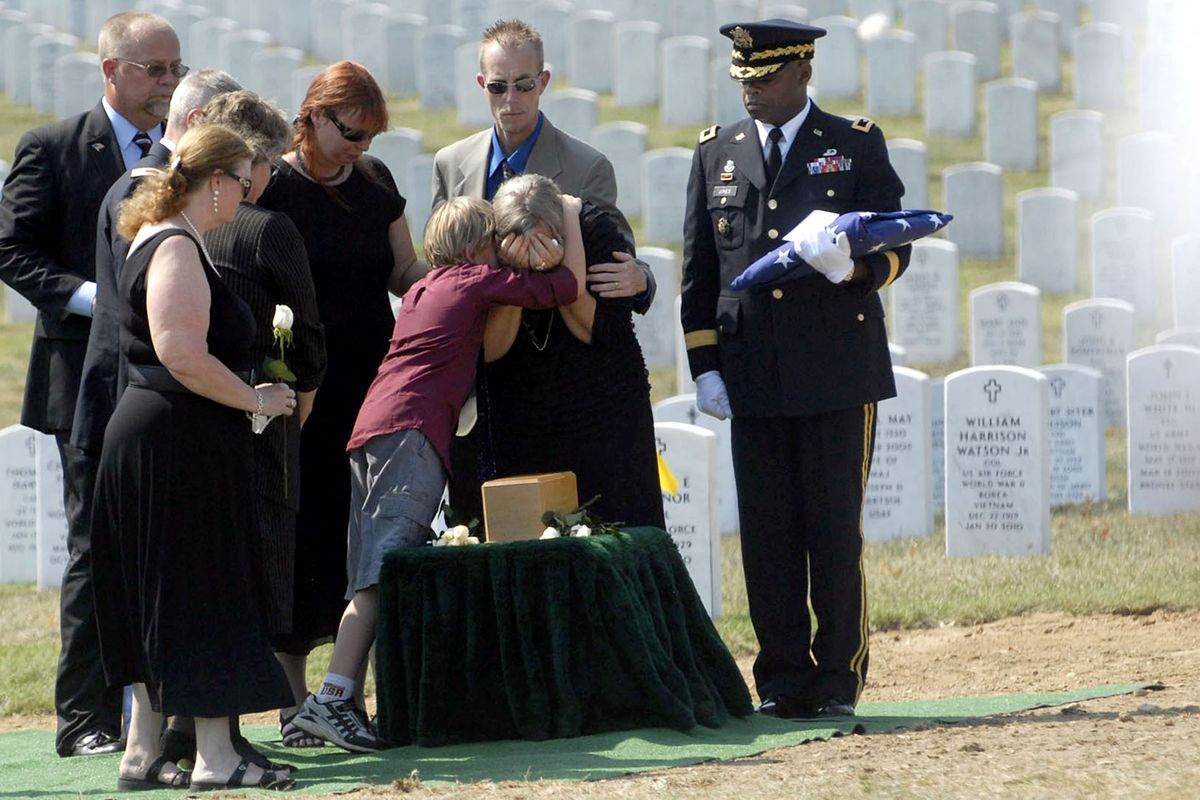
Heidy Baker is comforted by her grandson, Vernon Pawlik, at the burial of Vernon Baker on Friday, Sept. 24, 2010, at Arlington National Cemetery. Major General Reuben Jones holds the flag to the right and Baker’s daughter, Alexandra Pawlik stands to the left.
(Full-size photo)(All photos)

ARLINGTON, Va. – A caisson drawn by seven white horses carried Vernon J. Baker to his final resting place in Arlington National Cemetery Friday under the solemn watch of the 3rd Infantry Regiment Honor Guard – starched and sharp in full dress blues despite the stifling September sun.

Four soldiers from the nation’s oldest infantry regiment led the procession along Arlington’s narrow asphalt lanes, followed by the U.S. Army Band, 18 white-gloved riflemen, the color guard and the flag-draped caisson. An eight-man casket team, a lone Medal of Honor flag bearer and three Vietnam Medal of Honor recipients came next. Widow Heidy Baker, escorted by Medal of Honor recipient Tom Norris and Maj. Gen. Reuben Jones, brought up the rear with a long line of mourners that included Paul Dickerson, who served with Baker in northern Italy in World War II.

They filed to Baker’s gravesite, located at the edge of a sea of white markers that stretched into trees now taking on autumn colors. A chaplain’s words spilled onto a breeze that brought minimal relief from the record-breaking 98-degree heat. A seven-man firing party snapped off three sharp rounds. Taps cried goodbye. Handkerchiefs wiped away tears and wiped brows.

Norris, retired Gen. Robert Foley, Brian Thacker, Joe Marm and Barney Barnum – all of whom earned the Medal of Honor in Vietnam – came forward one by one at the end of the ceremony to lay a yellow, long-stemmed rose beside Baker’s urn, then stepped back and saluted a hero’s farewell.

Baker, who lived near St. Maries, was the only living black World War II veteran to receive the Medal of Honor, the nation’s highest commendation for battlefield valor. That recognition, delayed by the racism of the era, came 52 years after Baker led an assault that helped the Allies breach the Gothic Line and drive the German Army out of northern Italy. His white commander deserted him and his men during that April 1945 battle.

Baker’s widow cried quietly throughout the memorial, like many others gathered here, far from ready for this final moment, far from ready to say goodbye to the humble orphan from Wyoming who emerged with remarkable dignity and grace from some of the worst that 20th century America dealt to black soldiers.

The contingent at the memorial included Lt. Col. Mark Jackson, who, as a captain, escorted Baker to the White House in 1997 when he received the Medal of Honor from President Bill Clinton. Gen. Colleen McGuire, provost marshal general of the Army, U.S. Rep. Walt Minnick, D-Idaho, and other dignitaries also came to pay their respects.

Baker’s stepdaughter, Alexandra Pawlik, and stepgrandson, Vernon Pawlik, were on hand, as was Kathleen Jackman, a neighbor of the Bakers in Idaho’s Benewah Valley; she also attended the White House ceremony 13 years ago.

Baker attended the reburial of the only other black World War II Medal of Honor recipient buried at Arlington – Sgt. Edward A. Carter – on a frigid day in January 1997, less than 24 hours after the White House ceremony.

Baker would have been uncomfortable with this attention, all the while proud of the recognition it brought to the forgotten black soldiers who fought in the last officially segregated combat units of the U.S. Army. He always took little credit for his deeds, insisting he was just a soldier trying to do his job.

“The real heroes were the 19 men I left on the hill that day,” Baker said repeatedly, referring to the men from his unit killed during that brutal but decisive battle.

That will inspire soldiers and citizens long after this day fades. “He’s an example worth following,” Norris said as Friday’s memorial concluded. “He was such a low-key, unassuming man with incredible insight and wisdom. I was incredibly lucky I was able to know him.”

Eight comments on this story so far. Add yours!
  • jdodgion on September 25 at 8:24 a.m.

    When will this country and our people finally put racism behind us. It is long overdue. Vernon J Baker was a true hero in every sense of the word.

  • RondaBarnhurst on September 25 at 8:43 a.m.

    Heroism like his comes from the character of the man. He did his duty with the same sense of honor that he lived his life. Triumphed under difficult times. He rose above those that tried to put him down, and that is the mark of a true hero.

    May he rest in peace, free from pain and knowing that his wife and his country honor him still.

    May God’s grace be with him and all who served with him for the things they carried for all of us.

  • misjustice on September 25 at 9:54 a.m.

    The photos that accompany this article are very touching. Kudos to the photojournalist that captured the images!

    RIP, Mr. Baker.

  • oneanddone on September 25 at 7:25 p.m.

    If this guy had been white he would have gotten no more notice than the thousands of who fought valiantly. And I’m sure there were as many black cowards as there were white ones. The medal on honor is for unnatural bravery and a man’s color should have nothing to do with it. From what I’ve read of his actions in battle he was no more noteworthy than thousands of others who did their duty.

  • misjustice on September 25 at 7:47 p.m.

    oneoverdone; how DARE you denigrate the service, valor, and grace of Mr. Baker?

    He stood and fought, even though his commanding officer deserted his men, and Mr. Baker beat the odds, completed his mission, and progressed the US goals in the war; all despite being treated as a second class citizen, and being deemed unworthy of civil rights in his native land due, solely, to the color of his skin. He fought for a nation that, largely, would not have fought for HIM.

    oneoverdone; your comments are disgusting, as are you, I’m sure. It’s one thing to attack me or others that post to this blog, we can defend ourselves, but to attack a dead patriot, a Medal of Honor recipient is beyond the pale; even for a jackass like you!

  • Thayne on September 25 at 7:56 p.m.

    oneanddone - your bigoted post is disgusting. One of the points of this article is that of the 266 recipients of the MOH only 7 were black. There is no way to know how many more deserving African Americans were denied recognition for heroic deeds because of their skin color. Additionally the article did not elaborate enough on Lt. Bakers heroics. He repeatedly engaged the enemy to allow other members of his unit to pull wounded soldiers to safety. I doubt you would have the guts to do the same thing. You could not win the MOH, it requires someone to put the safety of others before there own. You only like to ridicule and belittle deserving people. And just to clarify - I’m white and served 20 years in the Marines.

  • drywitt99 on September 26 at 5:01 a.m.

    oneanddone…. Exactly how many entrenched enemy positons must a soldier destroy before he displays the “outstanding courage and leadership” referred to in Mr. Baker’s citation?
    Mr. Baker destroyed two positions while alone, and two more while accompanied by one other man. He then drew enemy fire from an exposed position and covered the evacuation of wounded personnel. Still later he volunteered to lead a battalion through enemy minefields and heavy fire, advancing toward his unit’s objective.

    I, of course, may lack the insight of someone who’s screen name is also his I.Q., but to me Mr. Baker sounds like a combination of Seargent York and Audie Murphy.

    And more deserving than Douglas Macarthur, who was awarded the Medal of Honor in World War Two for LOSING the Phillipines.

    Of course, Macarthur was white. And color didn’t matter, did it?

  • Thayne on September 26 at 7:42 a.m.

    BRAVO drywitt99 for an excellent post! oneanddone doesn’t appreciate the sacrifices thousands made during WWII. Because of people like Mr. Baker he enjoys the many freedoms they secured with their lives. There is freedom of speech, but a person should also know when to keep their racist attitudes to themselves.

You must be logged in to post comments.
Please create a profile or log in here.