
December 11, 2011 in City
Renewable energy thirst fueled wind farms on gusty ridges
But that demand soon might be drying up
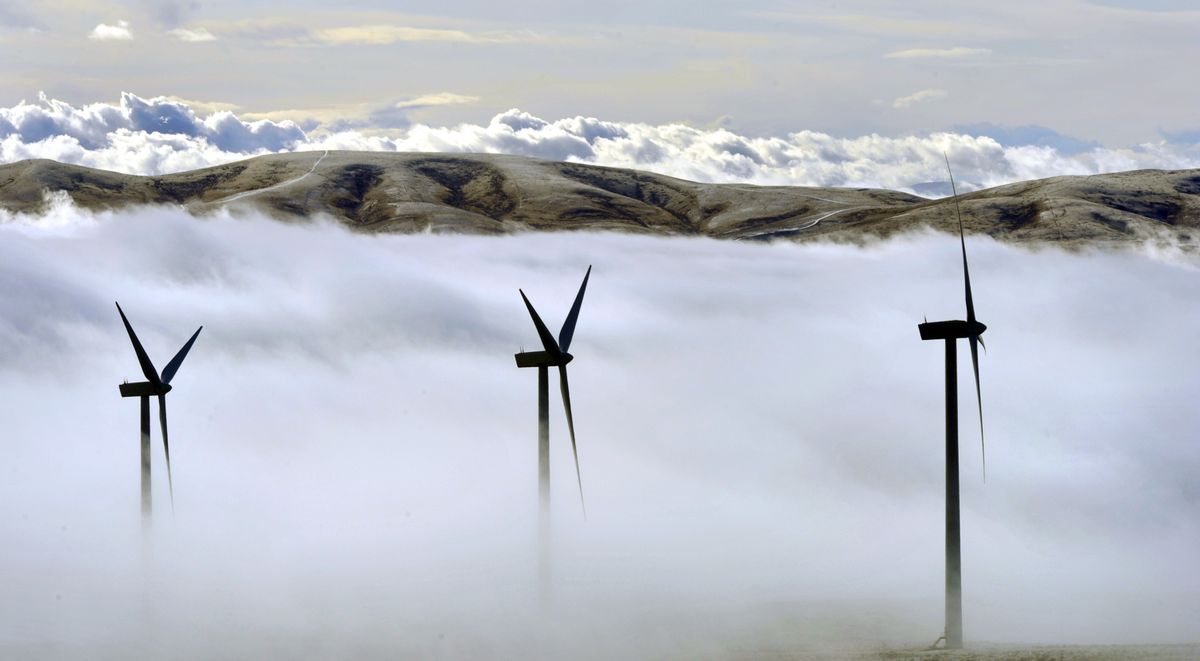
ELLENSBURG – Gusty winds sweep through Central Washington’s Kittitas County, scattering tumbleweeds and spinning the blades of 149 turbines on Whisky Dick Mountain. The westerly wind is a gift of geography. Moist air from the Pacific Ocean picks up speed as it’s forced through Snoqualmie Pass. As it hurtles down the eastern slopes of the Cascades, it rushes through Puget Sound Energy’s Wild Horse wind project.
Since 2006, the Seattle-based utility has harnessed the wind, converting its force into kilowatts of electricity. When wind speeds hit 9 mph, the turbines start producing power for the utility’s customers in the Puget Sound region.
Wind farm development has been on a fast track across the Northwest, with at least 40 farms in operation and several more under construction. Anyone who’s driven to Seattle or Portland has seen the evidence. The towers – as high as 22-story buildings – dominate wind-swept corridors east of the Cascades.
But the boom in Northwest wind farm development may have hit its peak.
About half of the wind power produced here is sold to California utilities, which are under state mandates to get 33 percent of their energy from new, carbon-free sources by 2020. Earlier this year, however, California passed laws requiring utilities to purchase more of their renewable energy from in-state sources.
The new legislation won’t affect existing purchase agreements for Northwest wind, but it’s likely to put a damper on new developments.
EnXco, a multinational French company with offices in Portland and San Diego, previously built two wind farms in Eastern Washington, but it’s holding off on two other Washington projects.
“It’s probably not a surprise that the projects we’re building right now are in California,” said Virinder Singh, enXco’s director of regulatory and legislative affairs. “We have to go where the market is.”
The rules for changes to California’s renewable energy requirements are still being written, and the impact isn’t entirely clear yet. However, “California is clearly signaling that it wants more of its renewable energy to come from California,” Singh said.
In the Northwest, wind development went through “a phenomenal trajectory,” said Tom Karier, Eastern Washington representative on the four-state Northwest Power and Conservation Council.
Since the late 1990s, the Northwest has installed nearly 6,000 megawatts of wind energy. That’s enough to supply 1 1/2 cities the size of Seattle, based on the wind blowing 30 percent of the time, which is typical for wind farms here. About $12 billion worth of investment has poured into wind farm development, aided by generous federal tax and production credits.
But Karier doubts that pace can be sustained. Future demand for wind development will rely less on California and more on Northwest needs, he predicted.
Utilities in Washington, Oregon and Montana face their own state mandates to get more of their power from carbon-free sources. In Washington, a voter-approved initiative requires large utilities to ramp up the amount of electricity from new renewable resources, hitting 15 percent by 2020. Wind has been utilities’ carbon-free resource of choice, though solar, biomass and geothermal projects also count toward the goal.
Karier said he expects wind development in the Northwest to continue, “but at a much slower rate.”
A cost-effective alternative
Puget Sound Energy moved aggressively on wind development. The utility, which serves 1.1 million customers in Western Washington, has built three wind farms east of the Cascades. When its Lower Snake River wind farm comes online next spring, Puget Sound Energy will be able to supply more than 10 percent of its customers’ average electric load from wind.
Wind is really the only cost-effective way to meet Washington’s renewable energy requirements as they’re currently written, said Roger Garratt, the utility’s director of emerging technologies and resource acquisition. Solar energy isn’t as viable in the Northwest as it is in sunny states. Other technologies, such as biomass and geothermal plants, face challenges to large-scale production, he said.
“If you have a big number to hit, wind is a way to hit that number fairly economically,” Garratt said.
The utility expects to add 1 million new residential accounts by 2020, primarily in suburban areas around Seattle. Puget Sound Energy needed to add generating capacity anyway, and on a cost basis wind compares favorably with natural-gas fired turbines, said Roger Thompson, the utility’s spokesman.
Garratt said utilities look at costs in several ways. Wind energy costs about twice as much as the current wholesale cost of electricity in the Northwest – about 6 cents per kilowatt hour compared with 3 cents. But running a wind farm, he said, is like driving a Toyota Prius: While the cost of building a wind farm is high, the marginal cost of generating electricity is low because the fuel is free.
That’s an advantage wind shares with hydropower, Garratt said. It helps the utility’s wind farms compete costwise with electricity from natural-gas-fired turbines and an existing Montana coal plant.
‘Controversial on a lot of levels’
Wind farms often receive a warm reception in rural counties. The construction phase typically brings 200 to 300 workers to town. Each tower and turbine represents a capital outlay of about $3 million, which translates into thousands of dollars for local taxing districts.
Klickitat County in the Columbia River Gorge actively courted wind farms, viewing them as compatible with the ranches and wheat farms in the thinly populated, economically depressed county. More than 600 wind turbines have been erected in seven large developments, including 500-megawatt Windy Point/Windy Flats, which stretches for 26 miles along the Columbia River’s ridgeline.
Wind developments have paid $13 million in local taxes over the past five years. The tax money has been used to buy new firetrucks and ambulances and even build a new school and fire hall, said Mike Canon, the county’s economic development director.
“Klickitat County is fortunate that we got as many wind farms built as we did,” he said, adding that some projects are on hold, given the uncertainty of future demand from California utilities.
But the welcome isn’t universal. In central Washington’s Kittitas County, home to three wind farms with a fourth in the planning stage, “they are controversial on a lot of levels,” said Paul Jewell, a county commissioner.
Many of the county’s 41,000 residents are either urban refugees from the Seattle area or longtime residents who prize the open vistas. They view the massive towers, topped by red blinking lights, as a blight on the landscape, Jewell said. Others oppose the turbines from an ideological basis, saying they don’t support federal subsidies for wind development.
Back in 2007, Kittitas County zoned 500 square miles of its sparsely populated eastern side as a wind-farm resource overlay zone. Two wind projects proposed outside the zone faced strong opposition. They were overturned at the local level, but the developers appealed to Washington’s Energy Facility Site Evaluation Council, which approved both projects.
The state’s intervention fueled local resentment. Project opponents felt they were getting stuck with the negative impacts of wind farms benefiting distant utility customers, Jewell said.
He’d like large wind projects to pay some type of local impact fee. There’s no question that wind farms benefit Kittitas County’s coffers, Jewell said. Each turbine represents about $4,500 in yearly taxes to the county’s general and road funds.
But after the flush of construction jobs ends, wind farms employ relatively few permanent workers, he said. Fewer than 50 people are needed to run Kittitas County’s three operating wind farms.
“A factory would take up a lot less land and bring 20 to 30 times the job growth,” Jewell said.
More turbines coming
The Wild Horse project escaped controversy. Built on an old ranch in eastern Kittitas County, the 12,000-acre wind farm is sandwiched between large blocks of public land, more than a mile from the nearest house.
“It wasn’t in the view shed that many people valued,” said Brian Lenz, Puget Sound Energy’s government and community relations manager in Ellensburg.
To further community acceptance, Puget Sound Energy allowed traditional uses of the land to continue. The 4,500 elk in the Clockum herd graze on part of the wind farm, and hunters drive through the property to reach state lands open to hunting. Members of the Yakama and Wanapum tribes dig bitterroots at the site each spring. As part of environmental mitigation, the wind turbines were situated to avoid sage grouse habitat.
Each year, thousands of people visit Puget Sound’s Renewable Energy Center, located on site. They can get public tours of the Wild Horse facility, learning that the 129-foot-long turbine blades were made in Denmark and other operational trivia.
The turbine heads swivel 360 degrees, with a computerized system that orients the blades to the best winds.
At wind speeds between 28 and 56 miles per hour, the turbines run at full capacity. They shut down when winds exceed 56 mph because strong gusts can bend blades and damage equipment.
Puget Sound Energy isn’t done building wind farms. To provide its growing customer base with the renewable energy required under Washington’s law, the utility expects to nearly double its wind generating capacity over the next 20 years. That means more turbines on the landscape – funky and futuristic to some but stark and industrial to others.
To Lenz, there’s a whimsical aspect to the giant structures and spinning blades.
“The synchronicity is what I look for,” he said. “We had one lady from Walla Walla call them our Rockettes.”

Spokane7


polistra on December 11 at 3:38 a.m.
Paul Jewell is right. Factories generate jobs and actually make things. Wind “power” generates nothing but subsidies.
The wind blows at exactly the times when extra power is NOT needed: spring, fall, frontal passages with moderate temperature. Extra power is needed on really cold and really hot days, and those days are calm.
WillyPeter on December 11 at 7:22 a.m.
Don’ch love it?
“Two wind projects…..overturned at the local level, but the developers appealed to Washington’s Energy Facility Site Evaluation Council (so here I say, “who in the hell are these nameless, unelected?, bureaucrats who have the authority to over-ride local citizenry), which approved both projects.”
“We’re from the government, and we’re here to help you.”
Some more!
Jethro_toll on December 11 at 7:45 a.m.
polistra must have grown up in Kititas and failed to graduate from their H.S.
There are a few holes in this story. Gregoire promised that no windmill would be within 2000 feet of a residence however they were built within 200 feet of farms N.W. of Ellensburg. It shows that what politicians say, has no force of law. Contact Wayne Bell for the “rest of the story”.
Another side is that its not being driven by the enviroment, but by “subsidized” economics and uh polistra you really want smoke belching, poluting factories in YOUR back yard?
Currently with the climate and massive amounts of that 3 cents/Kw of Hydropower, many of the wind farms are running at idle as they are not needed for in state energy production. Most electrical supply contracts are written for 30 years. Cities in CW have signed onto the Bonneville Project Administration contracts for DECADES. If you were Ellensburg, would you break a $.03/KW contract for a $.06/kw one?
Those blades are made overseas, shipped across the pond to Longview, offloaded and then transported to the windfarm sites. Why cant Boeing make them? Who makes the rest of the guts of the turbines?
Lenz is a faceman placed in Ellensburg to assuage the Commissioners and City Council.
Instead of building more EXPENSIVE power production, why dont we quit building the 3000 sqft Glutten homes? It should be noticed that some power utilities are even considering Nuclear Power plants.
The article is rated about a “B” for inclusion of unessential information and for not telling the “Whole” story. The author fails to mention the “solar farm” that the smoke and mirror developers and ignorant politicians want to build in environmentally sensitive areas east of Cle Elum. Can we read 6’ of snow here in the winter? When Hanford and other areas in C.Washington are right next to the power grids. and the sucker part is they want to build a solar cell plant in the Hi-Tech town of Cle Elum to build the panels and sell to other companies. Do we hear another Synestra boondoggle?
dataxman on December 11 at 8:43 a.m.
The problem with intermittent energy…
A utility must have firm generating capacity to meet the higest peak demand (plus a margin) it has ever experienced - be it August or April. It can do this by building a generating facility or by purchasing the power. Purchased power must be firm capacity. So while a utility can displace firm capacity with wind or solar, it cannot replace firm capacity with it. They can release less water or make their gas plants idle (the cannot shut these down as they have to be able to come on-line quickly, so staff is still on-site). So customers get to pay for renewable power in so many ways - subsidies from the Feds, tax exemptions from the State, higher mW-h rates charged to the utility, payment for the expenses associated with the firm contracts and the expense of building/maintaining a generating plant. A plant that the utility is guaranteed a fixed rate of return on their investment - paid for by the rate payers…
Bob_Knows on December 11 at 8:56 a.m.
None of these wind farms are cost effective. As the article points out, they rely on government mandates that force utilities and CONSUMERS to pay more, above cost effective prices. There have been 14,000 wind turbins that have expired their government subsidies and have been shut down, including some major wind farms in Hawaii and California.
http://www.americanthinker.com/2010/02/wind_energys_ghosts_1.html
Also see: http://www.dailymail.co.uk/news/article-2071633/UK-weather-Wind-turbine-EXPLODES-hurricane-force-gusts-batter-Northern-Britain.html (scroll down for photo)
They are unsightly, noisy, chop up hundreds of thousands of migratory birds, unreliable, intermittent, dangerous, and are way to expensive to be useful. There is a reason California is bankrupt.
Bob_Knows on December 11 at 8:59 a.m.
Odumbo/Haywire energy policy: No coal. No gas. No oil. No nuke. No hydro. No firewood. Burn our food. Buy Chinese windmills. What a horrible mess.
JBlim on December 11 at 9:00 a.m.
The money we spend subsidizing wind is a drop in the bucket compared the money spent subsidizing our fossil fuel economy. As it stands today, we have to maintain military supremacy and control over the Middle East and other foreign oil producers because if the flow of oil were disrupted, the world would slip into a costly recession. Add that to the cost of oil and it’s not such a good deal.
Bob_Knows on December 11 at 9:09 a.m.
Over 100 have caught fire in the past decade alone (at least 8 between January and September of this year). At least one has caused a massive forest fire (in Australia it burnt out a national park. Another fire in Australia last year ended with an article about it, including comments from the fire service that noted there’s nothing that can be done about hem. They can’t use water to put out the fire (because of the electricity) at best they can put out the spreading embers. But they also can’t get too close, because debris sheds off them, even blades, which can go through a roof a mile away, as has been discovered in Germany. And when it gets icy? They can throw ice up to 2 miles, so don’t get close at all!
Explains why they’ve caused 80 injuries and 70 deaths in the last 10 years. How many did Fukushima kill? oh yeah, NONE.
cheddar on December 11 at 9:24 a.m.
So glad we’re busy ripping out the dams that faithfully and consistently produce clean and cheap energy to build expensive windmills that only work half the time..
JBlim on December 11 at 9:49 a.m.
Bob_Knows says “Explains why they’ve caused 80 injuries and 70 deaths in the last 10 years. How many did Fukushima kill? oh yeah, NONE.”
You are comparing a whole industry to one nuclear incident. Why not throw in the thousands of people who died as a result of the Chernobyl disaster?
DDC on December 11 at 10:05 a.m.
Most of the alternative technologies hold the grid in common as the answer. It’s all about centralized distribution…that way the decisions are concentrated away from the individual and placed in the hands of paid for politicians and their misled activists (that’s also why $7.7 Trillion of our money in secret Fed loans went to the big banks, couldn’t let those banks fail and all that money decentralize and go to the regional banks and CU’s. It would give the locals too much control over their money and real decision making power).
As is usually the case, the most promising solutions are intentionally omitted and definitely not reported on.
http://www.thorium.tv/en/thorium_reactor/thorium_reactor_1.php
Benign, efficient, no need for the cost of containment and if there was a car with it as it’s power source, you could drive the car to work and when you return, plug it in to power your home.
Which is why it will never happen.
Coffee on December 11 at 10:06 a.m.
“Wind power has the ability to be a green, bird-friendly form of power generation, but can also adversely affect birds. In 2009, the U.S. Fish & Wildlife Service estimated that 440,000 birds per year were killed by U.S. wind turbines. Birds can die in collisions with the turbine blades, towers, power lines, or related structures, and can also be impacted through habitat destruction from the siting of turbines, power lines, and access roads. Some birds, such as sage-grouse are particularly sensitive to the presence of turbines, and can be scared away from their breeding grounds several miles away from a wind farm.”http://www.howstuffworks.com/framed.htm?parent=wind-turbine-kill-birds.htm&url=http://www.abcbirds.org/conservationissues/threats/energyproduction/wind.html
I know birds are killed by other man made things, but wind power is nothing more than a feel good project that can not sustain it self. These projects our nothing more than government welfare for the rich.
liberal_in_right_wing_land on December 11 at 10:38 a.m.
Ahhh…..good morning hypocritical tea baggers. Complaining about subsidies to wind mill farms while big oil companies who make more money than any company on this planet get refunds paid by us tax payers.
Again, you guys only complain about things you don’t agree with, but as long as the company is making billions and billions of dollars and killing thousands of people, they are ok to get tax subsidies, but wind mill farms are not.
??Riddler?? on December 11 at 10:45 a.m.
?? DDC ??
?? The Grid is to energy as The Net is to communication ??
liberal_in_right_wing_land on December 11 at 10:47 a.m.
Oh yeah, and tea baggers talking about dangerous wind mills are funny……guess they already forgot about the BP Gulf Oil Spill that killed 12 people and millions of wildlife. Maybe you tea baggers should do a google search of oil well explosions in the United States and see how many they have killed also.
But hey, some windmills burned some trees down…they are evil!
??Riddler?? on December 11 at 10:49 a.m.
?? The Resident Self-Proclaimed Experts On Everything ??
?? What state is the largest net exporter of energy ??
?? Why ??
Bob_Knows on December 11 at 10:54 a.m.
The death toll from wind turbines is not just somewhere over there. http://www.komonews.com/news/local/9383316.html Wind turbines, often called “bird choppers” are a threat to everyone nearby.
Bob_Knows on December 11 at 10:59 a.m.
This is your wind turbine on fire.
http://postbulletin.typepad.com/honk/2010/07/this-is-your-wind-turbine-on-fire.html
Bob_Knows on December 11 at 11:03 a.m.
Hey Coffee. So wind turbines only killed 440,000 birds in one year in the US. Now that is the most environmentally sensitive news I’ve heard lately . How many of those were spotted owls, bald eagles, or other “endangered” species? I’m so glad that the “Greens” are protecting wildlife.
Bob_Knows on December 11 at 11:10 a.m.
Of course while we are killing only 440,000 birds per year in the US, the other forest and land dwellers risk death from fires and falling blades. From various sources there apparently are numerous major and minor wildfires caused every year by flaming debris falling from burning windmills. Of course fires, falling blades and ice flung 2 miles can’t be reported by the lamestream media because its not PC to object to “saving” the earth.
I’m so glad that Odumbo and Haywire are saving the planet.
http://bangordailynews.com/2011/06/29/opinion/forest-fires-and-wind-turbines-the-danger-no-one-is-talking-about/
Bob_Knows on December 11 at 11:21 a.m.
If you look on You Tube there are many videos of what actually happens to these whirling disasters: Here’s another one. Be careful when the wind blows. Stand miles away.
http://www.youtube.com/watch?v=OeoVaqdwZXw&feature=related
RedCedar on December 11 at 11:26 a.m.
I’m glad to see a healthy dose of skepticism amongst the commentators here. I actually think the windmills may be on the verge of being economically viable even without subsidies, though they’re not there yet. A huge amount of good engineering has been done in the past decade to make them more reliable and more economical, and they’re now pretty good. Considering that we’re not only unwilling to dam up more rivers, but we’re also slowly removing existing power dams and reducing the energy efficiency of many that remain in order to improve fish survival, windmills are probably the only “renewable” energy source that’s even remotely economical. That means even if they’re subsidized directly and indirectly, they don’t have to be subsidized as heavily as, say, a solar farm.
If we were really serious about wind power, though, we’d stuff the central part of the Columbia Gorge (around Wind River and Wind Mountain) with them. That’s arguably the best wind power site on the planet, but we’ve decided to preserve it as a scenic view corridor rather than use it as a renewable energy resource. Stuffing the gorge full of windmills wouldn’t have any more of an environmental impact than building them out past Goldendale. The impact is purely aesthetic. I hope the environmental community is at least aware of the tradeoff being made.— more environmental destruction elsewhere in return for the illusion of untrammeled nature in a more visible place.
I’m not clear why a diminishing demand from California should hurt the Washington wind projects, though. I thought that the legislature passed a law a few years ago that essentially mandated that Washington utilities buy a certain fraction of their power from wind farms. Hydro was not considered “renewable” in this law, although it is renewable in California, so selling Washington hydropower to California satisfied their requirements, while Washington utilities were supposed to make up the difference with wind farms. So, why isn’t the demand there? Still just too expensive?
One thing I will say in defense of wind farms is that they are as good as a conservation easement in preventing suburban sprawl. Now that all the farms around Ellensburg are full of wind mills, nobody is going to try to build a Rancho Vista Estates under them. That’s some consolation in return for cluttering up the landscape with a bunch of industrial machinery and flashing lights.
The real test will be whether they are still operating 20 years from now or will have gone the way of Jimmy Carter’s rooftop solar water heaters.
liberal_in_right_wing_land on December 11 at 11:35 a.m.
Hey Bob_Knows,
You like posting videos of windmills killing birds and starting fires. Here are videos of oil companies killing people, not birds.
http://www.youtube.com/watch?v=7K-DEl42CTs
DDC on December 11 at 11:37 a.m.
Riddler, your internet provider is very possibly different than mine, based on a pseudo-competitive business environment. I doubt your energy provider is. That’s the difference.
??Riddler?? on December 11 at 11:53 a.m.
?? DDC ??
Good point, but….
Energy deregulation means that one company may own the Powerline, but not necessarily the electricity it carries. This applies to transmission, but not - at this time - to distribution. If it did, AVISTA would own the lines and poles in my alley, but I could buy “my” electricity from “virtually” any supplier.
DDC on December 11 at 12:11 p.m.
Riddler, agreed…personally, I am a supporter of it applying to distribution. I was once told by an employee at customer service at Avista that if I didn’t like the way Avista did business, I could “move”….nice. On the other hand, I did some follow up on “Smart Meters” and the woman was very helpful, but that’s another subject.
Your using the net as a parallel is not a bad comparison, it’s just that when AT&T tried to prevent data from competitive companies to run on it’s lines in the ‘80s, the Supreme Court felt otherwise. I don’t believe a similar case has ever been tried in the energy sector…and it probably won’t. AT&T didn’t see it coming, or they would have made sure the correct politicians were in place before it got to the S.C. The energy sector isn’t that dim.
JBlim on December 11 at 1:46 p.m.
” . .The death toll from wind turbines . . ”
Don Quixote Republicans ride again, attacking monstrous windmills!
nslopeofw on December 11 at 2:13 p.m.
Maybe i could just make some stuff up like they do.
www.youtube.com/watch?v=Yrd3HYU80Dk
drwonderful on December 11 at 3:29 p.m.
It sure makes for a pretty landscape picture, doesn’t it?
Pigrobin on December 11 at 4:28 p.m.
Let the name calling begin.
westerly on December 11 at 4:29 p.m.
If we got 100 % electricity from green sources like wind farms…rates would still be the same today…..or higher. Air would be cleaner.
JBlim on December 11 at 5:19 p.m.
How does one even respond to such a moronic comment as Nslowp’s “blim and lib in rt wing land always blame the left for failed technology and policy?
Huh? Yeah let’s blame the left. That’s what I always do. Christ, what an a******.
Coffee on December 11 at 7:36 p.m.
If all the wind power generators were shut down tomorrow there would be very little long term damage (Though the birds would be appreciative). If you shut down oil, gas, or coal production there would be a catastrophic and immediate effect, namely the implosion of modern civil society and the swift return to pre-Industrial Revolution life and all that entails.
greenlibertarian on December 11 at 9:29 p.m.
Ah, the old Thorium hoax. You’d think that thing would die off.
Wind turbines are not a panacea, nor excessively subsidized, nor as dangerous as some here claim. They are a small part of a diversified energy production policy.
For grid consideration, solar ought to be co-located with wind farms.
libmark on December 11 at 10:15 p.m.
Unless I missed it, I think it’s interesting that none of the comments or the article mention the idea of solving some of our energy problems by just plain using less energy. Of course Puget Sound Energy doesn’t want us to be serious about conservation. The wind turbine industry doesn’t want us to be serious about conservation. The petroleum industry doesn’t want us to be serious about conservation. The nuclear industry doesn’t want us to be serious about conservation. Those charged with seeing after our local tax revenues don’t want us to be serious about conservation… and so on.
If you don’t like subsidies going to fund the construction of wind turbines, fine. But turn down your thermostat and turn off a few lights. If you don’t like birds getting chopped up, fine. But turn down your thermostat and turn off a few lights. If you don’t like vistas broken up by ranks of turbines, fine. But turn down your thermostat and turn off a few lights. Reduce demand for power and all sorts of problems get solved simultaneously.
JBlim on December 11 at 10:38 p.m.
yes libmark, but conservatives are against conservation. They ridicule it every chance they get. They want the freedom to waste energy guilt-free, so you best be layin’ off that guilt trip.
greenlibertarian on December 11 at 11:12 p.m.
There are a conservatively estimated ten billion birds in the US. 100 times as many birds are killed by domestic and feral cats as are killed by wind turbines.
Conservation of energy is the most efficient thing that can be done. The good thing is that the US wastes as much energy as the EU consumes, so we can do a much better job in conserving energy.
Problem is the typical capitalist business model does not incent the energy producers and sellers to an environment of selling less “product”.
Strange that this article didn’t mention the wind project closest to Spokane, whatever your opinion on wind power might be:
http://www.palousewind.com/content/press-release-first-wind-begins-construction-palouse-wind-project
addyh on December 12 at 10:40 a.m.
@greenlibertarian, the Avista project is included as a sidebar with the story that ran today:
Avista signs contract to buy wind energy
Avista Utilities has signed a 30-year contract to purchase wind energy from a Whitman County development.
First Wind of Boston is building a 46-turbine wind farm near Oakesdale, about 45 miles south of Spokane. Avista expects to get the first electricity from the turbines by the end of next year.
Spokane-based Avista will receive an average of about 40 megawatts of renewable energy from the development, which will provide enough electricity to power about 30,000 homes.
The wind farm is being built on private land between Oakesdale and State Route 195, capturing the prevailing southwest wind.
Becky Kramer
Bob_Knows on December 12 at 12:26 p.m.
Yes, Avista is required by Haywire and loony lefties to purchase hoax electricity and pass the cost to all citizens in our utility bills. Thank you Governess Haywire. Thank you loony toons for all your idiotic waste of our money.