June 22, 2011 in City
Shawn Vestal: Dollars clarify debate over red-light cameras
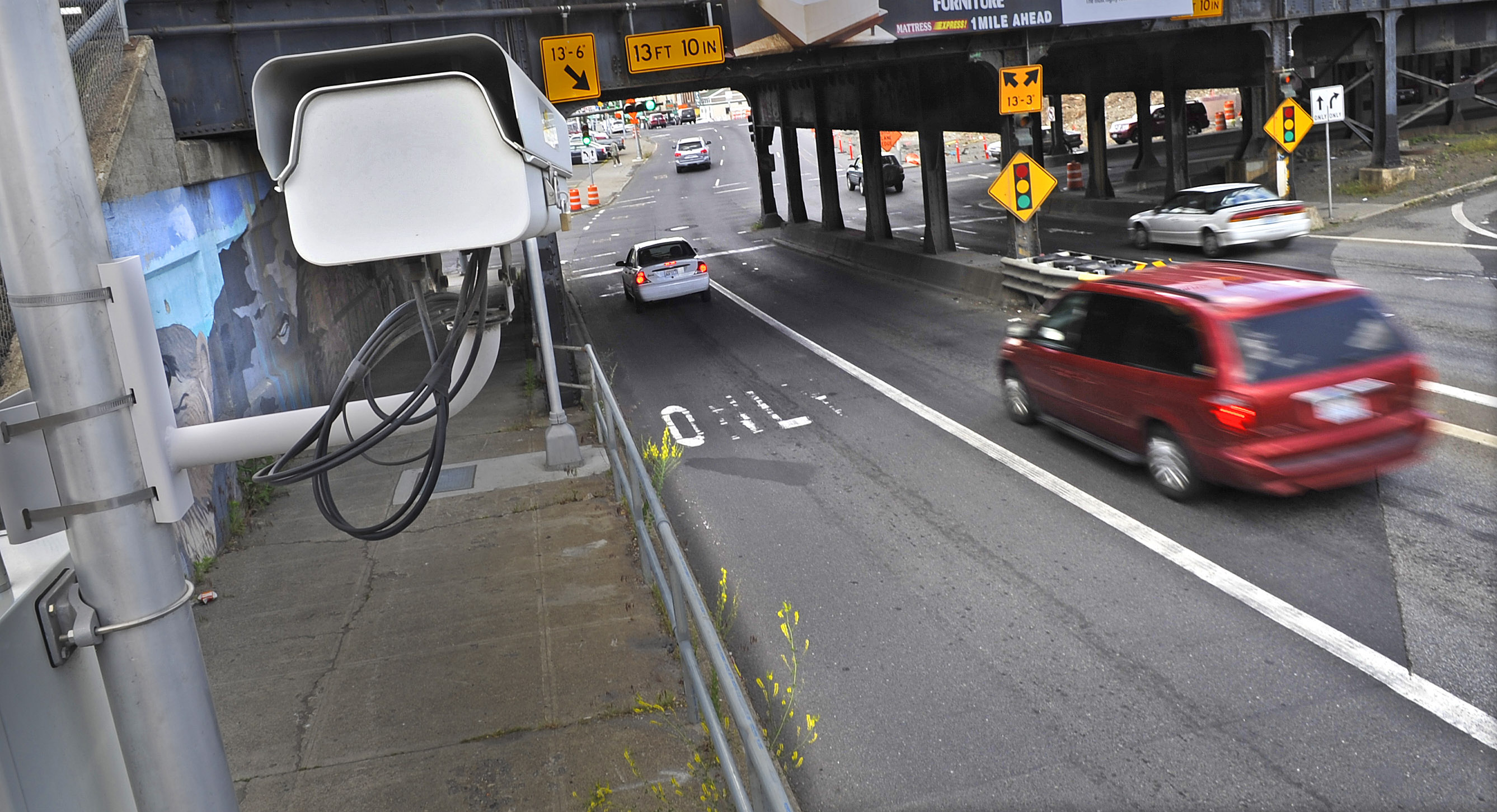
With every new turn in the city’s red-light camera experience, the discovery is made all over again.
Aha! It really is all about the money!
Well, duh. The only evidence to the contrary – ever – was the dubious assertions of politicians. Which are now crumbling before the latest onrushing budget train.
So, yeah. Red-light cameras are a big, gassy cash cow. But if there ever was a time to milk it – given that the city’s other cash animals are gnats and minnows – it’s now.
I’m pretty undecided so far about the necessity of this program on other grounds. A Spokane County judge has ruled that the push-button method of officers “signing” tickets produced in Arizona is unlawful – which may not be a major hurdle, but is the kind of technical legality you run into with an automated law-enforcement program run by an out-of-state company.
Spokane seems to be seeing a reduction in crashes and violations at the intersections with the cameras, though the changes are modest and traffic stats typically fluctuate. City officials say it’s working. But if you spend any time trying to sort out the effectiveness of the cameras, the only rock-solid thing you can say is this: Be wary of drawing conclusions.
There’s a number for every argument, and an argument against every number.
Meanwhile, some cities are seeing awfully good results with a very simple, non-revenue-producing strategy: taking down the cameras and extending the duration of yellow lights.
In Loma Linda, Calif., the city dumped cameras after seeing that their “straight-through” red-light violations plummeted when it added one second to yellow light times. Something similar happened in Fairfax County, Va., a few years back. Los Angeles is now on the verge of getting rid of cameras as well.
Here’s the thing. Those cities also weren’t making money on the program. That tends to influence opinions about the cameras’ effectiveness.
In Spokane, the cameras are still bringing in the dough. And for whatever perfectly valid objections one might raise, there’s also a perfectly desperate need for cops and libraries and pothole fodder. So, yes, Mayor Mary Verner’s proposal to raid the red-light funds for budget hole-plugging is exactly what we were so clearly told would not happen.
But the city’s budget has been full of lousy choices lately. This deal with this devil seems less than deplorable.
According to a Police Department briefing prepared in March, almost $650,000 was pumped into the city’s “traffic calming” fund in 2009 and 2010 from camera tickets. That’s slightly more than the company that runs the program, American Traffic Solutions, was paid.
In the report, Officer Teresa Fuller cited statistics that showed a decrease in violations and collisions at intersections with cameras, though figures for some of them are very preliminary. At Division and Francis, for example, the city saw a small increase in accidents after the first two years, from 15 to 18 – perhaps influenced by an increase in traffic from nearby roadwork – but then a drop to just four collisions last year. Of course, just a few years before the cameras were added, the number of wrecks there was three.
Fuller is less impressed with the yellow-light idea than I am. For one thing, the city did increase its yellow lights to four seconds at intersections with the cameras. For another, drivers simply get used to yellow lights and adjust their stopping times, she said.
“It has been shown across the country that you can increase the yellow-light time a second or two, and people get used to it,” she said.
This seems at least arguable. Cities that have shown improvements in yellow-light experiments have gone to five seconds or longer. And Gary Biller, executive director of the National Motorists Association, points to studies that suggest yellow-light extension is very effective.
Biller, whose organization opposes the cameras, argues they are unfair to motorists – hauling in cash for lots of split-second red-light infractions and doing very little to offset the worst kinds of crashes, where motorists blow through lights several seconds late.
The Washington Post undertook an analysis of District of Columbia cameras in 2005 and found intersections with the cameras were no safer. A Los Angeles television station undertook a similar project and found police had dramatically overstated safety gains.
On the other hand, a new study by the pro-camera Insurance Institute for Highway Safety claimed to show that the cameras reduced fatal accidents from red-light running by an estimated 24 percent. This study seems persuasive at first glance – it compares data from 1992-96 with 2004-08 in 99 cities. But when you look carefully, what emerges is a picture of radical unsummarizability.
Between the two time periods, 14 cities adopted red-light cameras and 48 did not. The study analyzed per-capita fatal crash rates citywide, not at specific intersections. The largest single improvement in the crash rate was a drop of 100 percent in Jersey City – a place without a camera program. It’s about exactly the same rate of change as seen in Raleigh, N.C. – whose fatal crash rate rose 99 percent despite the presence of red-light cameras.
The variation from city to city is so great as to make the averages almost meaningless. As with so much of what the “studies show” about red-light cameras, the numbers are all over the place.
Except, for the time being, on Spokane’s bottom line.
Shawn Vestal can be reached at (509) 459-5431 or shawnv@spokesman.com. Follow him on Twitter at @vestal13.

Spokane7


Orphan on June 22 at 7:51 a.m.
Nothing new here Shawn the goverment isn’t doing what they said they would and the Cops have misrepresented the truth, WOW I am shocked who would have thought.
CommonSenseJoe on June 22 at 7:57 a.m.
I have never gotten a photo red ticket, and am going to say that I never will get a photo red ticket because I don’t run red lights. It all seems very fair to me, actually. Don’t know what Shawn’s problem is with them, maybe he got one a while back and feels wronged by the whole experience. I’m sure whoever gets these tickets would have stopped if they saw a cop at the intersection enforcing the red light laws.
Gato on June 22 at 9:32 a.m.
I’m confused. Why is this such a cash cow if the money coming in is only slightly above the money being paid to the company?
“According to a Police Department briefing prepared in March, almost $650,000 was pumped into the city’s “traffic calming” fund in 2009 and 2010 from camera tickets. That’s slightly more than the company that runs the program, American Traffic Solutions, was paid.”
BuRgEoNyT on June 22 at 9:38 a.m.
Maybe I have the worst luck ever, but it seems like whenever I come up to those camera intersections, the light will turn yellow at the most inopportune time. Instead of turning yellow way ahead with time to stop, or turning yellow when I’m almost in the intersection when it’s a clear-cut roll through: the light seems to turn yellow in that zone where I am forced to make a split-second decision (stop or go) based on a variety of factors (speed, distance, load in vehicle, stopping capability of vehicle) and with the cameras that gets muddied in the reaction as well.
If you haven’t received a red light ticket, it’s not that you are more responsible or a better driver….it’s plain and simple because you haven’t been caught in the ‘yellow zone’ where you are forced to make a split-second decision and guess wrong. Paying money to someone is not a solution to that problem, anyone with half a brain can understand that. In the meantime, I’ll avoid all the cameras and the businesses near them as best I can…how’s your tax revenue now, City of Spokane?
shawnv on June 22 at 9:46 a.m.
Gato — Sorry if that was confusing. The city took in almost $650,000. And the company was paid that amount over and above that — so the total take was something like $1.2 million.
Joe — I don’t really have a problem with them. I’m not that persuaded about them either way. Bottom line — if someone doesn’t run a red light, there’s not a problem.
One update: I hear from a reader in Virginia who says that, as Officer Fuller says, their experience showed an adjustment to the longer yellow-light times. I did not find that in my original research.
Gato on June 22 at 9:58 a.m.
Thanks for the clarification. Excellent column, as usual.
HenryS on June 22 at 10:50 a.m.
ATS, the camera supplier, was just found hidden behind a lot of the pro-camera comments posted online. The expose caused the suspension, in May, of an ATS VP. Source: Everett Daily Herald (heraldnet dot com). Put Kroske in search box.
VP Kroske was just one of ATS’ men. There is Mark Rosenker, former NTSB chair, now with an ATS-supported pro-camera group, the Natl. Coalition for Safer Roads (NCSR). His NTSB credential garnered Rosenker pro-camera “guest columns” in papers around the country. In those he mentioned his current position with NCSR but did not reveal that NCSR is supported by ATS. (Early in his career he did electronic monitoring for CRP, the campaign to re-elect Pres. Nixon. CRP did the Watergate break-in, many went to jail, Nixon resigned.)
ATS is hidden behind many “citizen supported” pro-camera sites in towns where the company is entrenched. Source: bancams dot com. Put “stupid” in search box.
So who is hidden behind ATS? Follow the money. In Sept. 2008 Warren Buffett (Geico), invested $5 bil in Goldman-Sachs which, later that month, invested $50 mil in ATS. There’s no audit trail from Buffett/Geico to ATS, but consider that Goldman was in dire straits back then, and couldn’t have made the investment in ATS without the $5 bil from Buffett.
berrybestfarm on June 22 at 10:58 a.m.
My objection to the camera’s is one of basic due process. We are not able to cross examine our accuser. there are any number of legitimate reasons for being caught in an intersection on a red light. A snapshot in time is not a credible witness. I’m sure these due process problems are exactly why these fines do not go on our record and are not reported to insurance. If they were, the resulting class action suit would decimate this revenue stream.
Dennis Patterson—Deer Park
Dazzeetrader11 on June 22 at 11:22 a.m.
Just another way to fleece the public for money. Did the public vote the redlight cams in? No. Were the people even offered a vote? No.
If this was put to a vote, I’m pretty certain the cam program would be over.
If the data was looked at in toto, there is NO reduction in accidents or death or morbidity. Not in Spokane anyway. The Data is being kept private. It’ll be massaged by the time the raw data is seen.
Verner at her finest. Vote Condon.
james_l on June 22 at 11:41 a.m.
It is important to understand that the yellow light duration at a majority of Spokane intersections is significantly shorter than the recommendations from the transportation engineering and traffic safety professional organizations.
Many cities have shortened the yellow light duration concurrent with the installation of their photo red systems. The following link is to a blog describing this practice: http://blog.motorists.org/6-cities-that-were-caught-shortening-yellow-light-times-for-profit/.
hunternomore on June 22 at 12:38 p.m.
OK what’s the deal here? Several weeks ago the article stated that the City gets 1/3 and the company 2/3. Now Shawn says $650,000/1.2 mil? The bottom line is that Spokane is doing this to pad the coffers. The thing is–where did they get the money to buy and install cameras at more than every major intersection in Spokane, especially since Mayor Verner says there are only 8 cameras operating at the major intersections.
greenlibertarian on June 22 at 12:43 p.m.
Too many big red flags that these red light cameras are a scam and have not proven to make Spokane intersections any safer.
And really now, should half the fine money be going to the shady camera company?
I agree with, and personally experienced the far more dangerous problem of people blasting through an intersection 2 seconds after it’s red, which I don’t think photo red picks up on at all.
And yes, there is a red light running problem in this town far in excess of anywhere else I’ve lived and drove upon the streets.
And no, I’ve never gotten a photo red ticket, nor any ticket for running a red light.
Nor does it make sense to me that a fully trained sworn officer of the law who could be on the street doing traffic patrol or other more important law enforcement activities is needed to look at every single picture taken to decide if a ticket should be issued.
Teseract on June 22 at 12:46 p.m.
“I never run red lights so I won’t get a ticket” is what I hear a lot from people — until they get a red light ticket in the mail for making a free right turn at an intersection with a red light camera.
If you roll across the white line and stop to check oncoming traffic, instead of stopping at the white line, waiting for an interminable amount of time, THEN rolling across the white line to see oncoming traffic, you can very easily get one of these tickets despite causing no danger to anyone.
Everyone else covered the rest of the downsides of these cameras quite well.
CommonSenseJoe on June 22 at 2:41 p.m.
Teseract,
That is the very reason why an officer reviews all the video from the cameras. If that officer wouldn’t have written a “real” ticket, they don’t issue the photo red ticket. All these cameras do is act in the place of an officer. You say everyone says they’ll never get a red light ticket, well, officers here everyday that they should be out arresting the real criminals rather than those that speed and run red lights. These cameras give one officer the ability to do what 5 or 10 would be required to do, so that those other officers can focus on the real criminals.
DickAdams on June 22 at 3:37 p.m.
The ship of fools at city hall claim photo red is for the sake of safety. Why then are vehicles not required to slow down on Thor driving through the school zone? Its like a speed way during the time the children are both arriving and leaving school. NOT ONE SIGN TO REDUCE SPEED ON THOR, MAYOR VERNER!!! HOW COME???
