
Inmates tapped to fill labor shortage harvesting orchards
Gregoire: Alternative was to ‘let the apples rot’
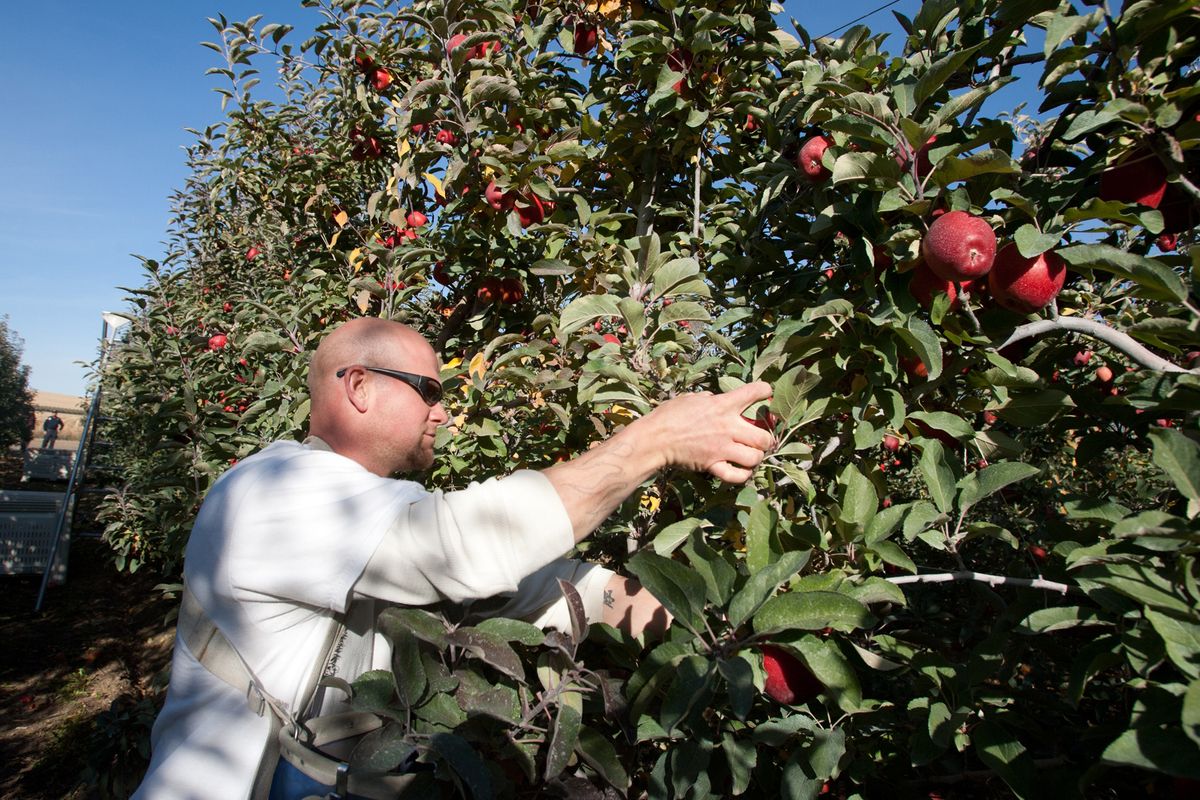
WASHINGTON – Even after deploying 105 prison inmates this week to help pick apples, Washington Gov. Chris Gregoire says growers still need from 3,000 to 4,000 workers to help harvest before the season’s first major freeze.
“We’re sitting on the potential of having the third-largest crop, at around 105 million boxes, and we can’t get them picked,” Gregoire said in an interview.
The Democratic governor defended the plan to dispatch the male offenders to an orchard in central Washington, where they began work Monday, earning $8.67 an hour.
She called it “a one-time deal” but said the nation’s top apple-producing state had little choice when growers could not find enough workers, even after advertising jobs with pay of $120 to $150 per day.
“I don’t believe we have ever done this in history. … But it’s either that or let the apples rot,” Gregoire said.
Gregoire, state agriculture official Dan Newhouse and a delegation of 15 agricultural producers came to Washington, D.C., last month to ask Congress for help, saying the federal government must make it easier for foreign workers to assist in U.S. agricultural operations.
Officials estimate that nearly 72 percent of the seasonal workers in Washington state are illegal immigrants. And they said that many would-be workers are staying away because they fear they’ll be detained.
While attempts to overhaul immigration laws have stymied Congress, Gregoire said it will be important for lawmakers to break their logjam soon to help the nation’s agricultural producers.
In the meantime, she said, “Let’s be honest with each other. If Congress doesn’t act, we’re going to have to go to some sort of extraordinary solutions.”
Putting prisoners to work for private business is hardly a new idea in much of the country, but it has generated plenty of controversy.
When a huge oil spill hit the Gulf of Mexico last year, BP used prisoners to help clean up the mess.
In Colorado, prisoners have been used for fish farming. Maryland prisoners have helped make flags. In Georgia, prisoners have helped clean foreclosed houses. And in New York, prisoners have helped pick up the garbage.
Paul Wright, founder and editor of Prison Legal News, a publication that has tracked the experiments, said the prison-labor plans often are attractive to politicians who want to appear tough on crime and appeal to voters by boasting that “we’re making the bad guys work.” But he said they have a poor track record.
“In the states that have tried it, it has fizzled pretty miserably,” he said. “As a general rule, it’s not like this is a great workforce.”
While the labor might be cheaper, Wright said that states often are forced to pick up the costs of security, transportation and other expenses, making the plans tantamount to “a not-so-subtle taxpayer subsidy” for employers. And he said that employers, instead of “casting about for slave-labor alternatives,” should consider a proven market solution for a labor shortage: Raise the pay.
“I have a hard enough time getting people to show up for $10 an hour to do light office work,” Wright said.
Bradley Brockmann, executive director of the Center for Prisoner Health and Human Rights in Providence, R.I., said most prisoners would welcome the opportunity to work outdoors, “given the dearth of exposure to anything natural in a normal prison setting, either air or light, let alone being truly outdoors.”
“This kind of work can actually be a positive experience for prisoners,” he said. “Assuming that the prisoners are clothed and fed adequately, given proper skin protection to the extent necessary, not forced to work in inclement weather, I don’t see this as a negative.”
Gregoire said she faced stiff opposition from some of her advisers, who responded with “a resounding no” when she first broached the possibility of using prisoners to assist in the harvest.
After all, they told her, it had never been tried before in the state. It would be too expensive to train the inmates, they said, and there were too many risks. But Gregoire said that officials at the state Department of Corrections “stepped right up” when asked to help.
The inmates, from the Olympic Corrections Center in Clallam County, Wash., a minimum-security work camp, reported to work at the McDougall & Sons Inc., orchard in Quincy on Monday morning, after undergoing brief training on Sunday.
The company declined to comment, but state officials said the company has been happy with the crew’s performance so far.
“They’re pretty happy to be doing it – not only are they making money, but they’re helping the community out in a way they’re not typically able to do,” said Danielle Wiles, assistant director for Correction Industries, a division of the state Department of Corrections.
Most of the inmates are age 25 to 45. Wearing red shirts and sweatshirts and khaki pants, they have been picking apples for seven to eight hours a day and are expected to remain at the site for the rest of the week.
For the workers, participation is voluntary, but there are restrictions: They cannot be sex offenders, they must be physically able to work and they must not have had any infractions in the past six months.
Wiles said the employer is paying the state $22 an hour for each worker, which covers the inmate’s pay and all other logistical costs, including the security provided by seven guards, and transportation, housing and food for the prisoners.
The state Department of Natural Resources helped bring in tents and trailers for showers and sleeping quarters. No security incidents have been reported.
Wiles said state officials estimate the average inmate will receive net pay of $1 to $2 per hour after money is subtracted for child support, taxes, crime victim compensation, incarceration costs and any other legal and financial obligations.
In addition, she said, prisoners are forced to save at least 10 percent of their earnings for “seed money” to pay for an apartment or other costs when they’re released.
Bernie Warner, secretary of the Washington state Department of Corrections, said the effort is helping all parties: “We help the apple growers, and the offenders work to pay off their financial obligations and cost of incarceration.”
Newhouse, who directs the Washington state Department of Agriculture, said growers are reporting more concerns about labor shortages than at any time in the past five years.
“If farmers can’t get their fruit off the trees before a hard freeze, they have a major disaster on their hands,” he said. “We’re working to fill the gaps.”