October 6, 2011 in Nation/World

Many legal immigrants leaving Alabama behind

Workers, employers fearful as strict law takes effect
Phillip Rawls Associated Press
 
Associated Press photo

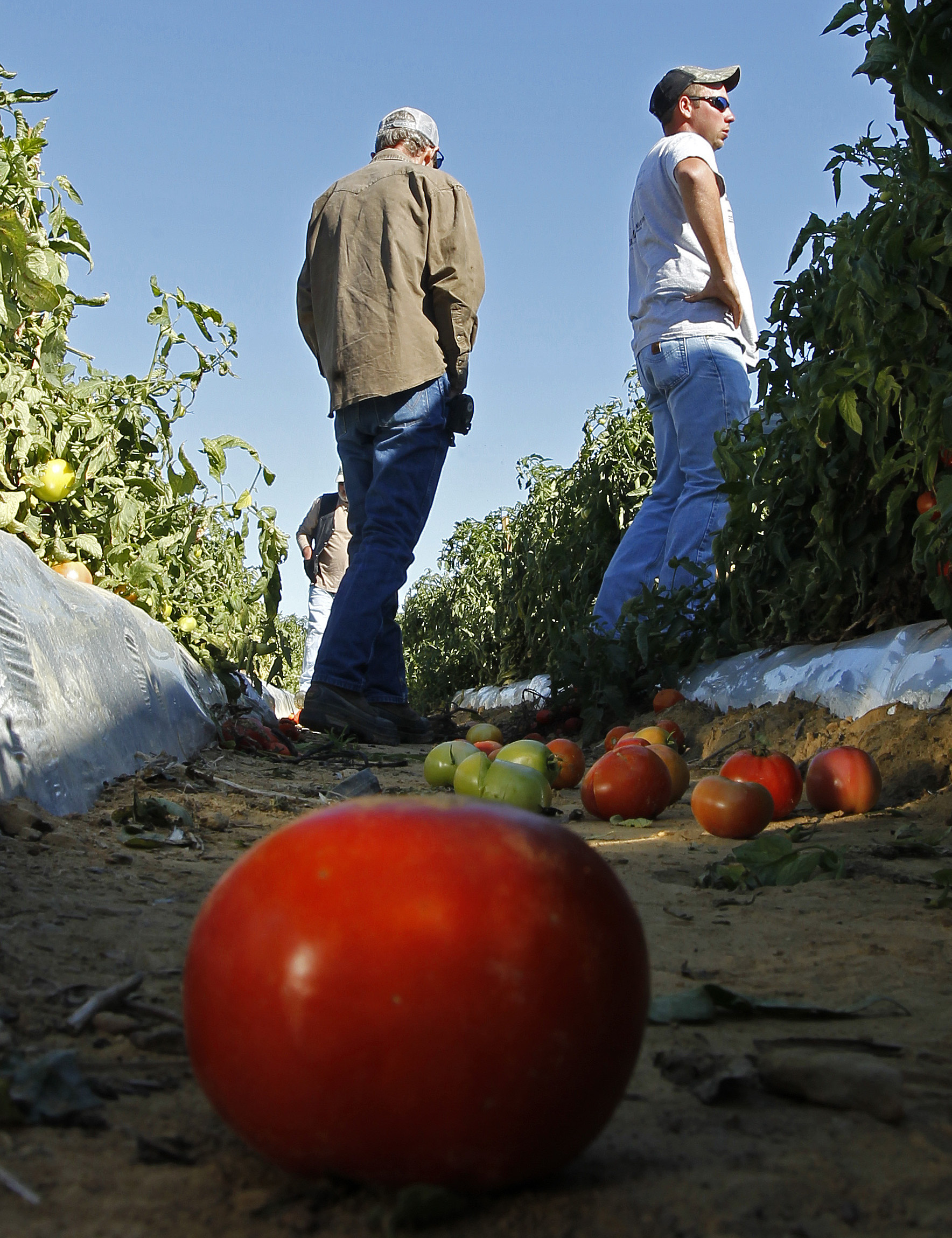
Farmer Chad Smith, right, looks over one of his fields of ripening tomatoes in Steele, Ala. Only a few of Smith’s field workers showed up for work.
(Full-size photo)

Schools must check new enrollees

Alabama’s recently adopted immigration law allows police to detain people indefinitely if they are suspected of being in the country illegally and requires schools to check the status of new students when they enroll. The law targets employers by forbidding drivers from stopping along a road to hire temporary workers. It also bars businesses from taking tax deductions for wages paid to illegal workers and makes it a crime for an illegal immigrant to solicit work. A federal judge has temporarily blocked some sections of the law so she can study them more.

MONTGOMERY, Ala. – Alabama’s strict new immigration law may be backfiring. Intended to force illegal workers out of jobs, it is also driving away many construction workers, roofers and field hands in the country legally who do backbreaking jobs that Americans generally won’t.

The vacancies have created a void that will surely deal a blow to the state’s economy and could slow the rebuilding of Tuscaloosa and other tornado-damaged cities.

Employers believe they can carry on because of the dismal economy, but when things do turn around, they worry there won’t be anyone around to hire. Many legal Hispanic workers are fleeing the state because their family and friends don’t have the proper papers and they fear they will be jailed.

Rick Pate, the owner of a commercial landscaping company in Montgomery, lost two of his most experienced workers, who were in the country legally. He spent thousands of dollars training them to install irrigation systems at places like the Hyundai plant.

“They just feel like there is a negative atmosphere for them here. They don’t feel welcome. I don’t begrudge them. I’d feel nervous, too,” Pate said.

While it’s not clear how many of an estimated 185,000 Hispanic people in the state have fled, one estimate figured as much one-fourth of the commercial building workforce had left since the law was upheld last week, said Bill Caton, president of Associated General Contractors of Alabama.

Commercial construction is a more than $7 billion-a-year industry in Alabama.

Legislators said the law would help legal residents suffering from nearly 10 percent unemployment.

One of the bill’s authors, Republican Sen. Scott Beason, said he expected short-term problems, but he has received “thank you” calls from two people who replaced illegal immigrants who fled their jobs. Beason predicts that trickle will become a rush.

“We have the best law in the country and I stand by what we’ve done,” Beason said.

Some farmers disagreed.

On Chandler Mountain in north Alabama, tomato farmer Lana Boatwright said only eight of the 48 Hispanic workers she needed for harvest showed up after the law took effect. Those who did were frightened.

“My husband and I take them to the grocery store at night and shop for them because they are afraid they will be arrested,” she said.

Farmer Chad Smith said his family farm stands to lose up to $150,000 because there are not enough workers to pick tomatoes spoiling in the fields.

“We will be lucky to be in business next year,” he said.

The financial toll will vary by area, and experts said it’s too early to make predictions.

Five comments on this story so far. Add yours!
  • greyhound2 on October 06 at 7:54 a.m.

    While amnesty advocates always ask “who is going to pick the tomatoes”, the truth is that illegals are flooding all kinds of jobs in factories, construction sites, transporatation and even some government jobs like CalTrans. The lure for employers is a large class of unprotected workers who can be paid less, if at all, with no benefits or worker safety and occupational protection who exist under the threat of deportation. The lack of pay and benefits are then made up at the local welfare office with the bill passed onto county propery owners who end up subsidizing business who hire them

    The Feds, who claim jurisdiction, have refused to fund enforcement because it costs them nothing. It is local property owners who get stuck with the bill for welfare, healthcare and education. The States are forced to do the job themselves to avoid bankruptcy from the staggering costs accociated with illegals.

  • Bruce (aka thatoneguy) on October 06 at 10:16 a.m.

    What greyhound said. However.

    Somehow I doubt the part about aliens — legal or otherwise — “…who do backbreaking jobs that Americans generally won’t.”

    More like jobs Americans generally won’t do unless they’re paid decently* and treated like human beings. That’s expensive and eats into profits which, thanks to Wall Street, need to be sky-high (“pretty good” is often not good enough) or the financial overlords will shut down your company.

    The companies have realized they can increase their profits by getting rid of the decently-paid workers (remember when construction and landscaping used to be respectable blue-collar trades? Those poor company owners sometimes had to scrape by on only two houses and 4 or 5 servants!) and replacing them with below-minimum-wage workers who can’t ask for a raise or job stability or safe working conditions. I somehow doubt that the spoiled babies of the American work force quit doing construction work because it’s not as much fun as sitting around watching TV and waiting for the government money to show up.

    * “decently” meaning enough to have your own crappy apartment instead of having to share it with 4 other guys, and enough to drive your own crappy car without having to hitchhike to work, and enough to buy your own groceries without having to use food stamps or food banks, and enough to save up a little money on the side so you can improve your life in the future.

  • Diana on October 06 at 10:39 a.m.

    Hey, unemployed in Alabama. Go get your jobs, fellas!

  • greenlibertarian on October 06 at 12:58 p.m.

    Same thing’s happening all over the place. More young Americans are obese and out of shape than ever before. And we think they’ll do stoop labor, happily? Happily or not, their health condition precludes them from doing this hard labor.

    Farm labor has always been a not so well hidden disgrace in this country. First the rural white poor were exploited, then the work was “outsourced” to mostly hispanic legal and illegal immigrants.

    This has enabled Americans to enjoy some of the lowest food prices in the world, however, the practices are unsustainable, as we are seeing now.

    October 5, 2011
    Hiring Locally for Farm Work Is No Cure-All
    By KIRK JOHNSON

    OLATHE, Colo. — How can there be a labor shortage when nearly one out of every 11 people in the nation are unemployed?

    That’s the question John Harold asked himself last winter when he was trying to figure out how much help he would need to harvest the corn and onions on his 1,000-acre farm here in western Colorado.

    The simple-sounding plan that resulted — hire more local people and fewer foreign workers — left Mr. Harold and others who took a similar path adrift in a predicament worthy of Kafka.

    The more they tried to do something concrete to address immigration and joblessness, the worse off they found themselves.

    “It’s absolutely true that people who have played by the rules are having the toughest time of all,” said Senator Michael Bennet, a Democrat from Colorado.

    Mr. Harold, a 71-year-old Vietnam War veteran who drifted here in the late ’60s, has participated for about a decade in a federal program called H-2A that allows seasonal foreign workers into the country to make up the gap where willing and able American workers are few in number. He typically has brought in about 90 people from Mexico each year from July through October.

    This year, though, with tough times lingering and a big jump in the minimum wage under the program, to nearly $10.50 an hour, Mr. Harold brought in only two-thirds of his usual contingent. The other positions, he figured, would be snapped up by jobless local residents wanting some extra summer cash.

    “It didn’t take me six hours to realize I’d made a heck of a mistake,” Mr. Harold said, standing in his onion field on a recent afternoon as a crew of workers from Mexico cut the tops off yellow onions and bagged them.

    Six hours was enough, between the 6 a.m. start time and noon lunch break, for the first wave of local workers to quit. Some simply never came back and gave no reason. Twenty-five of them said specifically, according to farm records, that the work was too hard. On the Harold farm, pickers walk the rows alongside a huge harvest vehicle called a mule train, plucking ears of corn and handing them up to workers on the mule who box them and lift the crates, each weighing 45 to 50 pounds.

    “It is not an easy job,” said Kerry Mattics, 49, another H-2A farmer here in Olathe, who brought in only a third of his usual Mexican crew of 12 workers for his 50-acre fruit and vegetable farm, then struggled to make it through the season. “It’s outside, so if it’s wet, you’re wet, and if it’s hot you’re hot,” he said.

    Still, Mr. Mattics said, he can’t help feeling that people have gotten soft.
    : …
    Mr. Harold’s experience is a repeated refrain where farm labor is seasonal and population sparse. And even many immigration hard-liners have come to agree that the dearth of Americans willing to work the fields requires some sort of rethinking, at least, of the H-2A program. Indeed, Representative Lamar Smith of Texas, a conservative Republican, is pushing a bill that would greatly expand the number of foreign guest workers admitted to the country each year. (continues)

    http://www.nytimes.com/2011/10/05/us/farmers-strain-to-hire-american-workers-in-place-of-migrant-labor.html?_r=1&pagewanted=print

  • Justin_Galloway on October 06 at 6:24 p.m.

    Hurray for unintended consequences! (which were totally foreseeable)

You must be logged in to post comments.
Please create a profile or log in here.