
Sacred artifacts
Coeur d’Alene Tribe prepares to showcase mission’s history
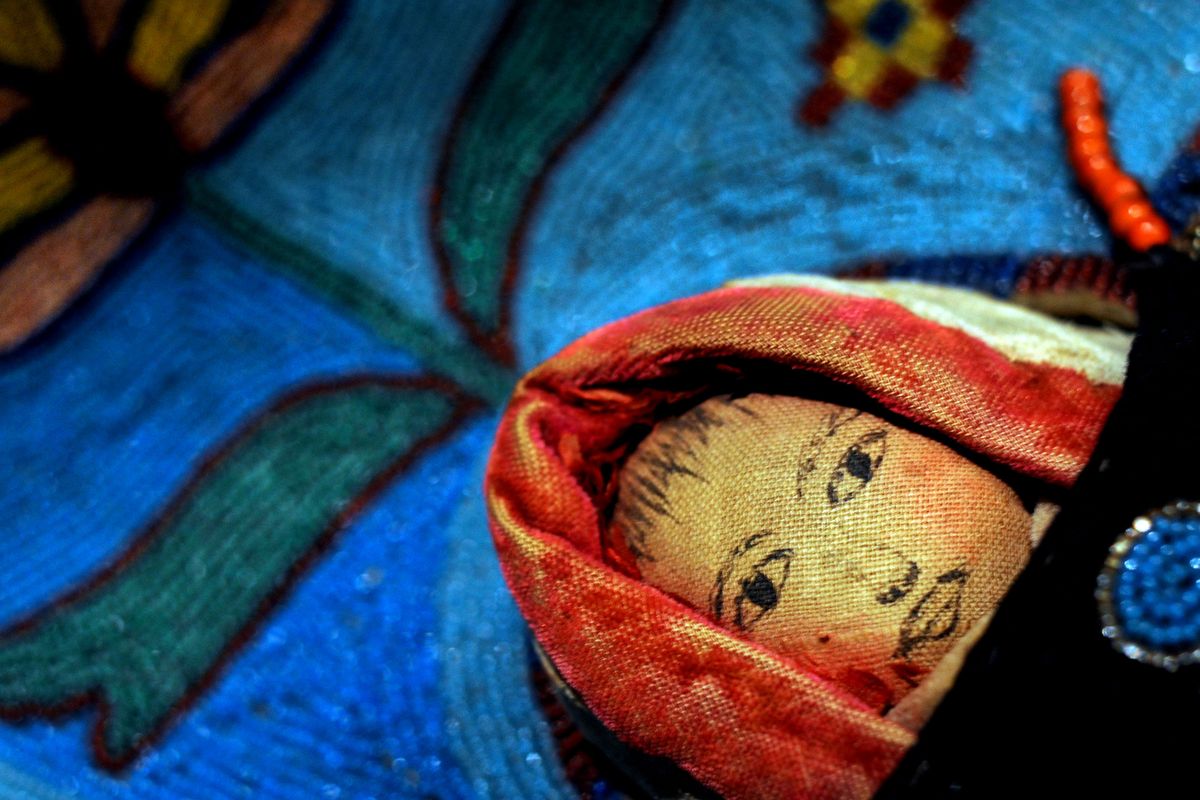
“It’s something coming back to us,” Coeur d’Alene tribal elder Felix Aripa said of the doll crafted by a tribe member. “I say welcome home,” he said as he watched Greta Hansen of the National Museum of Natural History lay three dolls – a Native American man, woman and child – on a table.
Sitting beside Aripa was tribal member Bertha Swan, whose great-grandfather, tribal Second Chief Peter Wildshoe, commissioned a tribal member to create the dolls for the Smithsonian in 1901. Through a correspondence with Campbell Babcock, a U.S. Army lieutenant from the Vancouver Barracks, the dolls and six baskets were donated to the national museum in Washington, D.C.
The dolls will become part of the new exhibit, “Sacred Encounters: Father De Smet and the Indians of the Rocky Mountain West,” which opens to the public Oct. 15. It includes artifacts and historical items borrowed from museums and collections from around the world and tells the story of how Pierre John De Smet of Belgium met the Salish tribes of the Inland Northwest in 1841-’42.
The dolls are on loan from the Smithsonian and will remain for a couple of years until they can be replicated by tribal artisans.
“Cataldo, through the Jesuits, the missionaries, was the true base of this whole Inland Empire,” Aripa said. “From this very place, we were given the true faith we follow up to this day.”
A $3.26 million visitor center was constructed at Old Mission State Park to house the 5,000-square-foot exhibit, which traveled the West from 1993 to 1997. After tribal members saw it in Missoula, the Association for Sacred Encounters was formed to raise money for the visitor center and to mount the exhibit. Among the association’s members are representatives of the Roman Catholic Diocese of Boise, the Idaho Department of Parks and Recreation, the Coeur d’Alene Tribe and private citizens.
When the exhibit closed 13 years ago, the Coeur d’Alene Tribe bought it for $2 million, said Lisa Watt, project manager and principal with Tribal Museum Planners and Consultants of Portland.
The exhibit unfolds in nine different scenes, brought to life with video, music and photographs. Among the items on display are Jesuit rings from 1750, the original letter from De Smet to his father saying he’d come to America to become a priest, an Indian woman’s dress from the late 1800s and beaded men’s shirts.
At the end, a video production called “Closing the Circle: The People Today” shows Coeur d’Alene and Bitterroot Salish elders talking about the past and about the relationship between Christianity and Native spirituality and the survival of Indian tradition and identity.
One of the photographs on the wall is that of 93-year-old Coeur d’Alene tribal member Marie Irene Seltice Lowley, who is still active with the tribe’s language program. Her granddaughter, Jennifer Fletcher, is editor of the Coeur d’Alene Tribe’s newspaper, Council Fires. Using a Coeur d’Alene word for grandmother, Fletcher said her “yaya” has always made her proud.
“When I walked in here and saw her picture on the wall, it made me tear up,” Fletcher said.