
Happy trails for all

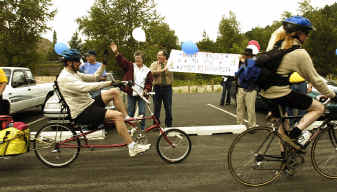
Dan Jolibois left Plummer at 3 a.m. Saturday by the light of the nearly full moon.
Bound for Mullan, he pedaled his bicycle the entire 72 miles along the recently completed Trail of the Coeur d’Alenes, strolling into town about 9 a.m. for the beginning of opening ceremonies for arguably the longest state park in Idaho.
“I just barely made it to the ribbon cutting,” Jolibois said.
He had just enough time to catch his breath, before turning around and heading back down the trail to Plummer in the path of a caravan of Idaho dignitaries.
The trail – paid for by the Union Pacific Railroad – was built in conjunction with tribal, state and federal agencies to address cleanup issues along the old rail bed, and turn years of scarring left by mine waste into an economic asset for North Idaho.
It follows the old Union Pacific right-of-way from Mullan, near the Montana border, to Plummer along the shores of the Coeur d’Alene River and Lake Coeur d’Alene.
Representatives from the Coeur d’Alene Tribe and the state – who will both manage the new paved parkway – along with railroad officials traveled by trolley along the trail, followed by several vans and trucks. They had planned multiple stops for ribbon-cutting ceremonies in several small towns that border the new recreational and economic gem.
At each stop, town residents gathered to greet the caravan and the small scattering of bicyclists trailing ahead and behind. Town mayors and officials cut the ribbons following speeches by the trail officials, and residents let off colorful balloons into the sky.
A tribal celebration was planned at the final stop in Plummer, with smoked fish and blessings.
“It’s just a great way to open up the trail,” said Francis SiJohn, a tribal council member, during a stop in Smelterville, and old smelting town on the edge of a Superfund site. “People have just been really receptive.”
As the caravan traveled along the portion of trail that borders the town of Pinehurst, residents there held up signs and cheered. It wasn’t a planned stopped, but the trolley stopped anyway as a gesture of appreciation.
“We called to see if they could stop here, and they said they couldn’t,” said Pinehurst City Councilwoman Nancy Burkhart. “It’s so neat that they did. We just had to let them know where Pinehurst is, and that we really love this trail.”
Even thought the trail wasn’t officially open until Saturday, bikers and hikers have been using portions of the trail for several years. With the completion of the landmark Chatcolet Swing Bridge over Lake Coeur d’Alene, plans were set to turn over ownership from the railroad to the tribe, state and federal government, making the trail officially complete and open for users.
The trail is paved the entire 72 miles, and relatively flat, with trailheads in most small towns between Plummer and the Silver Valley.
In Mullan, riders can link up with an unpaved portion that connects to a similar rails-to-trails project – the Route of the Hiawatha.
“I use this trail just about every day,” said John Davis of Kellogg. Davis was riding the entire length of the trail Saturday from Mullan to Plummer, with plans to camp at Heyburn State Park. “It’s just nice to have this great park that is 72 miles long. There are all kinds of wildlife and scenery to look at. It really is a gem.”
For years trains hauled ore concentrate out of the Silver Valley along the now paved trail, spilling some of the concentrate and rock along the way.
Trains stopped running in 1991. They hauled most of the waste away and capped the rail bed with asphalt, leaving a trail of heavy metals including, lead, cadmium and arsenic.
Even now, trail goers are greeted with signs posted at every trailhead that say, “Wash hands before eating” and “Don’t let children play near shorelines or off the trail.”
But the leftover contamination doesn’t seem to bother the towns or the riders.
“We are just really pleased. It’s a good example of groups coming together to turn a liability into something great,” Smelterville Mayor Tom Benson said.
Like most of the small communities that border the trail, Smelterville is already reaping the economic benefits of cyclists coming from around the region to ride the trail.
The town has secured state grants and funding to build three small park-like stops along the Smelterville portion of the trail.
Each park area – one at both ends of town, and one in the center – will feature 1,600 square feet of shrubbery and benches. Each will cost about $5,200 apiece, and are scheduled to be completed by fall.
“I think this trail is really going to help turn the entire Silver Valley into a recreation destination, not just a drive-by,” Benson said.
“This is just one more good thing to happen around here after 20 years of hard times. And it’s just going to keep getting better and better.”