
NC grad named Gates scholar
When Trisha Samuels was 6, the mayor of Spokane presented her with her first community service award. She was given $100 for picking up trash in her West Central neighborhood. She used the money to buy a Little Mermaid coloring book, bought her brothers and sisters a present and took her family out to dinner.
Since then, the graduating senior from North Central High School has received numerous awards for sports, leadership, academics, and her work in the community. Her most recent honor is the Gates Millennium Scholars award, funded by the Bill and Melinda Gates Foundation, which helps students complete college and advanced degrees in areas where their ethnic and racial groups are underrepresented. Samuels, a member of the Spokane Indian Tribe, will receive $12,473 for each of her four years of college.
For a time she wondered if she would be attending college. As she was taking the Scholastic Aptitude Test for college admission, the words began to disappear on the page, leaving just a page of white, with letters fading in and out.
She took the test three times and scored 340 in the verbal section each time. The average score in the United States is 507. This could have ended her dream of becoming a special education teacher and coach.
But Samuels had a very high grade-point average in all subjects, including advanced-placement courses. She had applied at Whitworth College, and it suggested she have formal psycho-educational testing done.
In February, Lisa Laurier, an assistant professor in the School of Education at Whitworth, administered several tests that indicated Samuels has a learning disability that had gone undetected. Samuels has visual discrimination difficulties or scotopic sensitivity syndrome. People with SSS struggle with reading text printed on white paper or very brightly colored paper. White paper reflects light and can cause print to become blurred, distorted or disappear.
Scotopic sensitivity syndrome, also known as Irlen syndrome, is a type of visual perceptual problem. It’s not a vision problem but a problem with how the nervous system deciphers visual information. The distortions affect everything that is seen but are most noticeable in reading. Academic and work performance, ability to sit still and concentration can be affected. Children may be improperly diagnosed as having attention deficit disorder or attention deficit hyperactivity disorder.
“What a time to find out. This poor girl has struggled for years with this. The fact that Trisha has done so well is amazing,” said Lisa Samuels, Trisha’s mother.
According to Trisha’s mother, her daughter did have reading problems in elementary school. While attending Holmes Elementary, she was placed in a Title One enrichment program for reading.
“So many other kids had greater difficulties. Trisha’s skills were better than her peers’ in the program and because of this she was only in the program a short time,” said Lisa Samuels. Trisha then attended Glover Middle School.
She has been accepted at Whitworth College, where Laurier believes she will be capable of doing college-level work with the help of tinted overlays and tinted glasses. Samuels believes that Whitworth’s small classes, individual attention and having an academic adviser will make it possible for her to succeed.
“We have to give credit to the wonderful teachers throughout the years. And not just the teachers, but the principals, counselors, school librarians have all been wonderful,” said Lisa Samuels.
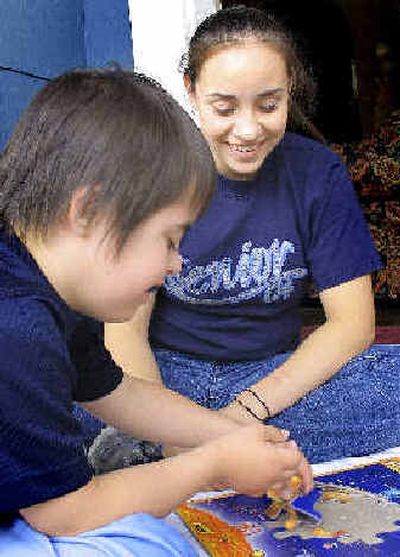
These wonderful teachers, especially Dorothy Nelson, her second-grade teacher, who is now retired, inspired her so much that Trisha made up her mind early in life that she wanted to become a special education teacher. Her youngest brother Matthew, 7, was born with Down syndrome and her senior year she worked as a teacher’s assistant with special education teacher Mary McDowell, doing on-the-job training at North Central. She helps students with math and is sensitive to how they learn.
“Whenever I get frustrated, I think of him (Matthew) and realize how hard he works for the everyday things I take for granted,” said Samuels.