
Kurdish rebels attack in Turkey
ANKARA, Turkey – The Turkish military declared an overnight curfew in a southeastern city late Sunday, after Kurdish rebels launched a rocket attack on a military officers’ club, a military official said. Troops killed two rebels in the ensuing clash.
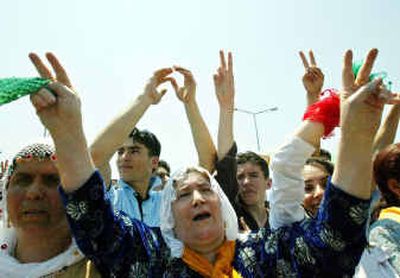
The attack in the southeastern town of Bingol came hours after more than 20,000 Kurds held a mass demonstration for peace in Diyarbakir, the larg-est city in the region. Former parliament deputy Leyla Zana, who was recently freed from prison, urged autonomy-seeking Kurdish rebels to resume their unilateral truce.
The rebels ended the five-year truce and intensified attacks on Turkish security forces earlier this month, saying Turkey had not responded in kind.
The military has vowed to maintain its crackdown until all the rebels either surrender or are killed.
Two soldiers were killed when their military vehicle was attacked Saturday in Tunceli province, 500 miles southeast of the capital, Ankara.
No casualties were reported at the military club targeted in the rocket attack in downtown Bingol. A local military official, speaking on condition of anonymity, said two rebels were killed in the ensuing shootout.
The official said the military had declared a temporary curfew in the city until Monday morning and that anti-rebel operations were under way. It is not uncommon for local military officials to declare a curfew after rebel attacks.
Zana and three other former parliament members were freed from prison last week following pressure by the European Union on Turkey to improve its human rights record. The four, who represented a Kurdish party in the parliament, had served 10 years for alleged ties to the Kurdish rebel group, formerly known as the Kurdistan Workers’ Party, or PKK. The rebel group is now known as the KONGRA-GEL.
Celebrating the former lawmakers’ release, thousands of people rallied in the predominantly Kurdish city of Diyarbakir in one of the largest demonstrations there in recent years. Thousands of Kurds also marched in Istanbul in a similar demonstration.
Turkey considers the rebels terrorists and has refused to talk with them. But the country’s Kurdish politicians, buoyed by the release of the four former lawmakers, are calling on the rebel group to observe their truce again.
Zana appealed to the rebel group to give “peace a chance” and to continue the cease-fire for at least six months.
Most of the protesters shouted “peace.” But many pro-rebel sympathizers chanted illegal slogans in support of imprisoned Kurdish rebel chief Abdullah Ocalan and unfurled banners of his outlawed group as well as posters with his picture during the rally.
“Tooth for tooth, blood for blood, vengeance!” chanted some demonstrators in apparent support for the rebels.
About 20 percent of Turkey’s 68 million people are Kurds, although they are not officially recognized as a minority. Under pressure from the European Union, which Turkey wants to join, Turkey recently granted the right for Kurdish-language broadcasts and to study the language at private schools.
Kurdish rebels fought a 15-year war for autonomy before declaring the cease-fire in 1999, shortly after their leader Ocalan’s capture by Turkish forces. Some 37,000 people died in the war.