
Israeli missile kills militant leader
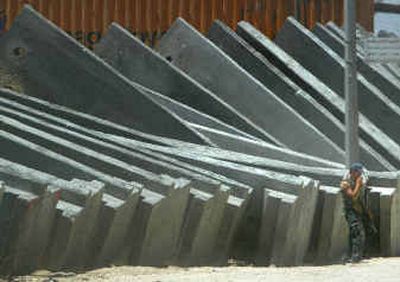
JERUSALEM – An Israeli airstrike in the West Bank late Monday killed two Palestinian militants, including a local leader, as Israel started building the most controversial section of its separation barrier, confiscating Palestinian land.
An Israeli helicopter fired a missile at a car in the Balata refugee camp next to the city of Nablus, killing Khalil Marshoud, the local leader of the Al Aqsa Martyrs Brigades, a violent offshoot of Yasser Arafat’s Fatah movement. The military said Marshoud was behind a number of attacks against Israelis.
Another militant was killed and a third person was seriously wounded, witnesses said.
Israel began building the barrier last year to keep out Palestinian militants who have killed hundreds of Israelis since the outbreak of fighting in 2000. In some areas, the trenches, walls and fences run near Israel’s old frontier with the West Bank, but elsewhere dip deep into the territory claimed by the Palestinians for a future state.
The latest land seizures are part of construction of a barrier segment near the Israeli settlement of Ariel, in the heart of the West Bank.
Palestinians charge that the barrier project is meant to swallow up large parts of the West Bank, pointing to the Ariel sector as a prime example.
If Israel builds the barrier to include Ariel on the “Israeli” side, it would mean cutting a wedge halfway through the northern part of the territory, because Ariel is in the middle.
With 18,000 residents, Ariel is the second-largest West Bank settlement. Maale Adumim, east of Jerusalem, has 26,000.
The United States is opposed to adding Ariel to Israel by means of the barrier, and Israel has so far avoided making a clear decision.
Asaf Shariv, Prime Minister Ariel Sharon’s spokesman, said that for now only an east-west section of the barrier is being built, leaving the option of encircling Ariel separately – a concept the Americans apparently do not oppose.
A U.S. official said there are ongoing consultations about the Ariel issue.
The Ariel barrier project is already causing hardships for Palestinians.
Residents of the nearby Palestinian village of Azawiya were informed that 4,500 acres of land are being expropriated for a two-mile stretch of barrier, said Annan Elashkar, a Palestinian liaison officer with Israel.
Azawiya resident Khader Abdel Raouf, 65, said he had his 32 acres of olive groves seized.
Abdel Raouf said his family of 15 lives off the olive oil produced by the trees. “I have been planting and harvesting these olives since I was a small boy,” Abdel Raouf said in tears. “This land belongs to me and I belong to it.”
Palestinian Cabinet minister Saeb Erekat said building a barrier around Ariel would “mean the destruction and devastation of the road map,” an internationally backed peace plan for a Palestinian state next year, because of the confiscation of Palestinian land.
For months, Palestinians and their supporters have been demonstrating at many construction sites along the length of the barrier, making similar complaints. Thousands of acres of land have been confiscated for the barrier.
Despite the tension, the military began easing restrictions in the West Bank by starting to remove about 40 ramparts and gates that blocked West Bank roads, a defense official said on condition of anonymity.
The official said obstacles can be lifted in areas where the barrier has been completed. The military released a statement saying the easing is in keeping with its policy to “to make a clear distinction between the terrorists who hide among civilians and those not involved in terror.”
Shortly after violence erupted in September 2000, Israeli forces erected dozens of roadblocks in the West Bank, choking travel.