
Pole vaulter revisits Olympic spirit
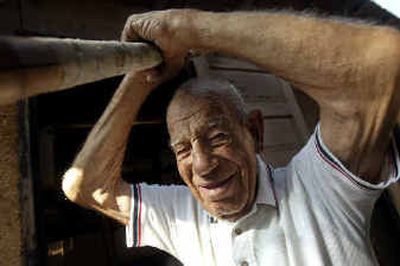
In 1932, a 23-year-old Greek pole vaulter named Peter Clentzos marched into the Los Angeles Memorial Coliseum for the Summer Olympics.
On Wednesday, Clentzos will be back — a day after turning 95. The man believed to be the oldest living Greek Olympian is expected to be the oldest person in the Olympic torch relay when it begins its leg in the United States.
For Clentzos, who will walk with the flame about 400 yards outside the Coliseum, the relay is another chance to honor the country that gave birth to the Olympics and hosts them Aug. 13-29.
“It is one of the biggest thrills of my life,” he said. “To know that the flame will end up in a country that will be born again with the Olympic spirit is just amazing.”
The torch is set to arrive in Los Angeles after a flight from Mexico City. Among those who will carry it during its one-day stop are swimmer Janet Evans, who won four Olympic gold medals, and Hollywood stars Tom Cruise, Sylvester Stallone and Ellen DeGeneres.
The flame will make an appearance in St. Louis on Thursday, Atlanta on Friday, and New York on Saturday before being sent to Montreal and eventually on to Athens.
Clentzos was nominated to carry the torch by friend Nicolas Nicolaidis, 71, who wrote to the committee overseeing the relay after the two men met at a social gathering for Greek-Americans earlier this year.
“He has such a great enthusiasm and love for the Olympics,” said Nicolaidis, a retired businessman.
Born in the United States to Greek parents, Clentzos was a pole vaulter at the University of Southern California in the early 1930s. His dual citizenship allowed him to try out for both the U.S. and Greek Olympic teams.
He failed to make the U.S. squad but was selected for the Greek contingent. During the games, he finished seventh in the pole vault competition, clearing 12 feet, 3 1/2 inches. American Bill Miller won the gold medal.
“I felt great that day, but I have no excuses,” Clentzos said. “It was just one of those days.”
Despite his disappointment, Clentzos has fond memories of the Olympics that helped energize a country that had been beaten down by the Great Depression.
He recalled little security at the games. Athletes staying in the Olympic Village watched movies at night in an amphitheater, and large crowds of spectators got around on streetcars.
“There was such a camaraderie among the athletes and complete respect for one another,” he said.
Torch moves through Mexico City
The Olympic flame that burned over Mexico City during the tumultuous 1968 Games returned for a more peaceful tour of the city Tuesday, part of a 26-nation relay leading to the Athens Games.
World champion sprinter Ana Guevara was joined by 119 scholars, journalists, workers and athletes — including a woman who began her running career at 80 — in carrying the torch through North America’s largest city.
From Mexico City, with a metropolitan area of about 17 million people, the flame headed overnight to Los Angeles — the first of four stops in the United States before its return to Greece for the Aug. 13 start of the Summer Olympics.
Tram has successful test
Athens’ new tram had a successful first test run, moving from central Athens to the southern seaside suburbs where two major Olympic complexes are located.
The $380 million project had been so delayed the International Olympic Committee was concerned it would not be ready for the Games.
“The general test of the tram was successful. Despite all the delays and problems that existed because of its course through densely populated urban areas, we finally did it,” said Transport Minister Michalis Liapis.