
Garden warriors
A quick quiz for gardeners: What’s your favorite sport?
Chances are few of you said gardening. But Eli Glick thinks you should.
“I look at gardening as a form of athletics,” says the Montgomery County, Pa., physical therapist, who’s also a Master Gardener. “I think all gardeners should consider themselves athletes.”
Think about it, says Glick: “If you hold an 8-pound cast-iron weight in your hand and lift it, that’s considered weight training. And if you fill a 1-gallon watering can with water and move it through a range of motions, you are also doing weight training.”
In fact, any time you move weight through a range of motion, that’s weight training. And all that physical labor in the garden is great exercise, as long as you don’t overdo it.
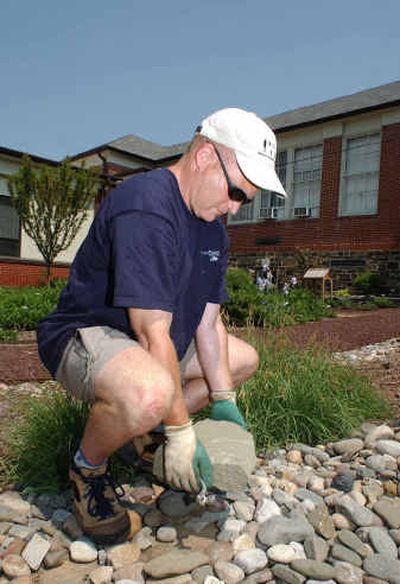
“I love working up a good sweat in the garden, being very physical and using all the tools,” says Glick, 44, who tends extensive vegetable and ornamental gardens at his home. “When I’m exhausted from working in the garden, it feels as though I’ve had a good workout.”
And that’s from an outdoorsman into mountain climbing and winter camping.
Just as athletes can injure themselves if they don’t train properly, so can gardeners.
“Many times throughout the year, we treat people who have injuries related to some sort of gardening activity,” says Glick, a partner at Wallace & Glick Physical Therapy in Erdenheim, Pa.
The body parts that suffer injury most often are the back, shoulders, knees, hands and wrists. But a little preparation by gardeners could prevent many of those injuries.
“Gardeners have to take responsibility for their own bodies, and what to do to protect their bodies,” Glick says. It’s a familiar refrain for the therapist, who talks about injury prevention to garden clubs, classes at arboretums, or anywhere gardeners gather, as part of his commitment to the Montgomery County Master Gardener program at the Penn State Cooperative Extension.
I first encountered Glick’s zeal when my doctor sent me for physical therapy for a nongardening knee problem. It was just before the start of the gardening season, so along with weight training for overall strength, Glick offered some pointers to get me safely out among my plants.
It makes sense, he told me, to start slowly and train to get into gardening shape, to warm up and stretch before each gardening session, and to do jobs in small bites.
No extended sessions doing just one task. Instead, do a half-hour of this, a half-hour of that, so you frequently change posture and positions. Plan your time in the garden so you use a range of body parts to reduce stress on any one. And keep tools clean and well-oiled, so they can do much of the work for you.
After a winter languishing indoors, it’s hard not to rush into the garden come spring and spend hours bent over weeding or planting new seedlings, or reaching up to trim trees. I know. More than once, I’ve done such foolish things. And the day after, as likely as not, I couldn’t move.
Holding any position for a prolonged period, or repeatedly moving any of our body parts or joints, can potentially lead to injury, Glick says. Injury usually occurs over time, when you take tissue beyond its normal activity level and sustain or repeat it.
For example, he says, “if you take your index finger and bend it back, you soon notice that your first knuckle begins to hurt. No big deal. But if you keep the pressure on it for an extended time, it really hurts, and the tissue begins to break down. … even if you keep it just below the level of extreme pain.” Nobody would do this intentionally, of course, “but this is what we are doing to our bodies.”
The good news is that although repetitive-movement injuries are very common, they are among the easiest to prevent, he says.
Lifting is another chore that causes problems.
A Gallup poll of 2,000 adults a few years ago showed that nearly half suffered from back pain, and about half of those blamed it on gardening. The problem for many of them, the survey showed, was that they didn’t know how to lift properly.
“Legs are designed to lift,” says Glick, not backs. “When you bend from the waist, your trunk becomes a large lever-arm, with the fulcrum in your lower spine. So if you bend forward with straight legs and lift something from the ground, heavy or light, your back is a force-multiplier — that’s what a lever is.”
To get the idea, hold your arm out straight and have someone push down on your hand as you resist; you’ll find it puts a lot of stress on your shoulder. Then have the person press down on your elbow, and you’ll find the force isn’t so great, because the “lever” is shorter.
“With the spine, we want to reduce the amount of leverage — reduce the lever-arm — by using our legs and squatting (to lift something from the ground). By keeping the back straight, or more upright, we reduce the pressure on the lower back,” Glick says.
What if you can’t squat because you have a problem with your knees?
“You can kneel, using a 5-gallon bucket for support,” he says. “This is the kind of plastic bucket you can get free at any construction site where drywall is being applied, or you can buy a similar one for a few dollars at home stores.
“Flip it upside down, with the opening on the ground — it can go over a plant, if necessary — and you can lean on it with one hand as you weed, while kneeling on one knee or two. It reduces the pressure on your back and your knee, because you’re not squatting.”
Glick is big on these free buckets. He usually carries two with him into the garden: One he leans on, because he has a little arthritis in his knees; he tosses weeds into the other, which has holes punched in the bottom for drainage.
“I don’t think you can have enough of them — and if you don’t use them, they’re going to wind up in the landfill, undegradable.”
When you use hand tools, make sure the tool you choose is the right one for the job. This applies even to something as basic as using a small hand trowel when you should be using a larger spade, or using a trowel in heavy clay soil — something I’ve done in the past, to my cost.
And don’t use a hand pruner to hack and saw through a branch that’s too big for it.
“You don’t want to have to use a two-hand grip to cut something,” he says, assuming the tools are sharp. “If the task requires two hands, get a different tool, such as a lopper. A lot of loppers have a blade similar to a pruner’s, but give you the mechanical advantage of the long lever.”
Glick, who has never been enthusiastic about working out in the traditional way, thinks gardening is a great way to maintain fitness at any age. Even as a kid growing up in the farm country of Vineland, N.J., he was interested in gardening and the physical work that went with it.
And then, there are those other benefits.
“To me, there is nothing like picking a ripe piece of fruit or a vegetable, and eating it while you are out there in the garden,” he says.