
4Runner brute looks good at play, work

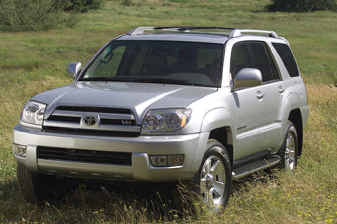
This week we test drive the 2004 Toyota 4Runner 4WD Limited, a midsize SUV loaded with technology and good looks.
There was a time when 4Runner looked like Toyota’s workhorse SUV, but not one you’d take on the town. The workhorse aspect still exists, with a 4.7-liter V-8 engine (a 4-liter V-6 is also available) and great off-road capabilities. However, nowadays this brute looks good at play as well.
The 4Runner Limited has a number of great features to talk about, from the interior to the drivetrain. Let’s start inside, where technology is abundant.
Our tester had the optional $2,675 JBL Synthesis 3-in-1 sound system and GPS navigation system. This incredible sound system comes with 10 speakers, rear-seat audio with remote wireless headphone capability, channel display, steering wheel controls and a remote control. The navigation system includes a 7-inch, touch-screen LCD monitor and voice guidance. A final element is the rear-view camera, which projects an image onto the monitor when reverse is engaged.
Off-roaders will appreciate some of the technology Toyota has put into 4Runner’s drivetrain. All 4WD models come standard with Downhill Assist Control, which aids engine braking to improve directional control during descent on steep or slippery surfaces. It works in reverse as well.
The 4Runner also offers Hill-Start Assist Control (HAC) on all models, including the two-wheel drives. A first for an SUV, HAC is designed to prevent the vehicle from rolling backward or slipping sideways during transition from a stopped position to climbing an upgrade. Imagine the four-wheeling confidence and overall improved safety.
Both the Limited and lower-cost SR5 4Runner models now offer third-row seating, with the second-row seats tumbling forward for improved entry and exit. Of course, with the third row upright, the cargo room is dramatically decreased, from 75.1 to 12.1 cubic feet. If both a third row and ample cargo room are important, Toyota’s Sequoia is a consideration, as it still offers a maximum 36.2 cubic feet with the third-row upright.
That raises one of our critical points about the 4Runner. Our tester is priced within $1,000 of the base Sequoia, and only $5,000 less than a loaded version of Toyota’s largest SUV. Adding third-row seats is a nice thought, but the 4Runner has essentially become a competitor to the Sequoia. Even the fuel mileage difference is minimal, with the Sequoia at 14 mpg city, 17 mpg highway, and 4Runner at 15 and 19 mpg.
Of course, a trimmed-down 4Runner can still be considerably more affordable and, with the V-6 engine, more fuel-friendly.
That said, we encourage the V-6 engine option to aid fuel mileage; if you prefer the V-8, maybe the Sequoia is a better option.
Other standard items of note on the 4Runner include multi-stage front airbags; vehicle stability control with traction control; 17-inch steel wheels; automatic up and down rear window with jam protection; leather trimmed interior; adjustable, heated front seats; and HomeLink garage door opener.
Other important numbers include a 23-gallon fuel tank, 109.8-inch wheelbase; 4,245-pound curb weight; 9.1-inch ground clearance; and 7,000-pound towing capacity.
In all, the 4Runner is quite a vehicle. Good looking, and loaded with performance as well. We rate it a 9 on a scale of 1 to 10.