
S2000: A sports car lover’s nirvana
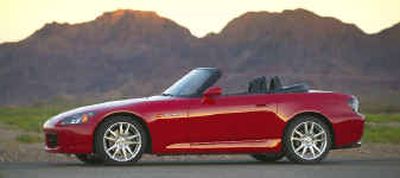
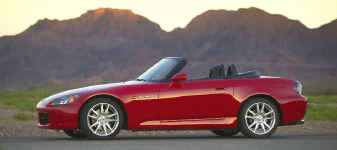
A group of us was flinging bull at a Valley watering hole when the conversation turned to cars.
I don’t remember what triggered my comments (couldn’t have been the beer talking), but I do remember overstating the case somewhat for Honda’s S2000.
“It revs to, I don’t know, 11 or 12 grand — it’s like a motorcycle!” I expostulated, completely sincere and just as wrong.
Wrong then and even more so now — now that the S2000 has undergone the surgeon’s knife for the ‘04 model year.
The original S2000 had one of the strangest power curves ever to grace a mass-production sports car. Its 2-liter, four-cylinder engine put out a remarkable 240 horsepower, but didn’t start generating real torque until the rev counter hit 7,500 rpm. At 8,500, the overachieving little engine was in its sweet spot and the power was still coming on at the 9,000-rpm redline, when it felt as if the pistons would blast through the cylinder heads, scattering engine parts to hell and gone.
The best thing ever said about the original was this: You have to drive it like you hate it.
Regrettably, all that high-end power came at the cost of low- and mid-range thrust, making the S2000 a remarkably frustrating commuter vehicle.
If you weren’t driving it at the track, you weren’t really driving it.
A pity, really, because the S2000 is blessed with all the attributes of a great sports car — a suspension with its own nerve endings, steering so sharp it crackles and a mid-engine design that produces superb balance.
Equip it with serious tires — and Honda did — and you’ve got a first-rate track car, at the bargain-basement price of $32,000 and change.
But there wasn’t much joy in Mudville, as even freeway onramps weren’t long enough to let the let the engine air out its virtues.
A mid-course correction last year brought the torque curve down a hair, but the S2000 remained a tweaky car that could send shivers up and down your spine or drive you to distraction, depending on the direction in which the tachometer pointed.
But all that — most of it, at any rate — is water under the bridge, as Honda’s engineers have excised the S2000’s more extreme torque tendencies.
The long and short of the story is that they lengthened the stroke (the distance the pistons travel inside the piston) to increase performance at lower rpms. Peak rpms had to be reduced accordingly, so the S2000 now tops out at 9,000. It’s a far site higher than most anything else out there, but not as exhilarating as it once was.
Total displacement is up from 2-liters to 2.2-liters.
Output remains the same, at 240 hp, which now occurs at 7,800 rpm rather than 8,300, and peak torque improves, from 153 at 7,500 rpm to 161 at 6,000.
It’s all quite amazing, considering the S2000 is normally aspirated (think no turbochargers) and displaces just 2.2 liters.
Now, you can squirt into that adjacent lane without that sickening wait for the power to come on and you can still wring it out in the upper revs — it’s just that there aren’t as many up there as there once were.
The S2000 is offered with just one transmission, a brilliant, short-throw, close-ratio six-speed manual. This year, it gets carbon-fiber synchronizers on every gear but reverse, lower ratios in the lower gears and a higher ratio in sixth. Fifth is unchanged.
Regardless of how they felt about the original version’s power curve, nearly every observer agreed that the S2000 was a brilliantly executed sports car. Lean and low, it looked the part of a well-bred two-place soft-top. Its electrically operated canvas roof lowered almost instantly and contained a glass rear backlight, with defroster, while more expensive sports cars with more prestigious badges used plastic backlights.
Fit and finish were — and are — typically Honda in quality and the materials of equivalent quality.
If there is a substantial gripe about the S2000, it’s the lack of useable storage space. Aside from small cargo nets in each of the doors and a little bin on the bulkhead behind the front seats, the interior is devoid of areas to cram your stuff.
There’s not much more room in the trunk, rendering the S2000 effectively a weekend-tripper.
To make those weekend outings more comfortable — and to achieve other desirable effects — Honda has worked some new magic on the suspension. Front spring rates are up, but rear spring rates have been dropped and the rear anti-sway bar is thinner by 1.8 millimeters, giving the S2000 a somewhat more pliant ride.
New structural reinforcements improve the already-superb body rigidity — this may be the most rigid open-top car I’ve driven — and the power steering ratio has been lowered for even greater responsiveness.
The standard anti-lock brakes now get yaw control logic, Honda’s nod to vehicle stability control. To make the S2000 more manageable at its limits, the transition to oversteer has been softened, making it more predictable.
Other changes include more deeply dished door panels for improved hip room and the addition of faux aluminum bits to dress up the interior. The digital gauges are somewhat more readable this year.
Modest exterior changes include a wider air intake below the front bumpers and new LED headlamps. The rear bumper cover has been resculpted and the dual exhaust tips are no longer round, but oval.
The old, 16-inch tires have been replaced by 17-inchers.
Standard gear includes power-operated top, leather seats, keyless entry, air conditioning, AM/FM/CD audio system and high-intensity discharge headlamps.
It’s not a car for everyone — one friend claims the sports car is dead, killed off by more comfortable and versatile sport coupes and sedans — but if you still love the intimate experience only a two-seat, open-top sports car can offer, then the S2000 is a no-brainer.