
Al-Sadr accused of ignoring cease-fire
KUFA, Iraq – The U.S.-appointed governor of Najaf accused radical cleric Muqtada al-Sadr on Saturday of failing to honor a deal to end fighting as U.S. soldiers clashed with Shiite gunmen. Three Marines were killed Saturday in separate fighting west of Baghdad, pushing the number of U.S. deaths to more than 800.
Al-Sadr’s fighters said they killed one Iraqi policeman and captured another during an exchange of fire in Kufa. Three Iraqis were injured in clashes, hospital officials said. There were no reports of any U.S. casualties.
Gov. Adnan al-Zurufi complained al-Sadr had done little to stop his fighters from brandishing their weapons in public or to send home militiamen not from this city – key parts of the agreement he struck with Shiite leaders to end seven weeks of fierce fighting around Najaf and Kufa.
“Unfortunately, there have been no positive initiatives from the office of Mr. Muqtada al-Sadr so far,” al-Zurufi said. “Armed men are filling the streets and there have been number of attacks on state employees in Kufa.”
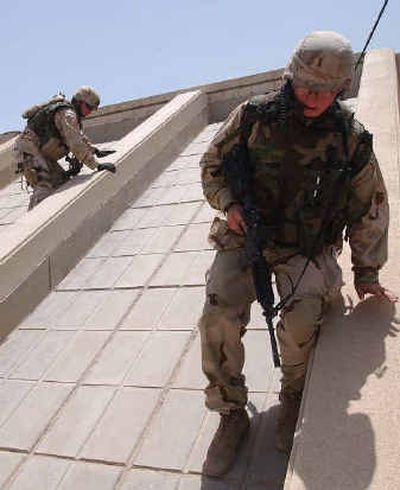
Ragtag fighters wielding Kalashnikovs and rocket-propelled grenade launchers exchanged fire with U.S. soldiers approaching the center of Kufa.
The militia accused the Americans of shooting first. Coalition officials said U.S. soldiers were attacked by rocket-propelled grenades and fired back.
Neither side released any casualty figures.
“God has protected us because truth is on our side,” said one fighter, Salam Abdel-Aali. “Truth is in our side. Truth is always victorious.”
Al-Sadr’s uprising, which began last month, opened a second front for the U.S. military, which had already been battling Sunni Muslim guerrillas to the west and north of Baghdad and in the capital itself.
The three Marines died in action in Anbar province, which extends from just west of Baghdad to the Syrian and Jordanian borders, the U.S. command said. No further details were released, the U.S. military reported.
Also Saturday, the U.S. military reported two other service member deaths – one soldier from the Stryker Brigade who died Friday from non-hostile causes in northern Iraq and the other soldier from the 81st Brigade Combat Team who was killed Tuesday in a mortar attack south of Baghdad.
Nine soldiers were wounded in the mortar attack, a military statement said.
The casualties pushed the number of U.S. service members who have died since the beginning of military operations in Iraq to at least 803. It was unclear if the official death toll included the deaths on Tuesday and Friday.
Explosions could be heard in the center of Kufa, where al-Sadr’s fighters took up positions in the streets surrounding a mosque. Militiamen manned checkpoints, standing near concrete barriers including one with a graffiti that read “Yes to armed resistance!”
In Kufa’s Furat al-Awsat hospital, Ali Moussa, 22, lay in a bed with shrapnel wounds. His head was wrapped in a bandage and his black T-shirt was soaked in blood. Moussa would not say if he was a member of the al-Mahdi Army.
“I was walking down the street and they started attacking people,” he said of the Americans. “They say there is a truce. Where is this truce?”
The deal announced Thursday provides for an end to armed clashes and removal of al-Mahdi militia fighters from the streets. It also calls for discussions between al-Sadr and the Shiite political and clerical hierarchy over the future of the al-Mahdi Army.
In addition, it calls for talks on the status of an arrest warrant charging al-Sadr with murder in the April 2003 death of a moderate cleric.
Lt. Gen. Ricardo Sanchez, the top U.S. commander in Iraq, has vowed his forces would kill or capture al-Sadr to put an end to his militia, which represents a challenge to the coalition and Shiite leaders cultivated by Washington.
But the agreement makes it unlikely al-Sadr will have to face justice or disband his militia before the Americans return power to the Iraqis on June 30.
The coalition has said it was not a party to the agreement but would suspend offensive operations to give the deal a chance to bring peace to this city, revered by Shiite Muslims worldwide.
In a statement Saturday, an official of the country’s largest Shiite political party – the Supreme Council for the Islamic Revolution in Iraq – blamed al-Sadr fighters for the continuing violence and for an assassination attempt against one of its officials, Sadreddine al-Qobanji. Al-Sadr’s office has denied the allegation.
Elsewhere, a loud explosion was heard in the eastern city of Fallujah and residents said an American Humvee was hit by a roadside bomb during a patrol. Saffa Bassem, 25, said he saw billowing smoke coming from the vehicle. There were no reports of casualties.
Fallujah, west of Baghdad, had been a center of the anti-U.S. rebellion in Sunni Muslim regions of the country.