
Southern belles
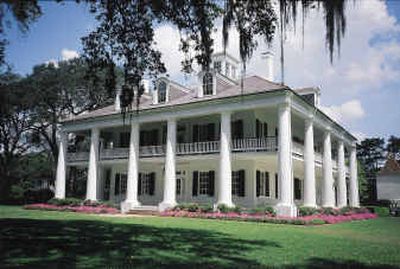
Twenty years ago, Kevin Kelly ended his paid tour of Houmas House by tossing a quarter into a wishing well fashioned from a huge, sugar-cane syrup kettle.
“I wished that one day I’d own a plantation,” Kelly recalled.
Wishes do come true.
Kelly, a 48-year-old bachelor from New Orleans, has done well in shipping and real estate. Last May, he returned to Houmas House and bought the 21-room Greek Revival mansion in Darrow, La.
Another of the grand old houses of the Deep South was saved.
Houmas House was built in 1840 and named for the land’s original inhabitants, the Houmas Indians, who had a woman as their chief. Known as “The Sugar Palace,” the plantation had 300,000 acres, making it the country’s biggest.
Before the Civil War, Louisiana was said to have 140,000 slaves working on 1,600 plantations. The great houses lined both sides of the Mississippi River from Natchez, Miss., to New Orleans. This was the richest area in America.
But with their workforce freed after the war, the owners no longer could afford their lavish lifestyle. Most of the columned mansions and Victorian castles fell into disrepair. Some burned, with only the columns left standing. Some were swallowed by the vegetation.
Today, a drive along the River Road features the survivors, many of which, such as Houmas House, are open to tours or welcome overnight guests. The most famous may be Oak Alley, which has 300-year-old live oaks shading the lane out front and five bed-and-breakfast cottages out back.
With each plantation comes a story, sometimes told by the heirs of the original builders of the houses, who still live there, or by the descendants of the slaves, who still work there.
A marker at Oak Alley lists an inventory of the plantation’s slaves in 1848 and their values. Prince, a 34-year-old carpenter, was worth $1,500. Marie, 69, “cook for the Negroes,” was a mere $50.
Kelly became the seventh owner of Houmas House after the descendants of the doctor who owned it previously decided they no longer could afford to maintain it. They auctioned off the furniture inside and put the house on the market with an asking price of $2.95 million.
Kelly spent millions more restoring the eight-bedroom house and gardens amid the remaining 35 acres. He also embarked on a shopper’s dream, spending another fortune on art and antiques to furnish it.
“I went on a buying spree,” he said. “What made it easy is the economy has been so bad for many of these plantation houses. I was able to go in and buy a lot from the houses in Natchez.”
To start our tour, we left Interstate 55 at Jackson, Miss., to drive the last 100 miles to the Louisiana border on the Natchez Trace Parkway. With no billboards and no commercial traffic, just farm fields, swamps and forests filled with tall pines, shiny magnolias and moss-draped oaks, the two-lane blacktop set the mood for a visit to the Old South.
The first stop on our plantation tour was St. Francisville and the Butler-Greenwood Plantation. The house was built in the 1790s, one of the earliest still standing. Eight charming cottages, including the original detached kitchen and cook’s cabin, are behind the house and rented to visitors.
“Bed-and-breakfasts are going to be the salvation for a lot of these plantations,” said Anne Butler, the house owner. “You cannot make it on tours alone. These old places are bottomless pits.”
Our cottage had a kitchenette, two bedrooms with baths and four-poster tester beds, a room with a whirlpool tub and a sitting room with a fireplace. An evening rain began to fall as we sat on the back porch swing and watched the geese, ducks and a peacock named Humphrey fuss around a small pond. A chill sent us inside, and we lit the wood waiting in the hearth.
“The house has never been out of the family; my children are the eighth generation to live here,” Butler said at the start of a tour. “This area was settled by the English; this is English cottage-style architecture. It’s not until the second or third generations that you get the big Greek Revival houses.”
The formal parlor held a 12-piece set of Victorian rosewood furniture with the original upholstery, bought in 1861 at a cost of $467.50. “This house has had a lot of children raised in it, and they knew how to act around fine things,” Butler said.
Butler is an author and recounts in one of her books how her estranged husband, a prison warden, shot her five times on the porch of the house. Thinking she was dead, he sat down and had a drink.
But that’s another chapter in the house’s colorful history.
The state has provided the salvation for another important plantation near St. Francisville.
Daniel Turnbull was a cotton baron who was one of the richest men in America before the Civil War. He used his fortune to buy 3,455 acres and build Rosedown, a two-story, seven-bedroom mansion named for a play he and his wife, Martha, saw on their honeymoon.
Rosedown was completed in 1835 at a cost of $13,109.20. The Turnbulls furnished it with the finest pieces available, most imported from the North and from Europe, and surrounded the home with formal gardens filled with camellias, azaleas and other plants brought from New York. Gazebos, fountains and marble statues decorated the grounds.
Martha Turnbull threw a party for 30 people when the house was completed. Her shopping list is posted in the kitchen: “6 chickens, 2 turkeys, 2 ducks, 1 ham, 1 tongue, 1 pig, 12 dozen eggs for cakes, 23 bananas, 6 pineapples, 2 hogshead ice, 4 decanters wine, 4 decanters brandy, 8 bottles champagne.”
At the peak of cotton production, 444 slaves worked at Rosedown. After the Civil War, the house went through a series of owners before Louisiana bought it for $5.7 million in 2000 and opened the grounds as a state historic site.
“Ninety percent of the furniture is original, most of it owned by the Turnbulls,” a tour guide said. “That’s what sets Rosedown apart. You can see other plantations, but we have original outbuildings, the gardens, the main house with the original furniture. Rosedown has it all.”
St. Francisville is on the river in West Feliciana Parish, a unique tract in mostly flat Louisiana. The land is full of rolling foothills and ravines, left unprotected by levees. Floods feed the old-growth cypress forests that welcome migrating birds passing through on the Mississippi Flyway.
Cat Island National Wildlife Refuge is home to the national champion bald cypress and attracts hikers, nature lovers and bird watchers, who are following in the footsteps of a young John James Audubon.
James and Lucretia Pirrie, owners of a simple, dignified plantation house named Oakley, hired Audubon in 1821 to tutor their daughter, Eliza. He was paid $60 a month and lived on the bottom of the three floors with Joseph Mason, his 13-year-old pupil and assistant.
Audubon devoted his mornings to teaching art, math and etiquette to Eliza and the rest of the day to painting the birds he saw in the plantation’s lush, 100-acre forest. He completed 32 bird paintings at Oakley, including renditions of the now extinct ivory-billed woodpecker and Carolina parakeet.
His stay at Oakley was short-lived. Audubon was fired by Lucretia Pirrie after he argued before guests at dinner that he should be paid for 10 days that Eliza was sick and could not be taught.
Old photos show that Oakley, built in 1806, was in shambles when Louisiana purchased it in 1947 and opened it several years later as a state historic site. A new interpretive center near the restored plantation has displays that describe the life of the 240 slaves. On the walls of the auditorium are 22 first-edition Audubon prints, including his aerial battle between two red-tail hawks over a captured hare.
“He stayed at Oakley three months and 22 days,” the tour guide said. “That means he completed a painting roughly every third day. Audubon did the birds; Mason did the plants.”
Nottoway Plantation, a relic standing amid the fuming petro-chemical fields near White Castle, La., is said to be the South’s largest remaining plantation — 53,000 square feet. We had every foot to ourselves during an overnight stay.
Visitors in the nine guest rooms have the run of the house, and my mate and I roamed through the antique-filled rooms as if they were our own. After watching the sun set from rockers on the second-floor veranda, she insisted on cocktails in the gentlemen’s study, which in a previous era was off-limits to women.
Nottoway, which has 365 doors and windows, an opening for each day of the year, was completed in 1859 for John Hampden and Emily Randolph — they of the Virginia Randolphs — and their 11 children. The 64 rooms include the Grand White Ballroom decorated with plaster frieze-work, hand-carved marble mantles and Corinthian columns.
But the real treat at Nottoway is next door in a building added in 1984 to house the Randolph Hall Restaurant, where Chef Johnny “Jambalaya” Percle rules the roost. Australian Paul Ramsey bought Nottoway 18 years ago for $4.5 million and, in one of his first, and best, moves, hired Percle.
“Y’all are not on the Atkins, I hope,” Percle said, referring to the diet, as he sat us beneath the crystal chandeliers.
Percle, a sidekick of legendary New Orleans musician Dr. John, has a radio show and CD that combines Louisiana food and music. He takes his “Soul in the Bowl” caravan on the road and has served the crowds at the Iditarod dog-sled race in Alaska.
In 1994, he went to Rome for the World Conference of Bishops at the Vatican. “The bishop called and said, ‘The Pope wants gumbo,’ ” Percle said. “Hey, I was an altar boy.”
We never saw a menu. Percle served up turkey and sausage gumbo, seafood beignets topped with Creole butter sauce, speckled trout sitting on crab cakes or eggplant and covered in oysters and crawfish and an overflowing dessert tray.
The next morning, he was waiting with breakfast.
Our last overnight was near Napoleonville at Madewood Plantation, which was built in 1846 by Col. Thomas Pugh, a sugar-cane planter, and saved in 1964 by Naomi Marshall, who still lives there.
Marshall confounded her husband, a New Orleans businessman, when she took on the aging project — Madewood, once hailed as “the Queen of the Bayou,” had stood empty for nearly 20 years. But then she was familiar with challenges. In 1929, Marshall won the only authorized swim race between women across the Mississippi River in New Orleans. Two men in a rowboat led the way, fending off logs and other debris.
During predinner cocktails in the parlor, Marshall mingled with the visitors staying in the five guest rooms in the main house. There are three more rooms in a relocated steamboat captain’s home out back.
“I enjoy having guests; I’d be too lonesome by myself,” she said in slow, deliberate sentences. “I’ll be 91 in August. That’s a lot of years, but I’ve enjoyed every one of them.”
Our plantation tour ended in New Orleans. After absorbing the rich culture and heritage that went with staying in the historic plantations, I wanted a room where the floor didn’t creak, with a bed that didn’t require a step stool for entry. I was in desperate need of something new.