
RX-8 offers new, better rotary engine
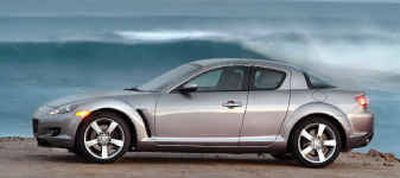
The most noteworthy feature of Mazda’s new RX-8 sports car is in the end its least critical feature.
To wit: Mazda has resurrected the rotary engine, last seen in the company’s landmark RX-7 sports car, which exited the scene in ‘95. The revolutionary design reduces an engine’s moving parts from hundreds to a handful (three, in the case of the RX-8) and produces prodigious amounts of horsepower from a small displacement engine.
Power delivery is also exceptionally smooth — with fewer moving parts, rotary engines produce less vibration — but rotary technology has been held back by the twin evils of poor fuel economy and high emissions. Mazda engineers have licked both problems, though, and figure the concept is ready for prime time.
After spending a week in the RX-8, it’s hard to disagree.
In a stroke that’s not exactly unique (think Saturn), Mazda has added two, rear-hinged half-doors that allow access to a rear seating area where even two adults will find relatively comfortable accommodations.
Add to four-person seating a generous (for a sports car) trunk, and the RX-8 begins to stack up as the practical choice among low-slung, head-turning sportsters.
Fortunately, practical doesn’t need to mean boring. While styling tends to be a make-it or break-it deal, Mazda bravely crawls out on a big limb with this one. Viewed head-on, the aspect is broad and flat — indeed, almost wing-like — with wide fenders flanking a hood that narrows toward the front, underlining the fenders’ bulk.
An arched greenhouse — it looks something like a Miata hardtop — sits atop the wedge-shaped profile, providing the interior with excellent headroom, even for rear-seat passengers.
Inside, Mazda designers have crafted a dramatic look dominated by a circular instrument panel; boldly designed, two-tone seats that are well-shaped and supportive, and a sculpted handbrake.
Yes, it’s small, with a corresponding shortage of storage space, but it is one of the more useful sports-car interiors on the market.
To broaden its appeal beyond the purist market, Mazda fit the RX-8 with a suspension that is capable but not punishing. In comparison to the tweaky, twitchy last-generation RX-7, a car that made certain you felt every bump and pothole, the RX-8 is settled and solid on the road.
The powertrain configuration is the enthusiast-preferred front-engine, rear-drive.
There are two editions of the RX-8 — one with an automatic transmission, the other with a six-speed manual.
Equipped with an automatic, the RX-8 is priced at $25,700, including destination; the stick-shift version weighs in at $27,200.
Each is powered by the same, 1.3-liter Wankel rotary engine, which produces 238 horsepower in the six-speed edition and 197 hp when paired with the automatic. Mazda says no automatic transmission can stand up to the demands of the high-revving rotary, with its 9,300-rpm redline, and so detuned the slush-box version.
All RX-8s are equipped with air conditioning; power windows, mirrors and door locks; remote keyless entry; cruise control; tilt steering with satellite audio controls; AM/FM/CD audio and tire-pressure monitor.
Safety gear includes anti-lock brakes with brake-force distribution, and front-, side- and curtain-style airbags.
Order the stick-shift version, with its more powerful engine, and a limited-slip differential, sport-tuned suspension and 18-inch tires come in the bargain.
Traction control and anti-skid systems are available options.
Underway, the RX-8 is surprisingly quiet, despite the large, low-profile tires our stick-shift test car wore. At low speeds, the driver will notice an occasional tug on the steering wheel when the tires catch a groove in the pavement.
The shifter falls easily to hand and with practice the driver will find the proper gate for the desired gear. I missed a few downshifts, but that’s a matter of feel that I expect would resolve itself over time.
Aside from the periodic pull of the wheel, the RX-8 behaves nicely around town. Peak torque doesn’t occur until fairly late in the power band but there’s enough power down low to get around in traffic. Push the tach up into the 7,000-rpm range and the RX-8 powerplant comes alive with a healthy snarl. Rotaries do not produce massive amounts of torque so power delivery is linear, rather than head-snapping.
In a head-to-head comparison with its most obvious competitor, Nissan’s 350Z, the RX-8 lacks the spot-on reflexes, responsiveness and ability to communicate with the driver via the seat-of-the-pants of the Z.
On the other hand, it’s more forgiving, both in terms of ride and handling. If taut and firm sound synonymous with punishment, the RX-8 is probably your kind of sports car. And there’s another benefit: With a reasonable amount of body roll at the limits, the RX-8 lets the driver know when it is approaching its limits. It may not be as quick as the purebred 350Z, or as likely to turn in the day’s fastest lap, but it’s also less likely to get an inexperienced driver into trouble.
There’s no such thing as the perfect car, but the best of the breed present a balancing act that blends comfort, performance, styling and ride-and-handling — to say nothing of affordability. A great engine is a single actor in a large cast and while rotary power is a nifty concept, it doesn’t begin to define the RX-8.