
X Prize win may herald new space age
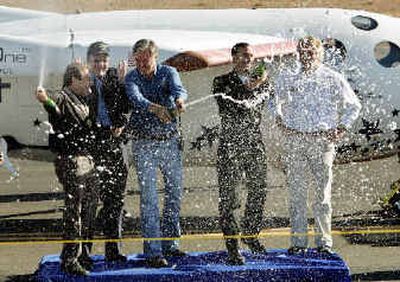
DALLAS – A new space age dawned Monday over Mojave, Calif., as a private rocket ship coasted to a world-record altitude and claimed a $10 million prize.
The winged SpaceShipOne, piloted by Brian Binnie, soared more than 367,000 feet high, easily making its second flight in a week into suborbital space.
In three years, anyone with a spare $200,000 might be able to buy a similar ride. Virgin Atlantic Airways founder Richard Branson has ordered five redesigned copies of SpaceShipOne, each to seat five passengers, for his new Virgin Galactic service to the edge of space.
Advocates toasted Monday’s flight, saying the frontier of space now is open to the public.
“Our vision is to do for space what Jacques Cousteau did for the oceans: Make it accessible to everybody,” said Peter Diamandis, founder of the Ansari X Prize, a competition to stimulate private space tourism.
The Mojave Aerospace Adventures group, led by SpaceShipOne designer Burt Rutan and financial backer Paul Allen, will receive a $10 million check from the X Prize Foundation on Nov. 6 in St. Louis. The group beat 25 other teams to be the first to fly three people into suborbital space twice in two weeks. (As did last week’s pilot, Binnie flew SpaceShipOne with ballast representing two passengers, which counted.)
The prize is modeled after the $25,000 aviation challenge that Charles Lindbergh won by flying the Spirit of St. Louis solo from New York to Paris in 1927.
Even with the X Prize won, commercial space flight has a long way to go. Its most formidable task may be proving its safety, a problem that dogged aviation in its early days.
“We must be safer doing space flights than the early airliners were doing passenger flights,” Mr. Rutan said after the winning flight.
SpaceShipOne is a prototype, and newer versions – SpaceShipTwo and beyond – will be tested over and over for reliability, he said.
People who might buy a ticket to space, marketers say, are the same people who dabble in adventure tourism now – climbing Mount Everest or driving fast race cars. In such cases, the participant enters into the activity knowing there is a certain level of risk involved.
But as in car racing, spaceflight must be as safe as possible for onlookers. The Federal Aviation Administration is in charge of licensing and ensuring the safety of space launches.
“We all recognize that there will be risk,” said Marion Blakey, head of the FAA. “We need to work closely together to achieve the kind of safety record that Burt has outlined.”
The FAA’s Office of Commercial Space Transportation has licensed more than 165 rocket launches in the past 20 years. Other than SpaceShipOne, the only license granted for a reusable launch vehicle has been to XCOR Aerospace, also of Mojave, which is developing a tourist space shuttle.
SpaceShipOne’s flight Monday showed none of the problems that plagued the first prize flight last Wednesday, when the ship rolled more than two dozen times on its ascent to space. Instead, Binnie enjoyed a relatively smooth ride.
Carried underneath another plane to an altitude of 46,000 feet, SpaceShipOne then dropped away and lit its rocket engines.
Near the top of the flight’s arc, Binnie took out a paper model of SpaceShipOne and watched it drift inside the cockpit in weightlessness.
“It is a thrill every human being should have once in their lifetime,” he said after the flight.
The spaceship’s target was the edge of space at 328,000 feet, or 62 miles, high. As a nod to that, its registration number was N328KF, for 328 kilofeet or 328,000 feet. Its peak altitude of 367,000 feet shattered a four-decade-old record, set by the X-15 rocket plane, for suborbital flight not from a ground-launched rocket.
Rutan deliberately scheduled the prize-winning flight for Oct. 4, the 47th anniversary of the launch of Sputnik, the world’s first satellite.
Much of the prize money came from the Ansari family of Plano, Texas, who made millions of dollars in technology startups.
Until now, NASA has had a virtual lock on U.S. astronauts. To hitch a ride on the International Space Station, for instance, businessman Dennis Tito had to go to the Russians and pay a rumored $20 million.