
Afghan kidnappers take U.N. staffers
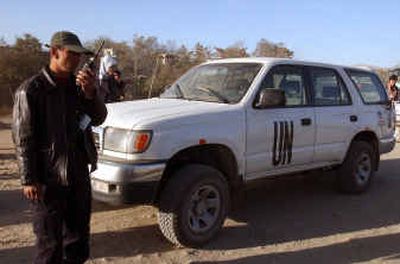

KABUL, Afghanistan – Men in military uniforms held up a U.N. vehicle in Kabul Thursday and abducted three election workers at gunpoint.
It was the first kidnapping of U.N. or aid workers since U.S. forces toppled the militant Islamic Taliban regime in 2001.
The attack cast a pall over the formal announcement of a complete vote count in the Oct. 9 presidential election. The U.S.-backed interim president, Hamid Karzai, won 55 percent of the votes, a solid victory over his rivals.
The peaceful, enthusiastic vote by more than 8 million Afghans has fed an air of optimism over the recovery of this war-shattered land, and led many international analysts to proclaim a heavy defeat for the Taliban and other extremists. But Thursday’s kidnappings, plus Saturday’s suicide grenade attack against foreign peacekeeping troops here, underscore that Afghanistan remains dangerous.
About midday, a dark-colored SUV with darkened windows veered in front of the U.N. vehicle, a white SUV emblazoned with the initials “UN,” and forced it to halt on a busy road. From three to five men with assault rifles leapt out and forced the U.N. staffers – an Irish-British woman, a woman from Kosovo and a Philippine diplomat – into the gunmen’s car, various witnesses told reporters. The SUV roared away, and Afghan and international police and troops soon began searching for it from helicopters and at roadblocks around the city.
A splinter group of the Taliban called Jaish-i-Muslimin (which can be translated as Soldiers of the Muslims) quickly claimed the attack. A spokesman for the mainstream of the Taliban, Abdullatif Hakimi, told reporters by phone that he was unaware his group had made any such attack.
But it remained uncertain who was behind the kidnappings. Jaish-i-Muslimin has asserted authorship of several attacks in Afghanistan in recent months, but has not given clear evidence for its claims. The Taliban have attacked most heavily in their political stronghold, the ethnic Pashtun homeland in Afghanistan’s south and east, and have been less active in Kabul.
And, Afghan and foreign analysts noted, political violence in Afghanistan is more complex than a simple contest between Karzai’s government and religious extremists. Karzai’s electoral victory, which has been evident for weeks, has raised tensions among ethnic Tajiks of the Northern Alliance. The alliance has held a big share of power in Karzai’s interim administration, but is likely to lose some of it in the post-election cabinet that he is expected to name in a few weeks.
In the three years that the United States and United Nations have led efforts to rebuild the Afghan state, unexplained violence has struck at times when Karzai has won some political victory that might let him reduce his dependence on provincial strongmen and warlords who have been part of his ungainly coalition. In 2002, three weeks after Karzai was appointed interim president by a grand national council, gunmen assassinated his key ally and vice president, Haji Abdul Qadir. The killing, like that earlier of Aviation Minister Abdul Rahman, remains unsolved.
In the complete vote count announced Thursday, Karzai won 55 percent of the total to only 16 percent for his closest rival, the Tajik politician Yunus Qanooni.