
Bridge
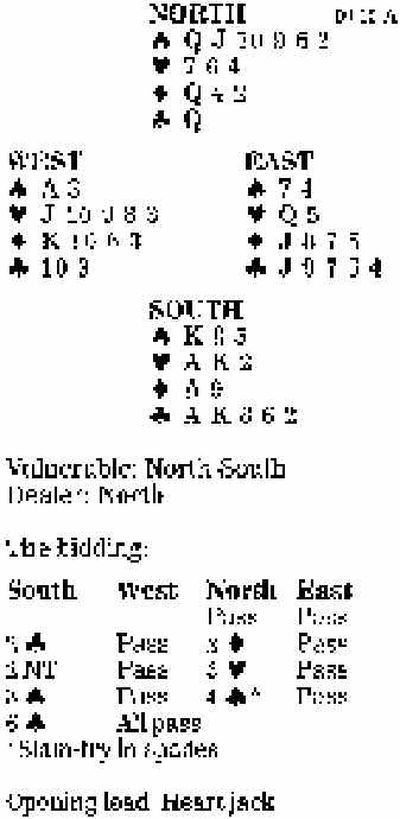
The German ladies, defending world champions, were struggling to qualify when they met France in the final qualifying match of the round-robin tournament in Tunisia in 1997.
In six spades, the German declarer won the heart-jack lead in hand, unblocked dummy’s club queen, and led the spade queen. West won her spade ace and pressed on with the heart nine. The heart layout should have become apparent when East followed with the heart queen. Slam needs nothing more than 4-3 clubs, but even on the 5-2 club split, South has excellent squeeze chances since the dummy’s heart has become a menace against West.
The correct line is to play off the spade king, then take the two top clubs, pitching diamonds from dummy, finding the bad news. Now ruff a club and run the trumps. In the two-card ending, East has to pitch diamonds to keep a club master, West must retain her top heart, and declarer takes the last two tricks with the diamond ace and nine.
Alas, declarer discarded dummy’s heart prematurely at trick six on a top club. Now she could play a simple squeeze against East, but could not exercise any pressure against West, since that player was discarding after her. When West turned up with the diamond king, the contract went one down – doubly painful since France had stopped in game in the other room. Partly as a result of this deal, France won the match comfortably and eliminated Germany.
Bid with the aces
South holds:
| •A 3 | |
| •J 10 9 8 3 | |
| •K 10 6 3 | |
| •10 3 |
| South | West | North | East |
| 1 NT | Pass | ||
| ? |
Answer: Bid two diamonds as a transfer to two hearts, planning to rebid two no-trump as an invitation to game with five hearts. Your good heart intermediates mean that you are worth a try for game, and this is the most descriptive move available to you. Transferring and then bidding diamonds would be a game force – an overbid.