
Look but don’t touch
If you spot Donald Trump in the flesh and cannot resist the urge to walk up and introduce yourself, he will smile and shake your hand. But he won’t be happy about it. He’ll be disgusted, if you want to know the truth, and there’s a good chance he’ll head straight to the men’s room and scrub both palms with soap and hot water. Nothing personal. He feels the same way about everybody’s hands. “People tell me, ‘Oh, Donald, Donald, you’re so elitist, you don’t want to shake people’s hands.’ But it’s not elitist,” Trump says in his Fifth Avenue office, a photo-stuffed shrine to all things Donald. “I wouldn’t mind a little bow,” he says. “In Japan, they bow. I love it. Only thing I love about Japan. “But read books! Read statistics! Shaking hands causes viruses and flus. Tremendous germs are on the hands. It’s not elitist. It’s just common sense.” A flamboyant dealmaker, tireless self-aggrandizer and longtime connoisseur of arm-candy babes, Trump has been wincing his way through unbidden handshakes for much of his adult life. But now, at 58, it’s getting ridiculous.
His starring role in the reality TV hit “The Apprentice,” which just began its second season on NBC, sent his Q-rating to a stratum where there is very little oxygen and even less privacy.
And it’s not just adults anymore – grown-ups who have followed his riches-to-rags-to-riches career as a real estate mogul, or bought his best-selling books, or applauded when he gave rambling speeches while testing out a run for the presidency in 2000.
Ten-year-olds spot him in public and spontaneously shout, “You’re fired!,” the catch-phrase closer from “The Apprentice.”
“After I agreed to do the show a friend said, ‘Why would you do this? Ninety-five percent of shows fail and they’re off the air,’ ” Trump recalls.
“And it’s funny because I was with Whoopi Goldberg at the ‘upfronts’ – that’s where the networks announce the new programs every year – Rob Lowe, all these guys, and they’re all gone. All these people. They’re all gone, and they were cut viciously and quickly. And here I sit, talking to you about the number one show.”
Trump’s desk is covered, like every other surface in this room, with Trump-related publicity. Framed on the wall are dozens of magazine covers bearing Trump’s face, and on a table is a stack of recent publications waiting for frames.
“This is just a small number of them,” he says, browsing through the pile.
Trump’s craving for fame and his need to be the object of mass envy are so all-consuming that they seem both pathological and charming. He never hides his parade float of an ego. Instead, he introduces you to it and urges you to marvel at its size.
He works on the top floor of a building named for him (Trump Tower), in a company named for him (the Trump Organization) where he oversees the merchandising of products bearing his name. His latest best seller is called “Trump: How to Get Rich,” and he’s readying the Trump Signature Collection, a line of business suits and golf wear.
Moments after you meet, he’s spilling leaflets and press clippings, crowing over the fabulosity of his career. Everything in Trumpworld is fabulous, or in first place, or better looking, or richer or taller, or it has bigger breasts.
“Right now I’m the biggest developer in the New York City, by far,” Trump says.
He also waves a copy of the DVD of the first season of “The Apprentice,” saying: “Can you believe this? Huge best seller.”
As it happens, this is a supremely awkward moment for Trump to reassume the role of corporate maestro on a reality TV show.
In August, his perpetually stricken, publicly traded Trump Hotels & Casino Resorts – just one of his many businesses – announced plans to enter Chapter 11 bankruptcy. To rescue the company, an arm of Credit Suisse First Boston recently announced it would pump in $400 million, reducing Trump’s own stake to about 25 percent and stripping him of majority control over operations. He also had to give up the rights to his likeness in the operation of the casinos.
It’s strong medicine, but as painful as that must be, Trump isn’t flinching, at least in public.
“Let me explain,” he says. “The business has been great. One aspect of the business is the casino business, and that’s a very small percent of my net worth, like much less than 2 percent and maybe less than 1 percent. But I want to fix it and the way to fix it is to reduce the debt, the way to reduce the debt is to do what I’m doing.”
Actually, it’s hard to know exactly what percent of Trump’s net worth is tied to the casino business because most of his portfolio is in privately held companies that don’t report earnings. He’s described himself as “a billionaire many times over,” but there are skeptics who believe Trump has $300 million, tops. And the guy has a reputation for, let’s say, shading the news in a light that reflects his enthusiasms.
Even his claim that “The Apprentice” is the No. 1 show is only sort of true. It finished seventh in the ratings overall last season, behind “Survivor” and “American Idol,” among others. It finished third with 18- to 49-year-olds, the demographic that NBC says it uses for advertising sales. It was, however, the top new show among viewers 18 to 49. In other words, it’s “No. 1” only with the right caveats.
The larger point is the way Trump is viewed as a businessman. As a private developer, he’s gifted and relentless at crafting deals, winning allies, fighting enemies, exploiting legal loopholes, charming, bullying and making sure the cement is delivered on time. He knows his market, the upscale buyer seeking conspicuous luxury that is heavy on pink marble and gilt. His properties have always commanded a premium because of the marquee value of his brand.
“You can’t take away his talent,” says one-time Trump critic and former New York Mayor Ed Koch. “Not just the ability to make himself the center of attention in any room, but in designing buildings that people want to live in.”
But stock and bond markets view Trump as a bit of a joke, which is what happens when shares in a company you run plunge by 99 percent. In other words, the people who know the least about business admire him the most, and those who know the most about business admire him the least – which irks the man who is forever complaining that his achievements as corporate rainmaker are overshadowed by his latest brand-name spinoff and his soap-opera love life.
This is a guy who nearly went bankrupt in the early ‘90s, when his real estate holdings were so over-leveraged he needed a bank bailout to stay afloat and was forced to sell some of his most treasured assets. Anyone else might have retreated. Trump buffaloed his way back into the game and turned the fiasco into a best-selling book, “The Art of the Comeback.”
There are plenty of developers in his league and beyond in New York and nobody knows their names. Trump alone is selling something bigger than any skyscraper, something you don’t need a decent income and good references to buy into: the fantasy of life as a very rich man, with the dames and the cars and planes and gold-plated everything. He’s what Americans think they could be if only they had the gumption to finagle their way into a fortune.
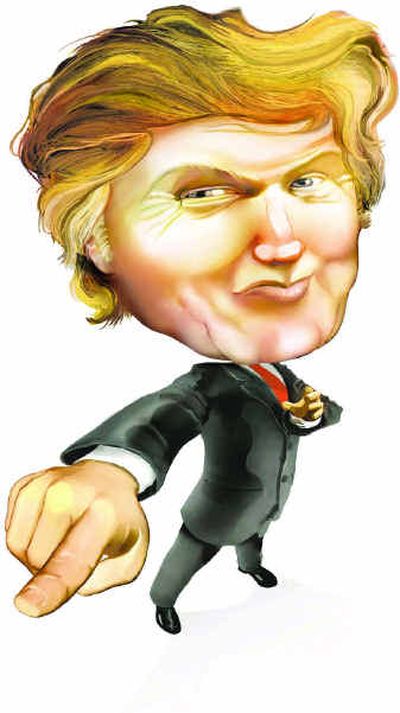
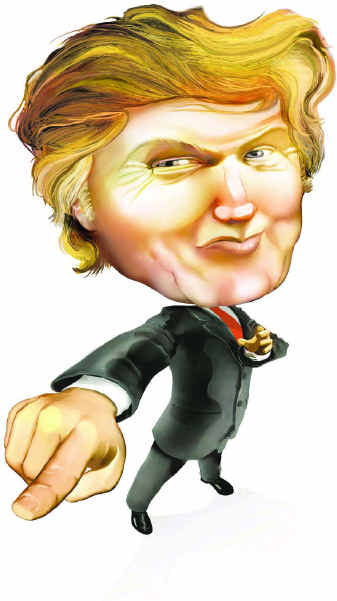
“He’s a caricature and that works for him,” says Eric Dezenhall, who runs a media crisis management firm in Washington. “If your goal is to get people in the American heartland to watch your TV show, having outrageous hair and pink ties and using superlatives is a legitimate pathway to that goal. If your object is to earn the respect of other moguls, that’s not the route.”
The beautiful part is that Trump the caricature and Trump the man are essentially the same person. This isn’t an act. He brings a genuinely unembarrassed joy to the role of high-rolling, model-squiring aristocrat and he doesn’t know the meaning of “overexposed.”
He can’t imagine, for instance, why anyone would turn down the opportunity to shill on TV for fast food.
“Somebody asked me a question recently,” Trump says. ” ‘Why do you do commercials, for Verizon or McDonald’s, or any of the big commercials you’ve done? … No other billionaire would do that.’
“I said, ‘No, they would do it but they’re not asked to do it because nobody cares about them.’ “
Amazingly for a such a high-profile guy, Trump doesn’t have a public-relations person. To get in touch, you call his secretary – not the buttoned-up vixen on “The Apprentice” but a woman named Norma – and leave a message. If Trump is interested, you’ll know soon.
Up close Trump has the sort of unwrinkled smoothness that looks expensive. He’s tall and broad, and his lips are pursed when he isn’t speaking. His hair, a wonder on TV, is a riddle in person. None of his elaborately swirled locks appears to actually touch his head. The whole thing somehow hovers, like one of those high-end turntables that float on magnets and aren’t attached to anything.
It’s apparently a look with appeal. Trump is getting ready for his third marriage, this time to a busty Slovenian model named Melania Knauss. A natural optimist, Trump likes his odds this time around, in part because Knauss sounds ready to be a homemaker and doesn’t issue the sort of demands made by his previous wives, Ivana Trump and Marla Maples.
“They were both good women but they had a hard time competing with my business,” he says. “Melania is very easy for me to be with. And I believe in marriage. It’s the best way to go, when you get it right.”
Trump’s office is more than a dozen stories above the fake boardroom seen on the television show. On this particular morning, the “boardroom” is a mess. Workers are cleaning up from the recent filming and readying for Season 3, which starts production next month.
It was recently the scene of a highly ritualized melee: 18 contestants, whose names will soon become fleetingly famous, winnowed down, one “You’re fired” at a time.
Trump says he came up with that devastatingly concise send-off during the first week of shooting last year. He said it, spontaneously, then heard crew members in the background screaming. He knew he’d hit on something.
“It’s both a horrible and beautiful phrase,” Trump says.
It’s not one he’s used very often.
“In real life if I were firing you, I’d tell you what a great job you did, how fantastic you are, and how you can do better someplace else,” he says.
“If somebody steals, that’s different, but generally speaking you want to let them down as lightly as possible. It’s not a very pleasant thing. I don’t like firing people.”