
Quake stirs up geologists

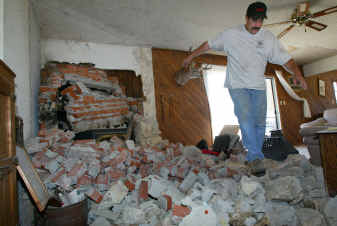
WALNUT CREEK, Calif. – Central California’s magnitude 6.0 earthquake Tuesday caused little damage, but created quite a stir among geologists.
Because the quake occurred on the most studied section of fault in the world, scientists could learn more from this earthquake than any other earthquake in history.
“It’s going to be a very, very important earthquake in the sense that it was recorded by so many instruments,” said Stanford geophysicist Mark Zoback.
Scientists are particularly interested in the moments leading up to Tuesday’s quake, and will be inspecting all the data collected for any telltale signs of what was to come.
“That would be really useful because down the line it could be used for prediction,” said Mark Blanpied of the USGS Earthquake Hazards Team, based in Reston, Va.
Tuesday’s quake hit the infamous San Andreas fault in a sparsely populated area seven miles south of Parkfield at 10:15 a.m., rupturing an estimated 20 to 30 miles of the fault. It was followed by a string of aftershocks, including a magnitude 5.0 jolt just four minutes later.
An hour after the earthquake, the U.S. Geological Survey warned of a 50 percent chance of a magnitude 5.0 or greater aftershock and as many as 70 magnitude 3.0 or greater shocks over the next seven days.
According to the geological survey, there is also a 5 to 10 percent chance another 6.0 or greater quake could hit the same area, or the fault section immediately to the south, in the next week.
The effects of Tuesday’s quake will be felt by geologists the world over who have been waiting for nearly two decades for an earthquake to hit this stretch of open rangeland.
Though Parkfield is a tiny town with no more than a few hundred residents, it looms large in the minds of geologists because of the regularity of earthquakes there. Between 1857 and 1966, a magnitude 6.0 earthquake has hit Parkfield, on average, every 22 years.
This record prompted the USGS to predict an earthquake would strike between 1988 and 1992. Geologists responded by littering the area with instruments to record the earthquake, hoping to get their first close-up look at a large earthquake in action, and discover clues that could help them predict future quakes.
“The Parkfield area is probably the most densely instrumented piece of ground in the world,” said Blanpied of the USGS.
Though 1992 came and went without a big quake, scientists figured it was just a matter of time and continued to deploy more and better equipment to Parkfield. They also started drilling a hole right through the San Andreas fault 2 1/2 miles below the surface for an even closer look at how the earth moves.
So Tuesday’s quake may have startled some cows, but not the geological community, which breathed a collective sigh of relief and said, “It’s about time.”
“We’ve been expecting this fellow,” said geologist Steve Walter of the USGS in Menlo Park.
Tuesday’s quake did bring some surprises, however. The last two Parkfield earthquakes, in 1934 and 1966, started in the north and ruptured southward, and were both preceded by a magnitude 5.0 quake 17 minutes earlier. But Tuesday’s quake had no foreshock and started in the south and headed north.
This northward movement could make another big quake to the south a little less likely than the 5 to 10 percent chance the USGS has estimated, though it still can’t be ruled out. The 1857 Parkfield quake was followed by a magnitude 7.9 monster just a few hours later, Zoback said, but it’s unlikely enough strain has built up since then for another one that big.