
Shippers hope fuel drops

Some of the nation’s largest transportation companies are still living in 1999.
That’s the last time diesel fuel sold for an average price of $1.10 a gallon or lower.
But that hasn’t stopped some trucking companies and even some members of the U.S. Congress from using that price as a baseline from which today’s ubiquitous fuel surcharges are calculated.
Others have moved a little further along the price continuum, basing their “temporary” surcharges on a base price of $1.50 a gallon, a price that was last seen in December 2003.
If people who make transportation their business are still clinging to the good old days, is it any wonder that many drivers are thinking gas prices will dip below $2 someday?
“There is ever the hope that fuel prices will go down again,” said Susan Rosenberg, a spokeswoman for UPS, which currently charges a 2 percent ground delivery fuel surcharge based on the difference between the price of diesel two months ago and $1.50 a gallon.
That might mean trouble two months from today, because the company’s chart tops out at $2.30 a gallon.
UPS has worked hard to improve efficiency and keep fuel costs down, said Rosenberg, but higher fuel prices mean surcharges.
Meanwhile, federal experts are projecting that average fuel prices won’t be falling significantly anytime soon.
Prices are up because demand is up, explained Neil Gamson, a U.S. Energy Information Administration economist.
“We still think demand will keep growing,” said Gamson, explaining that in addition to increasing U.S. fuel demand, China and other economically expanding countries are now importing oil instead of exporting it.
Gamson added that he doesn’t expect fuel prices to fall below $2 through the end of 2006.
Still, companies such as UPS remain hopeful that prices will drop.
“Our goal for our surcharge is for it to be temporary,” said Rosenberg.
The company has had a fuel surcharge since 2000.
Smaller companies have been forced to follow suit.
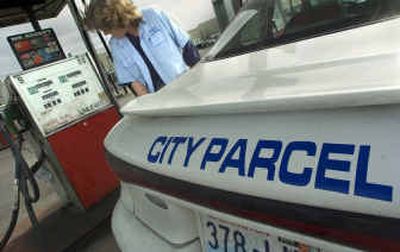
When then-record prices hit last April, local delivery company City Parcel charged a 4 percent fuel surcharge. It’s now at 8.5 percent.
City Parcel’s surcharge is based on the difference between the current gas price and a price of $1.45 a gallon.
Owner Teri Griffin said it’s not possible to just raise delivery rates to make up for the higher cost of gas. Because other delivery companies use the fuel surcharge approach, consumers would view City Parcel’s prices as being higher if they raised rates and dropped the surcharge.
“I can only hope (gas prices) stabilize or go down,” said Griffin.
UPS’ and City Parcel’s baselines are closer to reality than that recommended by America’s Independent Trucker’s Association (AITA).
An article on AITA’s Web site suggests truck drivers implement a $1.10 per gallon benchmark.
AITA representatives didn’t return calls for comment on the surcharge issue, but they aren’t the only ones using a $1.10 figure.
The U.S. House of Representatives included a mandatory fuel surcharge in its version of the transportation bill, but the Senate declined to follow suit.
If members of the House had had their way, trucking companies would have been required to add a fuel surcharge based on that $1.10, 1999 price.
Despite their apparent reliance on such surcharges, trucking companies opposed the House’s proposal as unnecessary regulation of their industry.
“We’re not in favor of that because it’s the feeling that government is not needed,” said Washington Trucking Associations Vice President Jim Tutton.
Tutton said that he hasn’t seen many trucking companies using a $1.10 baseline price – $1.50 is more common.
Still, fuel surcharges among the association’s members are averaging 12 percent to 15 percent on top of the basic shipping rate.
Motorists are also contending with rising fuel prices.
On Friday, the average price of a gallon of regular unleaded in Spokane was $2.48, up from $1.92 a year ago, according to AAA. In Coeur d’Alene AAA reported Friday the average price was $2.45 a gallon, 56 cents higher than one year before.
But unlike trucking and delivery companies, they have no one to pass the increased price along to.
Declining crude oil prices add to the frustration. If crude oil goes down, gas prices must follow, right? So goes the argument.
“They’d have to come down a lot more for gasoline prices to come back to $1.50,” said Gamson.
On the supply side, with the exception of Saudi Arabia, oil producing nations are pumping as fast as they can, Gamson said, adding that demand for refined oil products just continues to rise.
Some drivers are dealing with the situation through humor.
“I still remember when the question was, ‘Will it ever go below a dollar again?’ ” said Spokane motorist Michael Cressey when surveyed about where future prices might land. “Does that mean I am eligible for AARP?”
In another 10 years people like Cressey may be remembering when shipping companies’ rates included the price of fuel.