
Medical bike provides hope
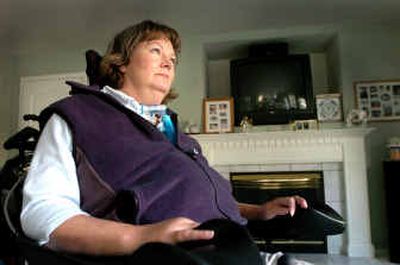
HAYDEN LAKE – A medical exercise bike may return to Sandra Dorosh what she most wants in life: use of her body.
Dorosh, 55, sits in a wheelchair in her Hayden Lake home now, but two years ago she celebrated March’s sun by swinging her golf clubs after working all day on her feet as a denturist. A swimming pool accident in July 2003 left her a quadriplegic, breathing with the help of a ventilator.
Doctors gave her little hope. She was told her spinal cord was severed. Dorosh was in the same condition as “Superman” star Christopher Reeve – unable to move her body but in great shape mentally. But the story recently changed.
“I knew there was hope because I was moving my shoulders,” Dorosh said Friday. “They’d said nothing would work from my neck down, but I could feel my stomach and diaphragm move.”
Reeve’s doctor and physical therapist confirmed for Dorosh last month that she could heal and recommended the use of a medical exercise bike to help. She met the pair through a friend of her brother, Doug Grace. The friend, Dale Nosworthy, was invited to a banquet for a retiring friend in St. Louis, Mo., in January. The banquet also was a benefit for spinal-cord injuries.
Nosworthy shared a table with Pat Rummerfield, one of Reeve’s physical therapists, and Dr. John McDonald, a neurologist who treated Reeve. Nosworthy shared Dorosh’s story with the two men and learned that Rummerfield was born and raised in Kellogg. A car crash in 1974 left Rummerfield a quadriplegic at age 21, but he taught himself to walk again. A type of exercise bike helped him rebuild his strength, he said.
Eventually, Rummerfield competed in an Ironman triathlon in Kona, Hawaii. He also competed in the Coeur d’Alene Triathlon in 1991.
Rummerfield and McDonald work together at Kennedy Krieger Institute, a branch of Johns Hopkins Medical Center in Baltimore. Rummerfield is the director of development at the institute’s International Spinal Cord Center.
Both men decided to visit Dorosh and evaluate her health. They arrived at her Hayden Lake home in February and found a smiling Dorosh in her wheelchair. She told them she broke her neck playing with kids in a pool in California. She was swimming slowly underwater like a shark, hit her head on the pool’s side and was knocked unconscious.
McDonald watched her as she talked for about 10 minutes, then took her off her ventilator and told her to breathe on her own, Grace said Friday. Dorosh’s diaphragm worked.
“He said my spinal cord was crushed, not severed, and it could heal,” Dorosh said. She breathes on her own now for several hours each day.
Rummerfield recommended the Ergys 2, a bike with electrodes that attach to a rider’s muscles and give bursts of energy, based on a computer program.
“It strengthens muscles, makes them healthier, improves bone density and eliminates skin breakdown,” Rummerfield said. “There’s a definite possibility she could walk again.”
The bike costs $16,000. Dorosh’s insurance agreed to cover the cost after it received a prescription for the equipment from McDonald. Therapeutic Alliance, the bike’s manufacturer, is building the bike now, but Dave Dorosh, Sandra’s husband, and Grace will need a week of training on the equipment in Baltimore before Dorosh can use it.
Rummerfield said Dorosh’s brother and husband will train her nursing staff how to use the bike, attach the electrodes and watch for problems and reactions. The training will take about a week. Grace estimates the trip will cost about $3,000.
Meanwhile, Dorosh’s friends, Dick Bohnet and Peggy Nelson, visit Dorosh five days a week and move her into a device that helps her stand. The machine helps stretch unused muscles and stop them from atrophying. Dorosh is ready to make those muscles work. Her bike should arrive within three weeks.
“I know the work on the bike will be hard,” she said. “I’m ready to walk again. And I’d love to go back to work.”