Filmmaker’s showcase: The best of David Fincher
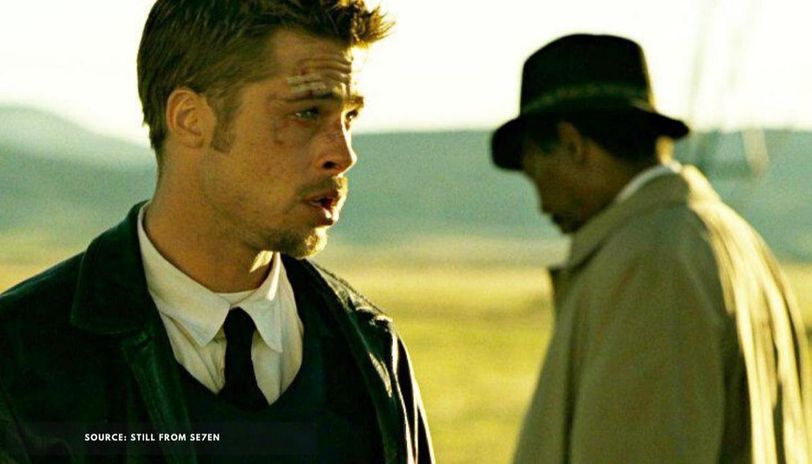
Above : Brad Pitt and Morgan Freeman star in David Fincher’s 1995 film “Se7en.” (Photo: New Line Cinema)
I seldom make line-in-the-sand pronouncement anymore. Age has taught me to be just a bit more judicious, if not humble, in sharing my opinions.
But I have no problem saying that David Finche r is one of the best filmmakers working today. He’s one of those directors whose work I look forward to seeing, no matter the subject matter or format.
The list of his achievements is impressive: feature films such as “Se7en,” “Zodiac,” “Fight Club,” “The Curious Case of Benjamin Button,” “The Social Network,” Gone Girl,” the American version of “The Girl With the Dragon Tattoo” and his latest effort, the biopic “Mank.”
And all of this came after (or at least while) learning his trade by making music videos for such groups as The Motels, Rick Springfield, Loverboy, Foreigner, Ry Cooder, Stevie Winwood, Roy Orbison, Madonna and Aerosmith ( “Janie’s Got a Gun” ) … just to name a few.
As if all that’s not enough, he’s been busy making television, too, producing such hit series as “House of Cards” and “Mindhunter.”
But it’s his feature films that most define him, at least to movie fans. And while the Netflix film “Mank” is his movie of the moment, and is something that my “Movies 101” partners and I will discuss on Friday, it’s not close to being my favorite of his works.
Following are my top five Fincher efforts, in reverse order (all are streaming on one service or another):
“Fight Club” (1999): Edward Norton and a pre-Oscar Brad Pitt star in this adaptation of Chuck Palahniuk’s best-selling novel. While it’s the story that most resonates with some, it seemingly being a glorification of an anarchical worldview, it’s Fincher’s imaginative ability to play around with narrative that I admire.
“The Girl With the Dragon Tattoo” (2011): It’s a tough task to make over a film that has already been one, actually quite well, by a foreign filmmaker – in this case Danish director Niels Arden Oplev’s adaptation of the late Swedish writer Stieg Larsson’s novel. But Fincher applied his usual professional touch to the project and ended up giving us a film that is at least as good (and even a bit more sophisticated) than the original.
“The Social Network” (2010): Aaron Sorkin’s work can be a bit much, at times. Example: His recent stage reimagining of “To Kill a Mockingbird,” which I saw in New York, missed at capturing the haunting coming-of-age sensibilities of Harper Lee’s novel. But in Fincher’s hands, the story of Facebook’s birth, although dialogue-heavy (Sorkin!) ends up being a dramatic triumph.
“Zodiac” (2007): True crime is all over the place, from feature films to paperback novels to the cheapest-produced television series (“Snapped” anyone?). But using actors such as Jake Gyllenhaal, Mark Ruffalo and Robert Downey Jr., and working from a screenplay adapted from Robert Graysmith ’s book, Fincher raises the form into a kind of whodunnit that emphasizes people instead of merely murder.
“Se7en” (1995): And, finally, my favorite. Based on an original screenplay by Andrew Kevin Walke r, which tells the story of a serial killer obsessed with the idea of the seven deadly sins, “Se7en” is a haunting study that never compromises. Morgan Freeman, a revelatory Kevin Spacey and Brad Pitt (again) form an unholy relationship triangle that ends with one of the most memorable scenes in movie history. And Fincher, overseeing the gloomy feel of the production’s set design, reportedly fought to keep the darker feel of the overall story intact – and as near perfect as I can imagine.
Below : David Fincher share his filmmaking tips.
* This story was originally published as a post from the blog "Movies & More." Read all stories from this blog