
A Latin American experiment in socialism could be nearing its end
SHINAHOTA, Bolivia – For nearly two decades, politics in Bolivia has been dominated by one man. Evo Morales, acolyte of Fidel Castro and Hugo Chávez, antagonist of the United States, was credited with lifting millions of people out of poverty. His “economic miracle” was held up as a socialist success story for the region.
But the movement he built now verges on collapse. The economy, now in the hands of a former protégé, is struggling through its worst crisis in decades: Inflation has reached double digits; the central bank nearly ran out of dollars. An energy shortage has left Bolivians spending hours waiting in line at gas stations.
The presidential election on Sunday could mean the end of a socialist era. Two right-leaning candidates are leading in the polls. And for the first time since Morales was elected president in 2005, neither he nor a stand-in will be on the ballot.
The 65-year-old has been blocked by the constitutional court and a referendum from running for a fourth term. He’s currently holed up in a tropical fortress in Bolivia’s coca-growing Chapare region – a flight and a five-hour drive from the presidential residence in La Paz – protected by a legion of supporters carrying sticks and shields, and evading an arrest warrant. The charges stem from an alleged relationship with a 15-year-old girl who reportedly became pregnant. He says the charges are baseless and notes that the alleged victim has not come forward publicly.
“If there is no victim, there is no crime,” he said.
But none of this has stopped him. From this redoubt, home also to a radio station, he has launched a new strategy: He’s calling on Bolivians to draw a big X on their ballots to protest the vote itself. He’s aiming to win enough null votes that he can declare the election illegitimate.
Having announced the campaign just days before the election, he has scrambled to open campaign offices across the country.
“We decided that if Evo isn’t on the list, voto nulo – there’s no other option,” he told the Washington Post journalists visiting his compound this week.
The stakes, he said, are high. If he’s shut out of politics, he said, the movement that brought growth and hope “will fall apart.”
“It’s not that Evo decided. I was obligated. I accepted, to save Bolivia for a second time.”
Morales, who marshaled the regional commodities boom of the 2000s to fund public works projects and programs for the poor, coasted to reelection in 2009 and 2014. A controversial run for another term in 2019 – he had secured a ruling from a friendly supreme court to override constitutional term limits – and allegations of vote tampering fueled violent protests. He resigned and fled the country.
From exile, Morales supported the 2020 campaign of Luis Arce, his former finance minister. Arce’s victory enabled his triumphant return.
But their friendship soon fell apart – a public divorce in which each has blamed the other for the country’s troubles. The Movement Toward Socialism, or MAS, their former powerhouse of a party, split into factions. Arce, struggling in the polls, chose not to run for reelection, and the political right is seizing the moment. Former president Jorge Fernando “Tuto” Quiroga and millionaire businessman Samuel Doria Medina appear to be the front-runners.
The end of Bolivia’s socialist experiment would be another win in a recent streak for Latin America’s resurgent right. After victories by Javier Milei in Argentina and Daniel Noboa in Ecuador, right-leaning challengers are trying to capitalize on frustration with leftist leaders in Chile and Colombia.
But in Morales territory, his most fervent supporters are mobilizing a response. Morales began his political career in Chapare as a trade union leader and farmer of coca, the leaf chewed or consumed in tea but also used to produce cocaine, and still enjoys deep support there. Many fear a conservative government would invite a U.S.-driven crackdown on the leaf.
Arce’s government, meanwhile, is preparing for tension, even violence, in Morales’s stronghold.
“There,” Arce told the Post this week, “anything can happen.”
Socialist dream until money runs out
When Morales took office in 2006, Bolivia was the poorest country in South America. Over the next 14 years, his socialist policies helped push an estimated 3 million people into the middle class. The percentage of Bolivians in extreme poverty was slashed from 33 in 2006 to 15 in 2018 – and continued to drop in the first years of the Arce government.
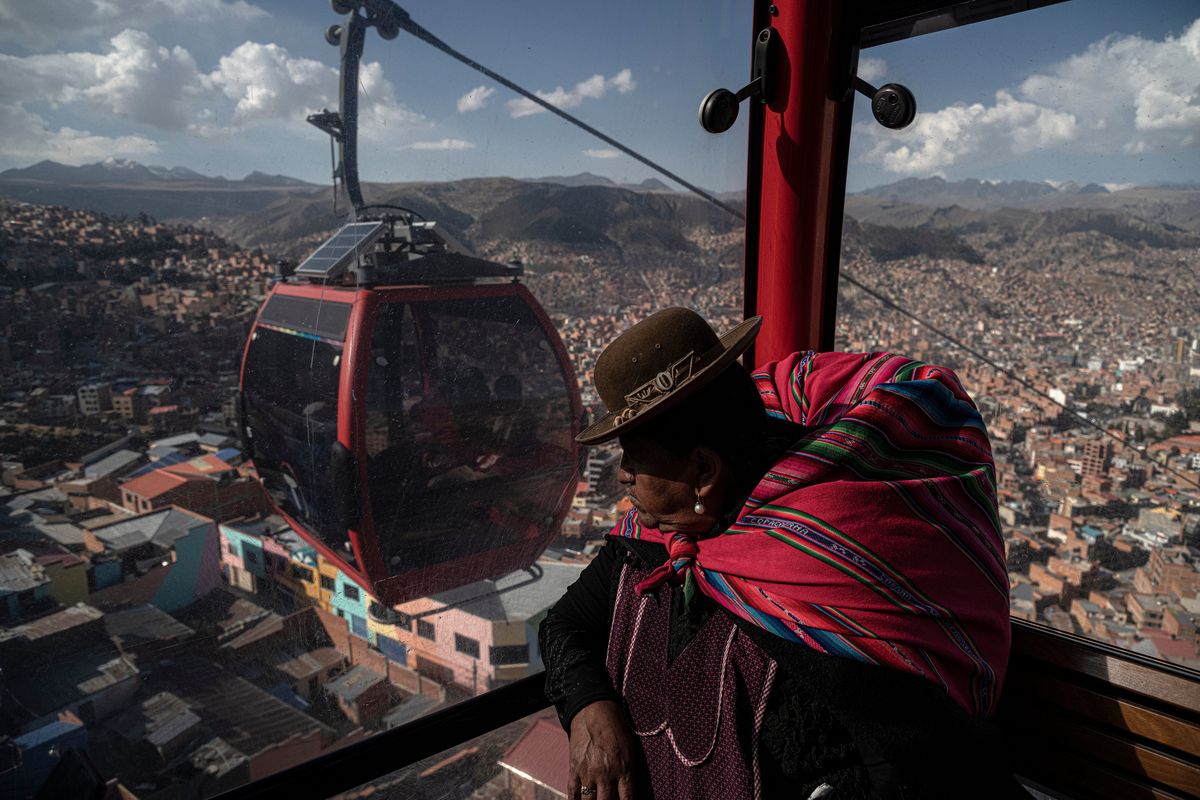
In La Paz, the Morales touch is impossible to miss: He built the world’s highest mass-transit system – aerial cable cars that float over the administrative capital, with a view of snowcapped Andes Mountains.
But Morales, like socialist comrades Chávez in Venezuela and Rafael Correa in Ecuador, depended on a global commodities boom to fund government spending. Thanks to the high price of natural gas, nationalized by Morales, foreign exchange earnings reached near $70 billion, according to economist Gary Antonio Rodríguez Álvarez.
“It was a fantasy of money for such a small economy,” said Raul Peñaranda, a political analyst. “Now, none of that is left.”
After 2013, prices dropped. Gas exports declined, imports rose. Nationalization chased foreign investors away, reducing production. Less than a decade after supplying 50% of its own diesel fuel, Arce said, by 2023 Bolivia produced only 12%. Soon, the central bank was running out of dollars. Inflation, which until 2023 was controlled at 2 %, was more than 16% in July.
The result, Rodríguez said, is the worst economic crisis in 40 years.
Arce and Morales accuse each other of failing to explore new gas reserves. Arce says his government has launched new exploration but Morales, through allied lawmakers, blocked the credits and loans it needed to import fuel in the meantime.
As they trade blame, Vladimir Apaza has slept in his car overnight waiting to fill his tank.
The 45-year-old minibus driver, whose earnings grew during Morales’s glory years, once believed in his movement. But not anymore, he said, reclining in the driver’s seat, parked on the side of a La Paz highway for another long wait. “Socialism is no longer the future,” he said.
Esther Ticona, 49, voted for Morales twice. A few years ago, she had saved enough money to open a corner store selling eyewear in a bustling district of El Alto. But she began to doubt that the Evo miracle was “100 percent real.”
This year, she said, has made that clear. The price she pays for a pair of glasses has doubled in a year. Customers aren’t buying, and she could no longer afford to pay her one employee.
Ticona is one of many who don’t know which candidate to vote for – or whether to vote for any candidate at all.
Protest vote
Along the main highway of Villa Tunari, a tourist town in Chapare, the pop of firecrackers called people to a small stage. “El Hermano Evo” – Brother Evo – was on his way.
A couple hundred people responded, some holding “Evo Pueblo” flags, chanting “Voto nulo!”
In a matter of days, coca growers and other Morales die-hards had cobbled together the last-ditch campaign. Community leaders had stayed up late the night before painting a banner. “Voto nulo” was scrawled in red on the buildings of suspected traitors – people who planned to vote for a former Morales ally, Andrónico Rodríguez.
In a crowded community meeting earlier that day, local coca-growing leaders spoke of the election and what might come after. One talked about making sure their opponents couldn’t campaign in their area. Another suggested going to voting centers to urge people to annul their vote. Morales, seated at the front, urged supporters not to let themselves be “provoked.”
But Morales knows that if need be, his supporters will run to his side. They have set up multiple checkpoints outside his fortress to question outsiders. Hundreds, living in tents, take shifts keeping guard. Since shots were fired at Morales’s vehicle last year, they have been on high alert.
Morales says 40 police officers have been following him. “With one call on the radio, people will be mobilized within five minutes.” One local leader put the number available at 10,000.
Morales says police are afraid to arrest him. “There would be deaths.”
Term limits, he argued, are not necessary for democracy. Asked whether that should also apply to El Salvador’s Nayib Bukele, the self-styled world’s coolest dictator who recently won a constitutional change to serve unlimited terms, Morales said it should – “as long as the people choose him.”
Arce said Morales’ time is up. He points to the 2016 referendum on whether Morales should be allowed to seek a fourth term. Voters said no.
“You have to know when you’ve lost,” Arce said. “It’s a personal ambition. It’s a greed for power.”