
Ceramicist Angel Luna draws inspiration from childhood with lineup of superhero farmworkers
Did you eat yesterday? Hopefully, the answer is yes. Data from the U.S. Department of Agriculture found that in 2011, the average American consumed nearly 1 ton of food throughout the year, or approximately 2,700 calories per day. According to Science Direct, family farms produce 80% of the world’s food.
“If you ate today, it was in part because someone else had their back bent over, often inhaling pesticides for 10 or 12 hours a day in the heat so that you can eat,” said Marshall Peterson, founder, owner and curator of Spokane’s Marmot Art Space. Peterson has utmost respect for farm workers and the role they play in “the land of immigrants, the United States of America.”
And that’s part of why Angel Luna is the featured artist at Marmot for the months of July and August.
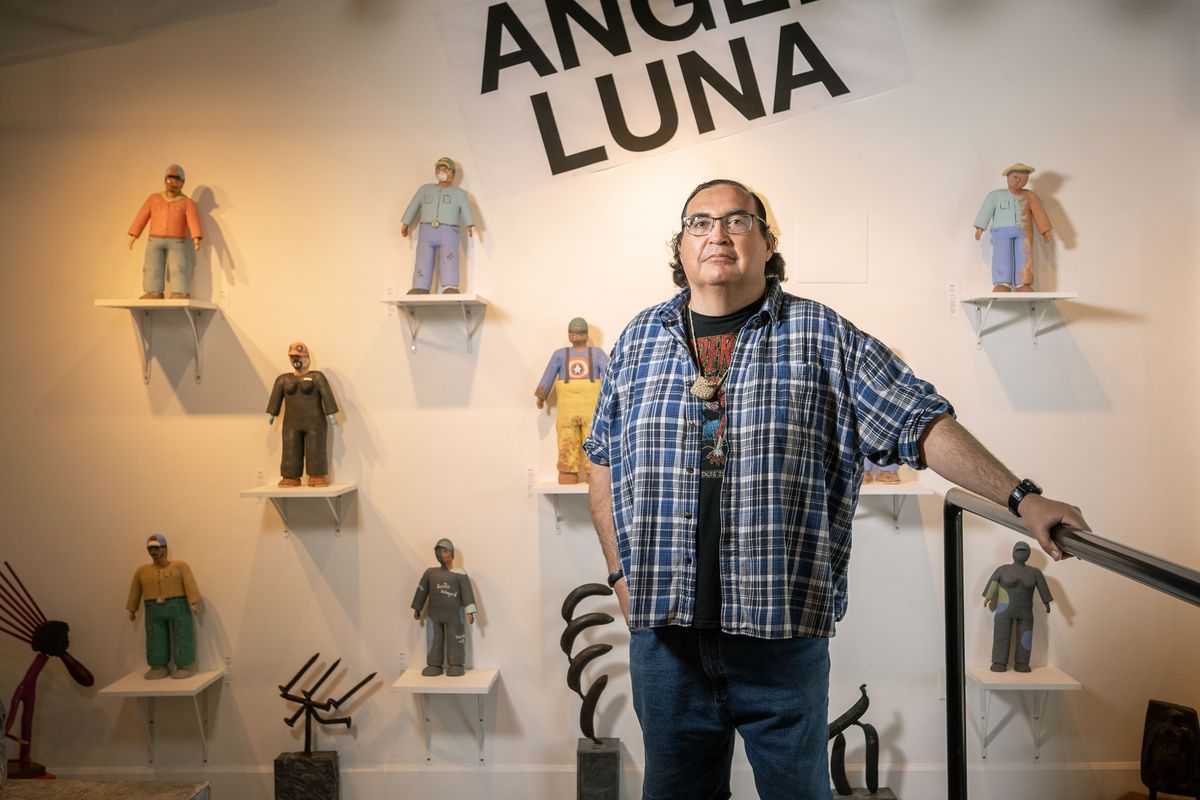
Luna’s portfolio consists of many clay brain sculptures, Dia De Los Muertos masks and an original series of sculptures that he hopes to share with “as many different people in as many different shows as possible.” The series, titled “Superheroes: Farmworkers,” features farm workers dressed according to their respective roles in the fields. Luna brought 91 pieces to Spokane, consisting of a variety of brains, masks and farmworkers.
Luna grew up in Prosser, Washington, and worked in the fields every summer from age 14 to 20. Collectively, Luna’s family has worked for Ken Lewis Farms in Prosser for more than 50 years. Even since his early days as an artist, Luna has drawn most of his inspiration from his early years, particularly his experience working on farms.
Luna moved around between different rental homes, which changed his perception of the concept of a home. For him, a sense of place refers to the people he grew up with, not the buildings he grew up in.
“A home is almost like not a permanent space in my head,” Luna said. “The house or the idea of sense of place is people, and for me, it was the people I grew up with.”
Luna has fond memories of celebrating Dia De Los Muertos, which was the inspiration behind his series of calaveras, or Day of the Dead masks. He says the reason he was drawn to ceramics as his primary art medium is that it reminds him of playing in the dirt while his mom picked grapes.
“Clay is my dominant material because it is my natural link to how I started in those fields,” Luna said. “Working with the earth, you know, the marks of the tractors on the earth … Clay, to me, is still that material that I’m inherently in touch with.”
Another reason for Luna’s appreciation for clay is the longevity of clay sculptures.
“I’ve stuck to clay because I feel like it’s a way to document stories,” Luna said. “So, any mark that you make with the material, you are leaving your mark in history. It’s one of the major things I teach my students. So, I make them try to realize how special the material is.”
Luna’s father was born in Mexico, and his mother was born in Illinois. Both families settled in Yakima Valley in the mid-1960s, with many family members remaining there today and some recently moving to Spokane.
Though he refrained from entering galleries in recent years and resorted to more online transactions, Luna said he agreed to return to Spokane to do the gallery because of the significant number of family members he has in Washington. Much of his family commuted to Spokane on First Friday to experience his work in a gallery setting.
Luna attended Whitworth University as a history major with aspirations to become a high school teacher. He met his wife there. In his final year at Whitworth, Luna had to register for a mandatory art credit and elected to take ceramics.
His ceramics professor, Jeff Harris, was a graduate of Eastern Washington University and introduced him to EWU’s professor emeritus, Ruben Trejo. Trejo, deemed by The Spokesman-Review as “one of the most important artists in the history of the Inland Northwest,” played a substantial influence as Luna’s mentor throughout his career.
Luna credits Trejo with teaching him to trust his gut.
“Ruben had a lot of impact on my career over the years,” Luna said. “With the work that I make, if you feel it’s right, it’s right.”
After his fourth year at Whitworth, Luna chose to change career paths and attend EWU to earn a bachelor of fine arts and study under Trejo. After graduating from EWU, Luna stayed in contact with Trejo and often turned to him for advice.
Luna recalls a 2004 phone call with Trejo where he changed his whole approach of selling art. Rather than limit himself to entering shows that featured exclusively clay, Trejo told Luna to broaden his horizons and enter national jury shows that feature many distinct types of mediums.
After this conversation, Luna stopped entering clay shows and began entering different fine art shows throughout the country. In fact, the gallery at Marmot Art Space will only be Luna’s second show since COVID-19.
“That all started with a conversation with Ruben,” Luna said. “It’s awesome, so I guess I would say he’s still influencing me.”
Trejo passed away in 2009 at the age of 72, though his legacy lives on. Luna says he tries to teach young artists as much of what Ruben taught him as possible.
Luna later attended the University of Idaho for graduate school, working toward a masters of fine arts. Shortly after graduating, he was invited to participate in a gallery at Washington State University titled “Sense of Place.” The gallery featured artists who had ties to the Northwest.
When brainstorming what he would show at the gallery, Luna came up with the farmworkers concept as a way to represent his early years and his family. Luna’s first farmworkers piece, in a series that is still growing 20 years later, was an homage to his father. The figures that Luna makes now are like the early ones, but now he dresses them as superheroes.
“The new series is based on the idea of the farmworkers as superheroes, you know, or the essential worker as a superhero,” Luna said.
Over time, the farmworkers have become influenced by his time as a professor in Arizona. The original farmworker was an apple picker, which was a reference to Yakima Valley, but after moving to Yuma, Arizona, Luna began making figures that referenced lettuce workers in southwestern Arizona.
During a 2007 workshop in Hope, Idaho, Luna brought his former professor, Glenn Grishkoff, to Trejo’s house to experience the love of his art. Grishkoff appreciated various pieces that they examined at Trejo’s house, but he never had the opportunity to dialogue with Trejo or do a trade with him. Peterson, who has been selling Trejo’s work for a decade, posted a new Trejo piece to his website. Luna saw the piece and instantly reached out to Grishkoff to tell him he found a piece he would want.
Peterson shares Luna’s admiration for Trejo’s work, so after Grishkoff purchased the piece, Peterson drove to Southern California to deliver it. He asked Grishkoff what his connection to Trejo was, and Grishkoff directed him to Luna. Shortly thereafter, Peterson contacted Luna, and the pair bonded over their shared ties to EWU.
Luna says he feels humbled to be selected as Marmot’s artist of the month, sharing a gallery space with “heavy hitters” such as Trejo, Gordon Wilson and Patti Warashina.
For the past five years, Luna has taught as the resident faculty member of ceramics at Mesa Community College in Mesa, Arizona.
As a teacher, Luna says his job is to help students translate their ideas into sculptures.
“One of the things I think is beautiful about sculpture-making is if you have the idea, you don’t have to limit yourself to how that idea carries over,” Luna said.