
A year after buying church from Messiah Lutheran, hundreds fill pews of St. Mary’s Ethiopian Orthodox Church for holiday and feast
Under the unblinking gaze of three owl-eyed icons in a mural painted at the head of the church, two rows of white-clad parishioners faced each other while singing and ringing sets of brass chimes to the booms of a traditional Ethiopian kabrero drum.
To one side of the dance is an ornate, brightly painted partition with intricate scenes depicting Bible stories custom painted by a deacon in Ethiopia.
To the other are hundreds of worshipers, singing along in the Ethiopian language Amharic, swaying and trilling in praise in Ethiopian ululation. The pews are fuller than they’ve been in decades.
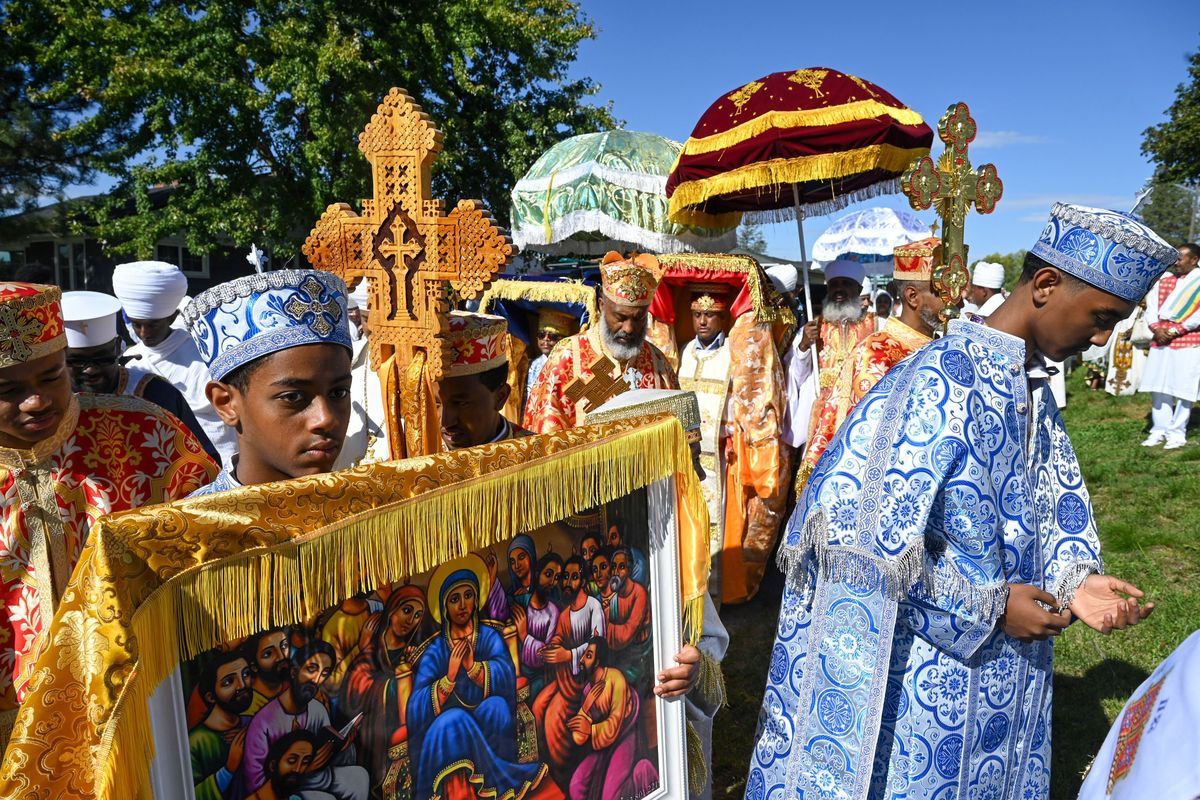
The choreographed performance is about nine hours into a half-daylong service at St. Mary’s Ethiopian Orthodox Tewahedo Church in north Spokane in an extensive celebration in honor of the holiday associated with the church’s namesake, St. Mary, that spurs the once-yearly procession with the holy Ark of the Covenant replica.
Even more reason to celebrate, it just so happens to be about a year ago that the Ethiopian congregation purchased the church from Messiah Evangelical Lutheran Church, from which St. Mary parishioners used to rent the small basement for Sunday service.
“We have been like wanderers finding a place where we can peacefully worship,” said Dagnachew Uma, who sits on the church council. “And we have gotten more than we expected because we now have a big, beautiful church.”
The holiday drew hundreds in the religion from as far as Seattle and Portland, including a regional bishop who formally consecrated the building. It’s traditional to celebrate holidays at a nearby church named for the festival, like the St. Mary celebration at St. Mary’s.
With visitors occupying the pews, plus the regular congregation of 70 or so people, it’s a far cry from the few who would regularly attend service at Messiah.
Wednesday was the holiday in honor of St. Mary to mark the day Ethiopia received a piece of the original cross on which Jesus was crucified, worshipers believe. It’s celebrated on Saturday when churchgoers are off work. The service officially started at 1 a.m. Saturday, when the clergy arrives at the church to begin prayer. Congregants arrived around 5 a.m., where they spent hours in service until 1 p.m., when the bishop carried a shrouded Ark of the Covenant replica out of the church for its annual procession on nearby streets, flanked by churchgoers carrying depictions of religious icons and singing in the bright midday sun.
The Ark of the Covenant is a sacred symbol to Ethiopian Orthodox Christians, who believe the original artifact is protected in a church in Ethiopia.
“In history, in short, it is very significant in our Christianity,” said Hailemariam Fetene, a pastor at St. Mary’s who has studied theology.
Each Orthodox church has a replica of the Ark, which only clergy members can view.
“The Ark is a mysterious thing, it is always covered,” said Father Michael Hatcher, priest at St. Gregorios Malankara Orthodox Syrian Church in Spokane, who has been involved with the church since their humble beginnings of around five parishioners.
According to Orthodox faith hearkening to the Old Testament, the original stone tablets in which Moses inscribed the Ten Commandments were stored in the Ark. It’s a point of pride that such a venerated artifact is located in Ethiopia, as worshipers believe.
“Surprising things,” Fertene said. “God, by His hand, wrote those commandments and that thing is here in Ethiopia.”
After hours of prayer, singing, listening to sermons and finally a march around the church building, parishioners filtered into the downstairs half of the church to dine on vats of labor-intensive Ethiopian food, a traditional feast associated with festivals like the St. Mary holiday.
Churchgoers begin to prepare the feast days in advance, ready with hundreds of servings after hours of worship. Women serve up plates of injera, a spongy, pancake-like bread that absorbs the flavors of the aromatic curried meats. Ethiopians use injera like edible silverware, tearing off pieces to scoop up other foods.
Included on the menu are steak-sized chunks of raw beef, butchered fresh that morning. It’s tender and flavorful when dipped in accompanying sauce and spices, both fiery and aromatic with a habit of staining diners’ fingertips orange.
Churchgoers packed into the downstairs rooms they used to occupy for worship, relieved at their new space in the full church to host such prolonged, extravagant holiday events.
“Now, we don’t have anybody to be afraid, anybody that we would worry to be upset,” Uma said. “We’ve been given the opportunity to worship God in the fullness of our tradition and our culture. It means a lot, especially what we’ve been doing for years, our worship being at the mercy of somebody.”
Part of their work to make the space their own is integrating traditional, colorful orthodox art along the walls of the church, most notably at the front of what used to be the pulpit, now an altar.
What was once occupied by an original piece by Harold Balaz is another huge piece of custom art, painted by parishioner Vanessa Bartlett. At the head of the church hangs a 15-by-12-foot mural depicting three icons with precise, intentional color symbolism that is a hallmark of Orthodox iconography.
“It’s basically like a Bible story in a visual reference, so they can tell you the story and even the allegories and the deeper meanings just by the picture itself,” Bartlett said. “That’s the whole point of an icon.”
According to the specific eye of the priest, Bartlett painted figures of Jesus on the cross, surrounded by icons Mary and John. Jesus wears a red loincloth, the color representing his blood. He’s also often depicted in white, representing his innocence, Bartlett said. Celibate, John wears yellow, a color associated with monks in Ethiopia. Mary wears a robe with her signature star.
“Those are all symbols, meaning something that goes into her deeper role and symbolism within the church as well,” Bartlett said.
While the busy holiday brought many additional worshipers to pack the pews, the typical attendance is around 70, parishioners estimated, many of them young children who enjoy notable agency from their parents during service, permitted to quietly play along the pews and not shushed if they cry during worship.
“Having a place where they can learn the word of God and grow in the faith and then take over it is huge,” Uma said.
“We’re so privileged and so happy that we are given this opportunity.”