
At 85, she leads a squad of women who dive deep in ponds for litter
By Maggie Penman
washington post
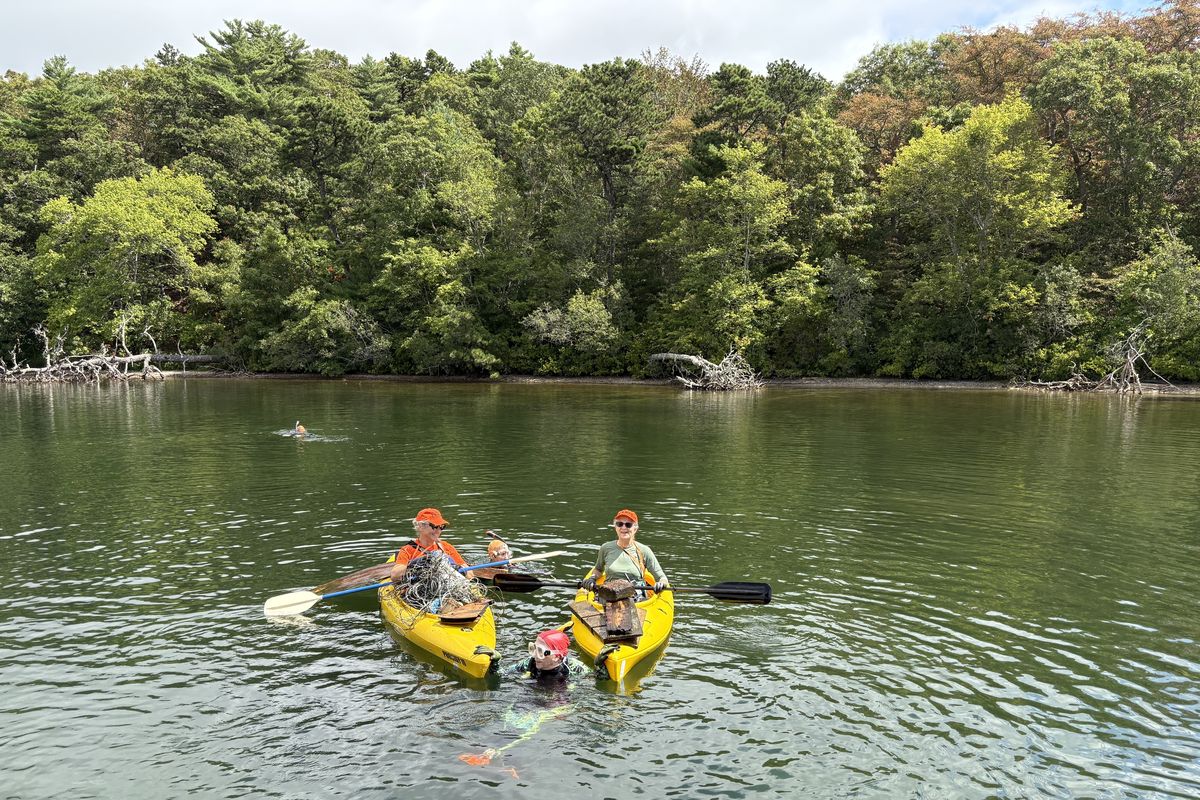
On an overcast chilly morning in late August, a group of women gather in a sandy parking lot, nearly all of them sporting a bright orange hat with the letters OLAUG – Old Ladies Against Underwater Garbage.
Founder Susan Baur gets the group’s attention to go over the plan: Two groups of swimmers with masks and snorkels will be dropped off by a pontoon boat in different sections of Johns Pond in Mashpee, Massachusetts.
Each group, accompanied by a kayaker, will swim in zigzags toward each other, diving as deep as 12 feet to pull trash from the pond’s muddy depths.
All of the divers – women between 65 and 85 years old – have an enthusiasm for litter.
The dives are exhilarating, and the trash tells a story.
“You literally never know whether you’re going to be excited, humbled, saddened. It’s all there, the whole emotional range you go through on a dive,” Baur said.
This area has been cleaned up before, but they know there’s more trash, in particular from a nearby construction site, that is getting dumped in the pond, Baur said.
“That’s what we’re really after,” she said, rubbing her hands together in anticipation.
Baur is a retired psychologist. At 85 years old, she is tiny but strong, moving quickly and fluidly as she checks equipment and greets swimmers. She says this project started on a whim in 2018, inspired by her daily swims in freshwater ponds and lakes near her home on Cape Cod.
“It was three or four or five friends that would get together and clean up a pond and laugh,” she said.
They were astounded at how much trash was in local waterways and ponds, and thought they could use more hands.
In 2023, OLAUG held tryouts for the first time, making sure volunteers could swim half a mile in under 30 minutes and finish the mile comfortably. They also had to be able to dive repeatedly down 8-10 feet. Overnight, the group expanded to 21 women. The youngest was 64.
Last year, Baur held another tryout, and the group grew again. Now there are 30 members, which Baur said is as many as she can handle for the moment, along with keeping tabs on an ever-growing waiting list. This year, there were around 20 formal dives beginning in May.
The dives are organized with walkie-talkies and safety protocols, and coordinated with local homeowners, who often express appreciation with baked goods. Each dive is run by an assigned “beach boss” who handles logistics and checks swimmers in and out of the water. Each diver has an area of expertise. If it’s deep, call Marci. If it’s disgusting, call Susan.
“What has fascinated me, which I did not predict and did not plan was – what’s actually going on,” Baur said. “Why does diving for trash in a pond make people so happy?”
Being a retired psychologist, she has some theories.
Finding flow in the water
Many of the women involved in OLAUG are motivated by environmentalism: wanting to clean up ponds and lakes for the fish and turtles that populate them. Some are motivated by the camaraderie or the exercise. For others, it’s the joy of imagining the provenance of the objects pulled out of the mud.
“Where did this garbage come from?” asked kayaker Diane Hammer, 70. “And how did it get in the pond in the first place?”
She got involved with OLAUG after moving from Boston to Falmouth in 2020. She looked out her window and saw people in wet suits digging in her pond. Hammer had been watching a lot of true crime during the pandemic, and her first thought was that the divers were FBI agents looking for dead bodies. She soon learned it was Baur and a friend looking for trash.
“There’s nothing better than doing something good with good people,” Hammer said. “It’s a reminder when things feel too overwhelming – it’s not overwhelming if you do it together.”
Kayaking for OLAUG has made her feel empowered in other areas of her life too: “When I’m kayaking, I’m carrying very heavy, awkward objects. I didn’t know I could do this. I’m using muscles I didn’t know I had,” she said.
This particular Monday morning, divers find a makeshift anchor and a rusted rudder, as well as two shoes – one a woman’s strappy sandal. On another day they found a blue toilet. On another, the back end of a Corvette. They’ve found old beer bottles that seem to have been dumped after an ice fishing expedition a century ago, lots of golf balls and so many baby doll heads. Once they found a dog leash and collar.
The main reason Baur thinks the women keep coming back to OLAUG is because in the water, they reach a state of flow – the concept in psychology that some researchers believe holds a critical key to happiness.
“The cool thing about flow is there’s no one thing you have to do to achieve it,” said Richard Huskey, an associate professor in the communication department at the University of California at Davis who has written about flow. He says the easiest way to understand it is as “being in the zone”: being so fully engaged in a task that you are entirely present, totally unselfconscious, not thinking about anything else.
“There’s nothing like cold water, icky garbage and a little bit of danger to get you out of your head,” Baur said.
Marci Johnson agrees. She’s one of the swimmers who joined the group in 2023. Johnson grew up on Cape Cod and moved back with her husband when she retired, but then he died. She was diagnosed with breast cancer. She was feeling isolated and struggling – and then she saw OLAUG was having tryouts.
“I never was good in gym, I wasn’t on a sports team in school, but I do love swimming,” she said. “You get into a rhythm when you’re swimming long distances, and your mind just goes somewhere else. You work through those problems you’ve been trying to figure out, sitting there thinking about it. But when you’re swimming the answer comes to you. It’s a happy place.”
She compared diving with OLAUG to being on a treasure hunt as a child.
“You’re looking, you’re looking, and you always find the treasure unfortunately. Because trash is everywhere,” Johnson said.
- – -
‘A very trashy day’
When the dive at Johns Pond is done, swimmers and kayakers set their items on an orange tarp and admire the assortment.
Some of the trash will go to the dump, while other bits and pieces will be salvaged for souvenirs. The women admire a tiny watering can, and Johnson decides to take it home. They keep some seemingly historic objects for future art exhibitions (They’ve already done one show at the local arts center, highlighting “Trash as Art.”)
“This is what we call a very trashy day,” Hammer said as she shows off her haul. “We love it.”