
Homes are crumbling across the U.S.; owners don’t have cash to fix them
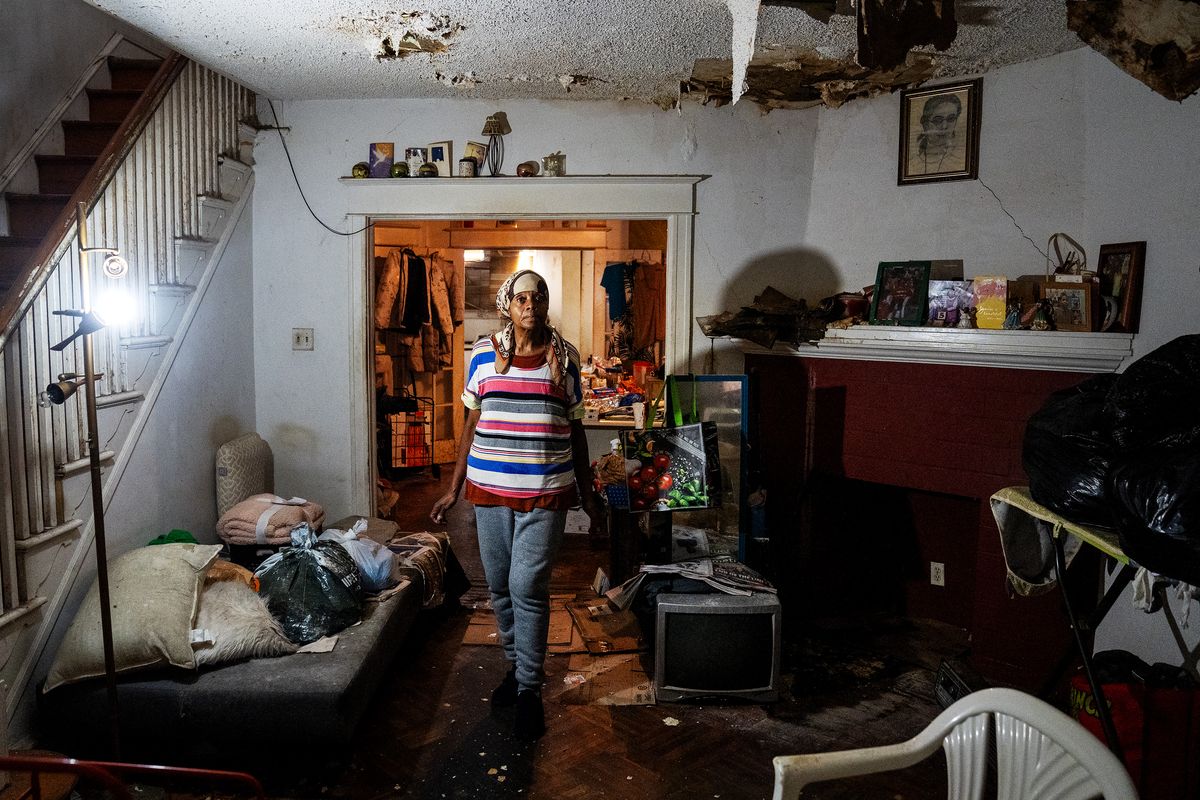
PHILADELPHIA - Even as her pre-World War II-era house falls apart around her, Bernadette Reese-Hobson tries not to feel “like a failure of a homeowner.” Her home is still her refuge, giving her space to sip tea while staring at family photographs that line the walls.
But there is a trash-can-size hole in her living room ceiling, caused by water that continually drips on piles of dank plaster and crumbled wooden beams on the floor. A gaping hole in her basement water heater spills even more water onto her belongings. And when Reese-Hobson steps into her shower, she fears she could fall through the wobbly floor because the pipes underneath her are corroded.
“I’ve tried to keep up the home and pay bills, and I just couldn’t keep up,” said Reese-Hobson, 63, a retired social worker and day care attendant who now lives off a $1,400-a-month Social Security payment. “It became one thing after another, and it’s been like a domino effect in this house.”
Across the nation, and especially here in Philadelphia, homeowners are increasingly struggling to maintain and repair aging homes that are withering, crumbling, and forcing homeowners to exist in near-unlivable conditions.
According to the National Association of Home Builders, the average age of the U.S. home is 40 years old, up from 31 years old 15 years ago. Homes tend to be the oldest in the Northeast, Mid-Atlantic states and along the Appalachian Mountains. Repair costs are rising, and homeowners face $100 billion in needed maintenance, according to the Federal Reserve Bank of Philadelphia.
Analysts say the problems associated with deferred maintenance and dilapidated properties span both rural and urban properties, resulting in structure collapses of occupied properties in Pittsburgh; Reading, Pennsylvania; Syracuse, New York; and elsewhere.
Philadelphia, one of the nation’s oldest cities, has emerged as an epicenter for the problem and the debate about whether government can or should step in. City records show 40 percent of houses in the city were built before 1939 with nearly two-thirds built before 1954.
Philadelphia also has a homeownership rate that far outranks most other major East Coast cities - about 53 percent, according to Pew Charitable Trusts. But Philadelphia ranks as the “poorest big city” in the nation with about one in five residents living in poverty.
“It’s the perfect chaos for a storm for upkeep” of properties, said Angela D. Brooks, Philadelphia’s chief housing and urban development officer. “You have people who have the benefit of being able to afford a house, or maybe they inherited it, but they don’t quite have the money to do even basic systems repair.”
For years, the hole got bigger
Reese-Hobson, who lives in Philadelphia’s Mount Airy neighborhood, purchased her three-bedroom rowhouse in 2001 for $75,000.
A single mother who never recalls earning more than $1,600 a week, Reese-Hobson said the property was her life goal as it provided a stable upbringing for her three children.
City records show the house was built between 1934 and 1942. The house includes a quaint living room with a fireplace, a dining room, hearty wooden stairs, and a second-floor bathroom with a stand-alone tub and a separate shower.
“I got the home on my own,” Reese-Hobson said. “I would say for at least 10 or 15 years, it was a beautiful house.”
But about five years ago, a bathroom pipe burst, and she was unable to pay for repairs.
Reese-Hobson watched for years as the water dripped into her living room and the hole in the ceiling continued to expand. Other elements of her plumbing system also failed. The faucet in her bathtub now runs continually, and the water has seeped throughout the foundation of the house, causing the ceiling above her living room to also sag.
Meanwhile, another water leak in the kitchen has caused the floor to buckle and become covered in rust and mildew. The problems in the kitchen also degraded the stove, causing the local gas company to cut off service to her home, Reese-Hobson said.
Reese-Hobson said coming up with money to fix the problem became impossible, especially after she retired last year due to chronic weakness. Reese-Hobson’s autistic 37-year-old son lives in the house and receives about $1,300 a month in Social Security due to his disability. About half of their combined income pays the $1,000 a month mortgage and utility bills.
Reese-Hobson said she has thought about selling the house, even for less than she paid for it, but worries she wouldn’t be able to find a rental unit as cheap as her mortgage.
For now, Reese-Hobson said she just tries to enjoy her house as much as she can.
“It makes me feel like it’s all my fault that the home is in such bad, bad shape,” she said. “I don’t think my self-esteem as a homeowner can go any lower.”
‘Conditions that other people would be appalled at’
Philadelphia leaders and social service agencies say growing numbers of families now live in properties that are teetering on becoming uninhabitable.
Emily Schapira, president of the Philadelphia Energy Authority, said problems include plaster and bricks falling off facades, collapsed chimneys, porches that have caved in, mold, unstable flooring, nonfunctioning kitchens and bathrooms, and even trees that are growing through the backs of houses.
“People have adjusted to living in conditions that other people would be appalled at,” Schapira said. “Anyone can get into this situation, and we have seen that can be true across every neighborhood, and income spectrum, because deferred maintenance is tough.”
Schapira said Philadelphia has at least 60,000 houses that are “in a pretty difficult situation” and need immediate repairs. Nationwide, about 6.7 million households are living in “inadequate” properties, according to the U.S. Census Bureau.
“Just on my block, if you saw 90 percent of the roofs, you would look and say, ‘all of those roofs need to be replaced,” said Bill McKinney, executive director of the New Kensington Community Development Corporation, which is located in central Philadelphia. “There is a house at the back of my house where I can look and see their kitchen through the brick work … I can see through the holes.”
In March, an 81-year-old woman was killed when the floor inside her house collapsed in an upper middle-class neighborhood in Northwest Philadelphia, according to the city fire department. Patricia Terry died of “blunt impact injuries,” according to the medical examiner’s office.
A few months before the collapse, neighbor James Williams had called the city’s 311 service to report the property was in distress.
“I just saw the roof was in such disrepair it was separating from the foundation,” he said.
City records estimate Terry’s house was constructed around 1960. Michael Slade, another neighbor whose house was built about the same time, said the cost to maintain houses in the neighborhood has been soaring. He recently had to pay $19,000 to replace his heating system.
“It would be hard to thrive in any of these homes making under $100,000 a year, and that’s minimal,” said Slade, 44, who assesses at-risk children and inherited his house from his grandparents.
Life saving and live changing repairs
David Thomas, president of the Philadelphia Housing Development Corporation, said he hears from homeowners - or their neighbors - “every day” expressing concerns that a property could collapse.
When that occurs, Thomas said, he connects people with the Philadelphia Basic System Repair Program, which awards low-income homeowners grants of up to $40,000 to fix structural, roofing, electrical and major plumbing problems. The city-funded program, which costs about $50 million annually, has a 5,000-person waiting list.
In recent months, Philadelphia Mayor Cherelle Parker (D) has pushed through a plan to borrow $800 million to build and preserve 30,000 affordable-housing units over the next four years. A significant portion of the money would be allocated toward helping homeowners remain in existing properties.
“We believe the most affordable home is the home that you currently live in,” Thomas said.
Another city program, Built to Last, also works with low- and moderate-income households to do comprehensive repairs on distressed properties.
In 2022, Pennsylvania allocated $125 million from the Biden administration’s American Rescue Plan to pay for major home repairs throughout the state. About $8 million of that money went to Built to Last.
But Schapira, who administers the program, said it has a 4,000-person waiting list and is out of money. Gov. Josh Shapiro (D) is seeking $50 million for a statewide program that would benefit local initiatives such as Built to Last.
“We want to avoid, at all costs, people abandoning their homes,” said state Sen. Nikil Saval (D), who represents Philadelphia. “You see this in cities, but frankly it’s just as prominent in sections of Northwest or Western Pennsylvania, former coal- and steel-producing regions that have lost serious amounts of money and have many older homes.”
According to the Joint Center for Housing Studies at Harvard University, the country’s poorest homeowners spent an average $3,100 on home improvements and repairs in 2023, about 16 percent of their household incomes. The highest-income earners spent more than three times that amount, but it equaled just 4 percent of their incomes.
Lisa Martinez, 64, reached out to Built to Last after discovering cracks on an exterior wall of her Northeast Philadelphia house and windows that were dry-rotted in her basement. The program inspected the home and paid for new windows, electrical wiring and air ducts.
“I had been depressed and scared, not knowing what to do, where to go, and how to get help,” said Martinez, who earns $2,100 a month in Social Security benefits.. “Now this is life saving and life changing because I am finally feeling secure in my own home.”
Evelyn Texeira, 68, who uses a wheelchair after she lost both of her legs due to diabetes, got $70,000 in repairs to her leaky bathroom and unstable kitchen floor from the program.
“The house would have fallen down,” Texeira said. “The bathroom was leaking, and everything was leaking, and I just know everything would have collapsed if it wasn’t fixed.”
Reese-Hobson, who needs about $50,000 in repairs to her house, is still waiting to see whether Built to Last can salvage her property.
“I realize this is my last chance, probably, to keep this home,” she said.