
Spokane Valley Performing Arts Center director asks fiscally conservative city for millions to help finish theater
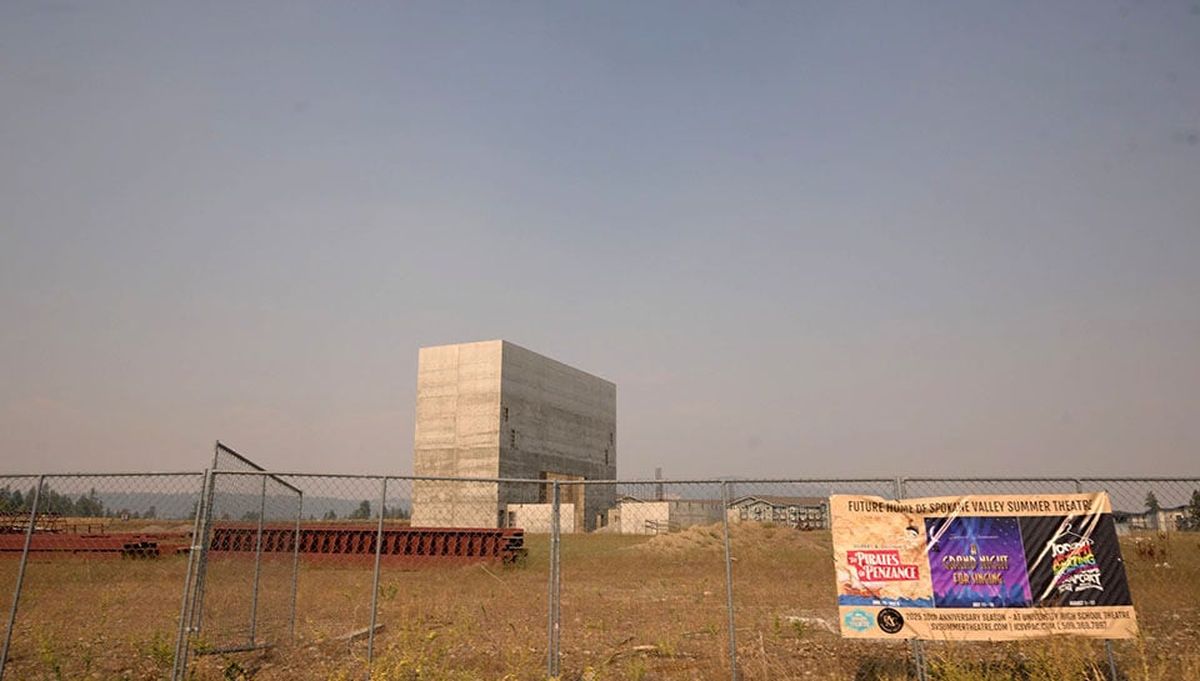
The Spokane Valley Performing Arts Center is asking the city of Spokane Valley to help fund its stalled building initiative with a $28 million infusion of cash raised from the sale of bonds.
The city received the request Feb. 27. It arrived after years of fundraising struggles and a pause by major investors.
The center’s executive director, Yvonne Johnson, describes the financial predicament as circumstances beyond her control, noting construction and labor cost increases.
Several local organizations – including Garco Construction, Idaho Central Credit Union and State Bank Northwest – have stepped back from the project, an ambitious new 59,000-square-foot community theater building on 5 acres in Spokane Valley’s Mirabeau Point area. When the project was announced, Johnson predicted it would cost $25 million. That projected cost from 2020 has about doubled to $48 million.
In five years, the center raised a total of $18.3 million, Johnson said.
To restart construction, the performing arts center submitted a proposal to have the city of Spokane Valley issue a $28 million limited general tax obligation, records obtained by The Spokesman-Review show. According to an email to the city from the performing arts center’s public finance consultant Roy Koegen, the center would repay the bonds until they are paid off or the city would take ownership of the new performing arts center.
Limited tax general obligation bonds allow cities to finance public infrastructure projects without an election. The bond proposed by the center would not increase taxes for Spokane Valley residents, but would require Spokane Valley to go into debt – which would be an unusual move for a city that is prideful of its financial stewardship that typically sees little to no debt.
The city has never agreed to fund a project like this in its history, Spokane Valley City Manager John Hohman said.
“This is a very unique request,” Hohman said. “And this council is very financially conservative.”
Before the bond proposal is considered by the council, city staff will review the proposal and a financial feasibility study.
It’s unclear when there will be a presentation or discussion on the potential bond. Hohman confirmed that it will not be considered by the council this month.
Plans for the center were sparked by the Spokane Valley Summer Theatre’s need for a permanent home.
The needs were exacerbated in October when the SVST canceled its 2026 season after the Central Valley School District denied some of the dates requested at University High School, citing scheduling conflicts and previous wear and tear on the high school’s theater.
Phase one of building the new performing arts center is predicted to cost $32 million and would be 45,000 square feet, with 463 seats at the main stage, 220 seats in a studio theater and an acting conservatory area, according to Johnson. Just over $18.3 million has been raised to fund the new center, according to Brent Wise, finance and construction consultant for the SVST. Of that money, a little more than $13 million has been spent on construction.
In October, Johnson said $2 million had been raised to restart construction, though in August she told The Spokesman-Review that it had raised $4.4 million in committed funds to restart construction on the project. In 2025, the theater raised $2 million through Washington state commerce grants, $1 million in private investments and $1 million from a private donor, Johnson said.
Garco Construction was initially hired by Johnson to build the theater. Work began in August 2022, but stopped about two years ago, Garco CEO Clancy Welsh said earlier this year.
When Welsh’s company began construction, he was under the impression that the project was already funded. After six months of construction, Welsh realized that wasn’t the case.
“It became apparent that the funding was not 100% there,” Welsh said. “I’m not sure how much money they had.”
When it became clear the project wasn’t entirely financed, Welsh notified Johnson that Garco would not continue the project. Garco was paid for all the work they did, but the company has stopped working with the theater.
Welsh said he doesn’t think Garco was deceived into joining the project, but that his company didn’t do enough digging into how much money the theater had for building the project.
After Garco pulled out, the steel and stone Johnson had purchased for the theater have sat where Garco left them: outside, for almost two years.
Garco isn’t the only organization that has stepped back from the project. Two banks, Idaho Central Credit Union and State Bank Northwest, have also stopped investing. In 2023, SVST got an appraisal from Colliers Seattle to get a construction loan from State Bank Northwest.
The size and scope of the project would require the involvement of multiple financial institutions and substantial fundraising, said Greg Deckard, CEO of State Bank Northwest.
“It was becoming difficult for the organization to raise enough capital and find financial institutions to partner with to get the loan that was needed,” Deckard said. “We’re not involved any longer because it’s a massive financial project that we aren’t able to finance alone, and that was known by everybody from the beginning.”
State Bank Northwest stepped back from the project over two years ago and “handed off” the project to ICCU, Deckard said. Deckard noted that the project cost has doubled since 2023, which contributes to the fundraising problem the center seems to be having.
“The vision is awesome, but when that cost increase came, we knew we needed to take a step back,” Deckard said.
Johnson approached ICCU to get a new construction loan. At the time, the theater’s publicly available tax returns indicated the land and unfinished building were worth $9 million.
“We can confirm our role with the Spokane Valley Performing Arts Center has been limited to the naming sponsorship, and that commitment remains unchanged,” wrote Michael Watson, ICCU chief marketing officer, in a statement to The Spokesman-Review.
Before investing in the project, ICCU required an updated appraisal study, which was done by Lembeck Appraisal and Consulting. That appraisal is not found on the center’s website.
Lembeck Appraisal and Consulting found that SVST’s revenue projections and historical data were inaccurate. The appraisal found that the theater was overengineered and would only be worth much less than its construction cost.
Despite the project’s financial difficulties, Councilman Ben Wick said he is excited about the possibility of collaborating to aid the construction .
“I’ve been a very strong supporter of the summer theater since the beginning,” Wick said. “I think it’s a tremendous opportunity for our community and for our kids to have a facility like this.”
Wick said it’s unfortunate that the organization has had such a difficult time getting enough money raised for the project. But he is convinced there’s a way to get the theater built.
“From my understanding, their proposal would require the city to borrow money to get construction started, and the center would make payments to the city until it’s paid off,” Wick said. “Our interest rates are lower than they are in the private sector, and they believe they have a business plan that would support them making bond payments.”
Wick has personally donated to the center, and his kids have attended summer camps through SVST, which would operate out of the new center if it is built.
“They serve hundreds of kids,” Wick said. “It would be a theater that other groups could utilize as a venue.”