Rich colors make Pixar’s ‘Luca’ a worthy sea shanty
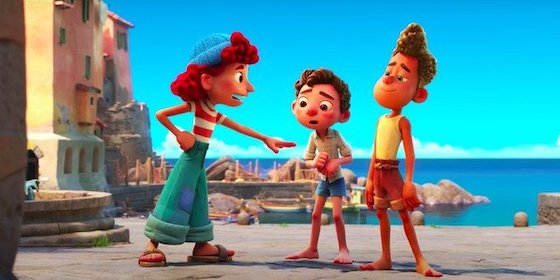
Above : Pixar’s animated film “Luca” is streaming on Disney+. ( Photo/Walt Disney Studios)
Movie review : “Luca,” directed by Enrico Casarosa, featuring the voices of Jacob Tremblay, Jack Dylan Grazer, Emma Berman, Saverio Raimundo, Maya Rudolph, Jim Gaffigan. Streaming on Disney+.
From that moment in 1986 when a small desk lamp named Luxo Jr. jumped on, and ultimately deflated, a rubber ball, the name Pixar has been associated with visual magic. Vastly different from traditional cel animation, that first Pixar cartoon – titled, appropriately, “Luxo Jr.” – ushered in the kind of computer-generated imagery that we now take for granted.
Since then, of course, Pixar has won 18 Academy Awards , split between features, shorts and a “special achievement” prize for 1995’s “Toy Story” – the latest win being last year’s music-minded feature “Soul.” “Luxo Jr.,” itself won a short film Oscar nomination, but lost out to the Belgian-made “A Greek Tragedy.”
Now we have “Luca,” a 95-minute animated film that was released June 18th on Disney+. Directed by the Italian-born Enrico Casarosa, who had worked as a storyboard artist on such films as “Up” and “Ratatouille,” and was the director of his own Oscar-nominated short “La Luna,” “Luca” is an original story that is based, at least partly, on director Casarosa’s childhood growing up in the Italian seaside city of Genoa.
It’s doubtful that Casarosa ever encountered sea monsters in his summer adventures. That part of the film, at least, is all imagination – even if it is part of the film’s overall message.
The fact is, our two main two characters – good-natured Luca (voiced by Jacob Tremblay ) and his rascally, free-thinking friend Alberto (voiced by Jack Dylan Grazer ) – are not your normal adolescent boys. In fact, they aren’t boys at all. They are, in actuality, sea monsters. Or sea creatures. Or simply residents of the sea. It all depends on how you view them.
The humans who live in the nearby village of Portorosso (a play on words suggested by Hayao Miyazaki’s 1992 film “Porco Rosso” ) see Luca and Alberto as monsters. But when Casarosa takes us under the Mediterranean, we can see that the boys, and Luca’s parents and friends, are your typical family units.
And they act in typical family manner, which is to say that they bicker, banter and act both responsibly and impulsively, the latter behavior belonging mostly to Luca who – charged with the chore of herding goatfish – grows bored with his duties.
So when he meets Alberto by chance, Luca is ready to play hooky and – against his parents’ strict wishes – head for dry land. The film’s conceit is that Luca and his tribe are sea creatures when wet, human when dry – a condition that, as you can imagine, becomes ever more important as the story unfolds.
Once on land, two things happen. One is that Luca and Alberto bond as fast friends. Alberto lives alone, having been deserted by his father many months before, and he is hungry for companionship, just as Luca is hungry for new experiences.
The second thing that happens involves the two boys desiring to obtain a Vespa motor-scooter, on which they plan to hit the road, explore the world and sleep under the fish – which is what Alberto calls the stars. To achieve their quest, the two visit Portorosso, where they meet the village bully, Ecole (voiced by Saverio Raimundo), are befriended by the independent Giulia (voiced by Emma Berman ) and join up with Giulia to race in the village’s annual Portorosso Cup Triathlon.
The rest of the story involves Luca’s parents, realizing that their son has disobeyed them, heading to the village – both in human form – to search for him. Meanwhile, Luca, Alberto and Giulia train for the triathlon, all while trying to avoid Ecole and keep him and everyone else from discovering their true sea-creature natures.
Because remember, to the villagers, creatures who come from the sea are monsters. And should be hunted. And killed.
This all plays out in a fairly predictable manner. As a screenplay, “Luca” the film is no “Toy Story,” no “Monsters, Inc.,” no “WALL-E,” each of which is built on a clever storyline involving inanimate objects expressing basic human desires and longing. Cartainly Luca longs for something, too, but other than the fact that he comes from the sea he could be any character from any teen movie ever made.
No, what makes “Luca” the film stand out most are its colors, which on a decent television offer up a rainbow coalition of imagery. With each film, Pixar’s CGI seems ever more realistic while still offering the fantasy feel of animation.
And that plot point about the water threatening to betray the true identities of Luca and Alberto? Well, isn’t that a perfect metaphor to suggest that we should accept others for who they are instead of merely what they look like?
We accepted Pixar’s scrappy little table lamp easily enough, didn’t we?
A version of this review was previously broadcast on Spokane Public Radio.
* This story was originally published as a post from the blog "Movies & More." Read all stories from this blog