Book Review: Three Cups of Tea
On a recent comment posted to my blog, a reader asks if I have seen the documentary “A View from a Grain of Sand” about life for Afghani women. I have not, but it is now on my list. Thank you for bringing it to my attention. I always enjoy reading books and watching documentaries about life in the Middle East- my second home.
On a related note, I have just finished reading a truly inspirational true story about school and peace building in Pakistan and Afghanistan. I couldn’t put the book down and devoured it on my flight here.
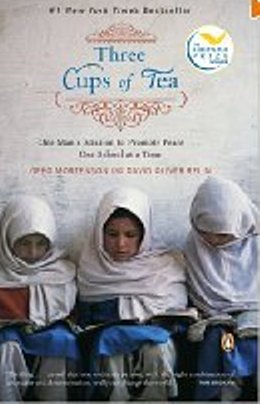
Three Cups of Tea, by Greg Mortenson and David Oliver Relin is an amazing tribute to what one man can accomplish. A climber who failed to summit on K2, Greg Mortenson was lost in the Himalaya range, without a porter, guide or any sense of direction. Through sheer will he was able to keep walking, eventually ending up in the village of Korphe. While he recuperated in the village from his grueling ordeal, he came to know and love the people who took such good care of him.
He discovered that the children of Korphe had a teacher- one that was shared with other villages in the area, and so he came only infrequently. The children would gather together, outside, on a wind-swept mountaintop and try to teach each other their lessons, scratching in the dirt with sticks. They had no proper classroom, no proper supplies, and no continuous teaching methodology. Yet, they were so determined to learn that they would attempt to teach themselves in their teacher’s absence.
Moved by these remarkable children, Greg swore to return from America and build a school for the children of the village.
Once he was back in the states, he realized that he had no idea how to go about keeping his promise. Taking night jobs in various ERs as a registered nurse, he lived out of his car while he tried to find funding for his project. He started writing to everyone he could think of that was known for their money and/or their philanthropy. Over five hundred individually typed letters later, he got his first donation- from school children in America.
After even more letters, failed grant applications and months later, he finally found the donor he was looking for. Taking twelve thousand dollars (the amount his estimates indicated), he returned to Pakistan, bought all the materials and supplies necessary, loaded everything on a truck and made the two day journey to Korphe. Rather than sit in the cab of the truck, he spent those two days riding atop the materials of his unbuilt school.
Arriving in Korphe, he felt victorious at having lived up to his promise. But it was short lived. In his absence, the village elders had decided a school was secondary to another, more pressing need. Doggedly, Greg returned to America to dig up more cash for the village’s other need- a bridge. Without the bridge, the materials for the school couldn’t get into the village. And nothing was going to stop Greg Mortenson from completing his project. By this point, one could see that Greg was on the verge of obsession. And clearly, that’s what was needed.
Greg continued to fight obstacle after obstacle, tackling any problem in his way, learning new languages and customs, new methods of accomplishing tasks, taking a crash course in donor funding, and working with the Korphe elders to make his dream a reality. His story is truly a lesson in tenacity.
Throughout the material buying and bridge and school building process, many people from various other villages became involved in the project. And once the Korphe school was completed, they all wanted schools built in their villages. Loathe to say no to education, Greg held discussions with his original donor and the Central Asian Institute (CAI) was founded. Using money from the endowment, as well as continuing to drum up further donations, Greg Mortenson continues to build schools in remote villages in Pakistan, where children would have no other opportunity for even a basic education.
And while he was visiting the furthest-flung village of Pakistan, a group of Afghani horseback riders thundered into the village. They had ridden six days to speak with him. Having heard of the great work he was doing in the Pakistani villages, they had come to ask that he expand his school building into their home villages in Afghanistan.
Today, there are over twenty schools in the CAI network, crossing the Afghani-Pakistani border.
The need for these schools is so great, the main difficulty today is deciding which village gets the next school. The only requirements that CAI has for their schools is that girls are welcome to attend (an on-going bone of contention with many until the high Islamic court in Iran decreed it legal), the material is secular in nature (no religious teachings, either Christian or Muslim) and that the teachers teach the standard government curriculum. These are not Western schools with Western teachers teaching Western ideas. Rather, they are an opportunity for local children to get a basic education appropriate for their way of life, as well as an opportunity for local teachers to find gainful employment with continuous wages (which CAI pays). By offering children an unbiased education and giving them the tools to succeed in life without coloring their views with religious or foreign morals, he is giving them a chance to grow up with a better understanding of their world, and to discover for themselves the rights and wrongs of this world. He is sowing the seeds of peace in harsh, mountainous terrain.
To be able to accomplish such an amazing feat in countries that are often beset by violence and a lack of governmental structure in these remote areas requires patience, drive and a love of education that goes beyond mere mortals. Greg Mortenson is a rare person indeed that he could and did accomplish what he set out to do and then some.
The subtitle, “One Man’s Mission to Promote Peace… One School at a Time” is absolutely accurate, and he continues to meet this goal with every school he builds. Greg Mortenson should be short-listed for the Nobel Peace Prize.
I recommend this book to anyone who has any interest whatsoever in education, children, the Middle East, or who simply appreciates an inspirational read. And of course, to anyone who wants a road map to achieving world peace, Greg Mortenson seems to have found the answer.
* This story was originally published as a post from the marketing blog "The Eco-Traveler." Read all stories from this blog