‘American Sniper’ hard to critique as mere film
When reactions to a film are all over the place, less attention is typically paid to the film itself than to the issues surrounding it. Such is the case with “American Sniper.” Following is my attempt, which I wrote for Spokane Public Radio , to critique what director Clint Eastwood has put on the screen
Reactions to “American Sniper,” Clint Eastwood’s adaptation of the late Chris Kyle’s 2012 memoir , can be split into two basic political camps: Those who see Kyle – the former Navy SEAL sniper who served four tours in Iraq and is officially credited with 160 kills – as an American hero. On the polar-opposite side, some commentators condemn Kyle as a flag-waving killer . As with pretty much everything else in today’s America, the truth likely rests somewhere in the middle.
Here’s the problem for a movie critic: How do you judge a movie such as “American Sniper” when politics won’t get out of the way?
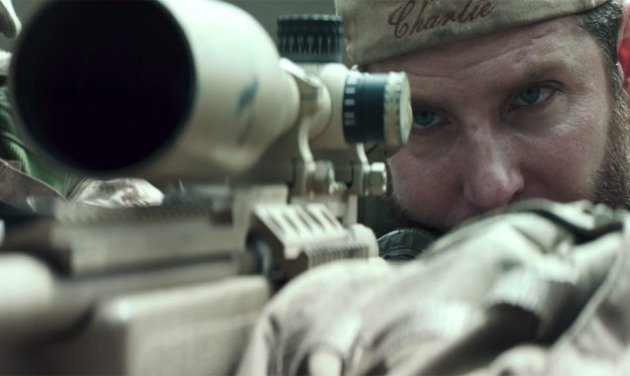
Well, let’s try. First of all, Eastwood’s film is one of his more technically proficient achievements. Whether we’re following Kyle as a boy being taught to cowboy up by his discipline-minded father, Kyle as a SEAL sniper lining up a target in the streets of Fallujah, or Kyle as a husband and father coping with post-combat stress during a backyard barbecue, “American Sniper” is firmly grounded in place. Each scene, especially the war sequences shot in Morocco, inserts the viewer into a situation that looks and feels authentic.
Then we have the acting. Having added 40 pounds to his frame, Bradley Cooper is no longer the pretty boy of such films as “The Hangover” and “The A-Team.” Having worked with a vocal coach, he manages to effectively impersonate Kyle’s native Texas drawl. Required throughout the film to show a range of emotions, Cooper succeeds, proving believable as a modern American gladiator, as a man torn between duty to country and his own family, and as a man capable both of cuddling his infant daughter and of at least being willing to shoot an Iraqi child who poses a threat to U.S. troops.
I place “being willing to shoot an Iraqi child” in quotes because, in contrast to “American Sniper” the movie, Kyle in his book makes no such claim. Which encapsulates the movie’s biggest flaws. That Eastwood would show Cooper’s Kyle actually gunning down a young boy, and then the boy’s presumed mother, serves no purpose that I can see. In his book, Kyle claims to have shot a grenade-carrying woman alone, “the only time,” he wrote, “I killed anyone other than a male combatant.”
And the movie’s contrivances don’t stop there. Kyle is portrayed as engaging in a mano-a-mano struggle with an enemy sniper, a Syrian and one-time Olympic marksman. Kyle is shown making his longest kill and then being saved during a sudden, and convenient, sandstorm. Ignoring the fact that the only characters who express doubt about the U.S. mission in Iraq end up dead or, as with Kyle’s Marine-Corps brother Jeff, simply disappear, the movie’s outright inventions do tend to emphasize a sense of drama. Yet they feel unnecessary – and they overshadow the movie’s true value.
Which, based on my own political viewpoint at least, involves showing what horrors we require American soldiers to engage in and what lingering nightmares those duties instill in the souls of even the hardiest of today’s warriors.
* This story was originally published as a post from the blog "Movies & More." Read all stories from this blog