‘Boys State’: a telling look at winner-take-all politics
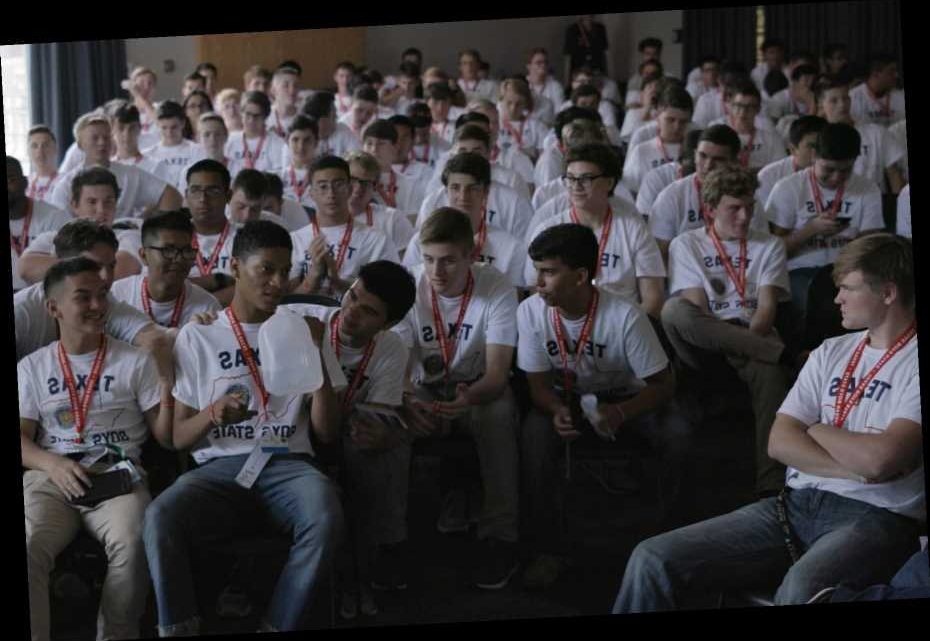
Above : “Boys State (Sundance Film Festival)
Movie review: “Boys State,” directed by Amanda McBaine and Jesse Moss, featuring Ben Feinstein, Steven Garza, Robert MacDougall, René Otero. Available to stream through Apple TV+.
We’re now immersed in the run up to the 2020 presidential election, and each of the two main political parties is attempting to portray itself in the most positive light possible. Yet it would be hypocritical for either party, Democrat or Republican, to claim that it is the party devoted solely to honesty, integrity and truth.
Both parties do make such claims, though, despite the historical evidence. Whether it be the big-city machine politics of New York’s Tammany Hall or the corrupt administration of Warren G. Harding – just to name two of many examples – both parties over time have shown an enduring devotion to the winner-take-all school of politics.
And you have to wonder, what is the genesis of this social-Darwinian attitude? Did it start when people still lived in caves and the general rule, at least among some tribal groups, was that only the strong should survive? Or is it something that evolved gradually, growing in tandem with the development of civilization, tethered to the ideology that some people are just better than others – and thus deserve more?
At its most basic, those are questions that documentary filmmakers Amanda McBaine and Jesse Moss tackle with their film “Boys State,” which is streaming through Apple TV+.
McBaine and Moss center their film on the 2018 Texas Boys State convention , which was where a thousand-some high-school-age boys from all over the Lone Star state congregated in the capital city of Austin. Part of a national program that was begun in 1935 by the American Legion (a Girls State was formed two years later), Boys State is intended as a kind of training ground in democratic government.
We watch as the boys board buses and begin to socialize. And from the very first moments, they start to practice their respective brands of politics. At least some of them do, which is how McBaine and Moss frame their narrative: True to the aim of every good documentary filmmaker, they focus on a few interesting participants, each of whom ends up playing a role in how both the convention – and the film – find resolution.
One of the participants, Ben Feinstein, is a double amputee. But instead of being what you might expect, an advocate for the disabled, he is a fan of self-help, one who reveres Ronald Reagan and who – as the film goes along – displays perhaps the most astute feel for winning politics, however dubious a distinction that might be.
At the other end of the political spectrum is Steven Garza, the son of a Mexican immigrant who comes to Austin wearing a Beto O’Rourke T-shirt and whose message is a blend of support for Bernie Sanders and for sensible gun control – the latter in particular not a popular stance in Texas.
Then there’s Robert MacDougall, an All-American guy who seems as if he’s stepped off the set of a Richard Linklater film – “Dazed and Confused,” anyone? – and whose political stance is somewhere in between Feinstein and Garza’s, though nowhere near as well conceived as those espoused by either one.
McBaine and Moss shape their film chronologically, taking us day by day through the week-long convention, showing how the boys are split into two groups – nationalists and federalists – how they are directed by the few adults who show up on screen to elect party leaders, come up with party platforms and work to elect members of their group as overall Boys State leaders.
The main position is that of governor, a slot that Garza, MacDougall and others vie for, and which the political operative Feinstein – who belongs to the Federalist Party – and his main foe, the Nationalist party leader René Otero, try to snare for their respective candidates.
We get to see all this unfold, with the filmmakers (aided no doubt by the skillful efforts of editor Jeff Gilbert ) interviewing each of the principals, their comments sometimes directed at the camera, sometimes included as voiceovers. And that unfolding, which includes an attempted coup aimed at dethroning Otero and a fair amount of testosterone-laced venting, occurs with far more drama than that offered by either of the just-held national presidential-nominating conventions.
Yet the message remains largely the same for both, which these politicians in training learn well and which reflects that famous statement by Al Davis , late owner of the one-time Oakland Raiders: “Just win, baby.” Just as telling, though, is a comment made in the film by governor-candidate hopeful MacDougall, one that gives an even better indication of how the process works – and likely always will.
“Sometimes you gotta say what you gotta say in an attempt to win,” he says. “That’s politics.”
* This story was originally published as a post from the blog "Movies & More." Read all stories from this blog