‘The Life Ahead’ a fitting cap to Loren’s life and career
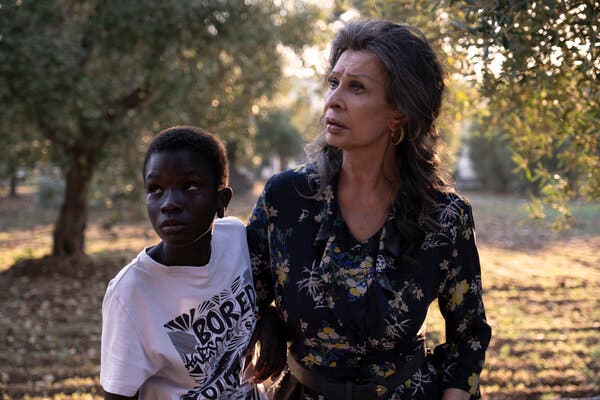
Above : Sophia Loren and Ibrahima Gueye star in the film “The Life Ahead.” (Photo: Netflix)
Movie review : “The Life Ahead,” directed by Edoardo Ponti, starring Sophia Loren, Ibrahima Gueye, Babak Karimi. Streaming on Netflix.
Some movie stars are beautiful. Some are talented. Quite a few are both.
Not that many, though, can match the dual qualities of Sophia Loren , the Italian star who began her career as a sex bomb, developed into an Oscar-winning performer and retains a good measure of both even at the advanced age of 86.
That much should be clear to anyone who watches the Netflix film “The Life Ahead,” which was directed by Loren’s son, Edoardo Ponti, and adapted from Romain Gary ’s 1975 novel “La vie devant soi” (which was published under one of Gary’s pseudonyms, Émile Ajar).
Why Loren, who hasn’t been seen on the big screen for the past decade, would agree to appear in this film should be obvious: It provides a meaty role for an older woman. Gary’s novel has been adapted twice before, most famously in Moshé Mizrahi’s 1977 film “Madame Rosa,” which starred the French actress Simone Signore t and not only won an Oscar for Best Foreign Language Film but also a Best Actress César – France’s Oscar equivalent – for Signoret.
Ponti’s version follows the same basic storyline. Loren plays Madame Rosa, once a prostitute who is years past her prime and now earns a living watching the children of those still walking the streets (the movie was shot in the city of Bari, which sits on Italy’s southern Adriatic coast).
Madame Rosa is a no-nonsense caretaker, and she rebuffs, at least at first, her doctor’s request to take in a tough, 12-year-old Senegalese Muslim boy, named Momo (played by Senegalese newcomer Ibrahima Gueye ). For his part, Momo – whose streets smarts haven’t yet hardened enough to put him beyond the reach of salvation – doesn’t want any part of her either. He’d rather earn his way by selling drugs, which presents him a dangerous but profitable way of making a living.
It’s only when he is encouraged by a friendly shop owner named Hamil (played by Iranian actor Babak Karimi ) to give Madame Rosa – and a life without crime – a chance that Momo begins to accept that fate may offer him something more than easy money and an inevitable bad end.
So far, the plot that Ponti and co-screenwriters Ugo Chiti and Fabio Natale inherited from Gary sounds fairly pedestrian, something you might see done with no-name actors on the Hallmark Channel.
But that same plot does offer a few complications. Though born a Muslim, Momo has no notion of what Islam even is, much less what his ties to it could possibly be. It’s only through Hamil that he regains some sense of the religion, which Ponti suggests visually through the use of what becomes Momo’s power symbol – a computer-generated lioness.
“In the Qur’an, the lion is a symbol of power, patience and faith,” Hamil tells Momo. “You have faith, right? Faith is like love.”
Madame Rosa herself is a Holocaust survivor, with an understandable distrust of the authorities and of hospitals, which is why she has constructed a secret hideaway – not unlike that of the famous Frank family – that offers her both a sense of protection and of solace.
When she begins to fail, as the aged tend to do, it falls to Momo to care for her. And his new-found sense of duty evolves into his making a promise that he will do his best to fulfill. And following Hamil’s pronouncement, the faith he shows gradually becomes a kind of love.
All of this could have been done in an overly maudlin fashion, again as would occur in a Hallmark production. But Ponti dodges the worst filmmaking traits by refusing to milk the storyline for more emotion than is necessary.
And young Gueye, who was chosen from among 300 candidates to play Momo, fills his part perfectly – angry and resentful at first, jubilant only when he succeeds at proving his abilities, but finally vulnerable and sensitive when confronted with the choice that life hands him.
It is Loren, though, who is attracting the most attention, and justifiably so. In this pandemic year, when producers are unsure about how to distribute their movies, Loren is already the subject of Oscar talk . Such a nomination might have been a certainty had “The Life Ahead” gotten a theatrical opening, as Ponti had originally planned. As it is, though, the theatrical circuit’s loss was Netflix’s gain.
Just as it is the gain, too, of anyone fortunate enough to witness what might be the last performance by one of cinema’s greatest stars.
* This story was originally published as a post from the blog "Movies & More." Read all stories from this blog