‘My Psychedelic Love Story’: Errol Morris’ trippy doc
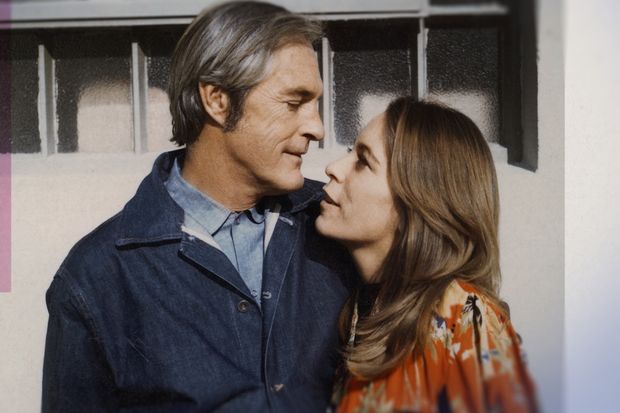
Above : Timothy Leary and Joanna Harcourt-Smith. (Photo: Showtime)
Movie Review : “My Psychedelic Love Story,” directed by Errol Morris, featuring Joanna Harcourt-Smith. Streaming on Showtime, Hulu, Amazon Prime and other services.
Being a good documentary filmmaker requires a number of talents. But the primary skills would the same as those of a good journalist. Namely, a desire to know who, what, when, where, why and how.
That, of course, is just another way to describe having a sense of curiosity. And when it comes to documentary filmmaking, no one is more curious than Errol Morris .
Over the past four decades, Morris has explored situations involving the nature of justice (1988’s “The Thin Blue Line” ). He has delved into controversial topics such as capital punishment (1999’s “ Mr. Death: The Rise and Fall of Fred A. Leuchter Jr.” ). He has studied the specter of regret (2003’s “The Fog of War: Eleven Lessons from the Life of Robert S. McNamara” – which, by the way, earned him a Best Documentary Feature Oscar).
And the one thing that all of these films have in common, besides Morris’ inventive penchant for narrative style, is curiosity – particularly about the various ways in which humans think, feel and behave.
Morris’s latest study is titled “My Psychedelic Love Story,” which is available through the Showtime Network. And while he tackles a subject rich with promise, that of the turbulent period during the late 1960s and through the 1970s, his aim is narrow, focusing on the one-time socialite Joanna Harcourt-Smith and her five-year relationship with LSD guru Timothy Leary .
Leary is not a name you hear much anymore. But the man behind the name once was a media darling. While working as a clinical psychologist at Harvard University, Leary embarked on studies involving psychedelic drugs. After being fired from Harvard, Leary went on to become a staunch advocate for psychedelics, particularly LSD. He wrote books, did a Playboy magazine interview , even appeared before a U.S. Senate subcommittee to espouse the value of LSD.
Not surprisingly, Leary’s own drug use made him a target. After a couple of arrests for marijuana possession, he was given a lengthy prison sentence, which led to a famous escape – with the help of the radical group the Weathermen. That led to his rambling through Europe – where he met and partnered with Harcourt-Smith – before being arrested again in Afghanistan. While serving his sentence at California’s Folsom Prison, where he met Charles Manson, Leary became an FBI informer to shorten his sentence – an act for which he was roundly condemned.
But even that criticism did little to dim his celebrity. When released from prison, Leary spent the remaining two decades of his life writing, lecturing and studying the nature of human consciousness. All that aside, those who remember Leary today tend to recall him as the man who coined the phrase “Turn on, tune in, drop out.”
Much of this is covered in Morris’ documentary, which is based on Harcourt-Smith’s 2013 memoir “Tripping the Bardo with Timothy Leary: My Psychedelic Love Story.” But most of it is included only as an aside to Harcourt-Smith herself.
Because she is the heart of Morris’ film. Though he uses a mass of archival footage – along with a sense of psychedelia in both his visuals and the accompanying music – Morris focuses mostly on interviews he did with Harcourt-Smith, who died this past Oct. 11 in the same city in which she was born, St. Moritz, Switzerland.
And one obvious question would be … why? Why would the same filmmaker who spent so much time examining the lives and motivations of influential figures such as Donald Rumsfeld and Stephen Hawking exert the same kind of effort on Harcourt-Smith? Even if you can believe all that she has to say, and at times Morris makes it clear that he doesn’t, he fails to make her seem all that interesting.
Yes, she can drop names such as Keith Richards and Andy Warhol, and she did carry on an affair with Leary during his time on the run in Europe and for a time after he was rearrested, but that is mostly all Morris gets her to talk about.
A bit of Google searching will uncover the podcast that she began in 2006, titled “Future Primitive,” which features episodes called, say, “The New Voice of an Ancient Spirit” and “White Spirit Animals, Prophets of Change,” the latter of which is a talk with holistic health-care proponent Zohara Meyerhoff Hieronimus .
Interesting? Maybe. But Morris mentions nothing about it. Nor does he mention her husband or her children. He does acknowledge her early life, and her troubled relationship with her mother, but he concentrates mostly on her time with Leary, which is hardly enough to carry a full documentary.
And even if it were, do we – at this time in history – really need another story of a woman whose image is defined mainly by her reflection off a far more famous man?
* This story was originally published as a post from the blog "Movies & More." Read all stories from this blog