There’s more than one way to appreciate a movie
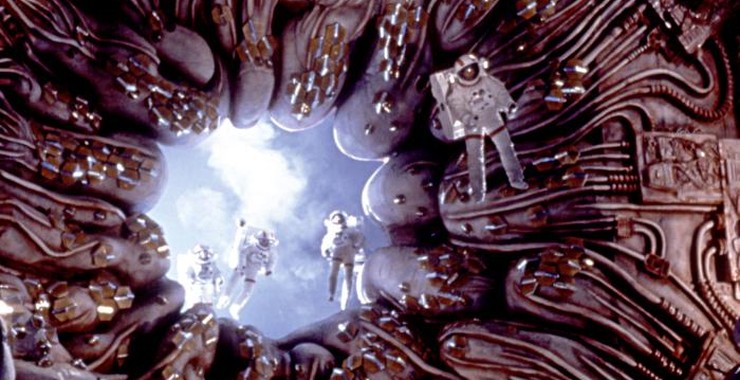
Above : If the “walls” in Tobe Hooper’s “Lifeforce” don’t intrigue you, something else might. (Photo: Tri-Star Pictures)
There are film fans, film scholars and film critics. Sometimes, one person can be all three at once.
I don’t know if Zane Delong considers himself to be a film critic. But he definitely is a film fan.
As for his being a film scholar, well he has a YouTube channel that proves that fact well enough.
It’s called “Welcome to the Mess Lab.” And though of this writing it has only 36 subscribers, that number is likely to grow. I say that because of the video Delong produced titled “Great Walls of Cinema History – Movies From the Deep.”
I was turned on to his channel because his mother, who used to be my editor for a time at The Spokesman-Review, operates a podcast called “At Home Radio.” And she interviewed Delong. So I went on YouTube to check him out and discovered that he’s produced five different videos.
“Great Walls of Cinema History” is his most recent effort. And during its 16-minute-and-two-second running time, Delong studies five different films: Tobe Hooper’s “Lifeforce,” Andrei Tarkovsky’s “Stalker,” Roberto Rossellini’s “Paisan,” Andrzej Zulawski’s “Possession” and Chan-wook Park’s “Lady Vengeance.”
He doesn’t just give a simple plot description of all five films, keying on certain themes or tones that they might have in common. I mean, he does do that. But he also does much more as well.
Working from a quote by John Waters , who insists, “There is no such thing as a bad movie,” he makes a serious point about having an appreciation not just of film but of life itself.
“If you really hate the movie,” Delong quotes Waters as saying, “just look at the lamps in it and pretend the movie is about lamps. And … ‘then never is it boring. It’s always exciting and it’s always surprising.’ ”
Supplanting lamps with walls, Delong talks about walls as they are employed in each of the above-mentioned films and how each “makes a statement based on its mere placement in the frame.”
“It’s not just a wall, it’s about the emotions it conjures or the ideas it frames,” he says, offering up the kind of heavy observation you might hear thrown around in a graduate-level film studies course.
Delong makes his case, though, not just convincingly but entertainingly as well, weaving his narration in voiceover as he plays out long snippets from each film.
His tone is at times comic. How else would you handle a grouping of Hooper’s “Lifeforce” (or as it is also known, “The Space Vampires”) with the work of cinema giants such as Tarkovsky and Rossellini? But his overall point is serious.
“Walls in films complement, contrast and or emphasize the ideas of a narrative,” he says. And whether you appreciate a lamp in the context of a film – or, for that matter a wall – “you can find presence and calm in the experience of the moment.”
And if that doesn’t help you enjoy a movie, however bad — “Lifeforce,” anyone? — nothing likely will.
* This story was originally published as a post from the blog "Movies & More." Read all stories from this blog