Burns, Novick explore the legend of Hemingway
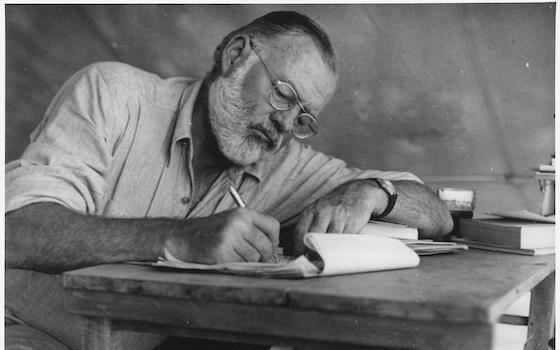
Above : Author Ernest Hemingway hard at work. (Photo/Wikimedia Commons)
Miniseries review : “Hemingway,” directed by Ken Burns and Lynn Novice, narrated by Peter Coyote, featuring the voices of Jeff Daniels, Meryl Streep, Patricia Clarkson. Streaming on various sites, including Amazon Prime and PBS.com.
Few writers had more of an effect on American literature than did Ernest Hemingway . Yet few writers – with the possible exception of Ayn Rand – attract such a wide range of reactions among today’s critics.
Writing in 1961, shortly after Hemingway’s death, noted literary critic Alfred Kazin expressed his opinion in the New York Times. “Probably no other American writer of our time has set such a stamp on modern literature,” Kazin wrote. “Hemingway was one of our true poets. He gave a whole new dimension to English prose by making it almost as exact as poetry, by making every word sound, by reaching for those places of the imagination where the word and the object are one.”
Writing a half century later, also in the Times, columnist Maureen Dowd made a far different point. “If you perused Hemingway in college in the first flush of feminism,” Dowd wrote, “he seemed like a relic. As F. Scott Fitzgerald noted, Hemingway needed a new wife for every big book. And even when he was cheating on a wife with her friend, he painted himself as a victim of predatory and trusting women.”
Dowd, of course, is critiquing Hemingway the man far more than Hemingway the writer. But if you watch the three-part Public Television series “Hemingway,” co-directed by Ken Burns and Lynn Novick, you’re likely to discover that Dowd’s point may be as accurate as Kazin’s. The Hemingway that Burns and Novick introduce us to was far more complicated than the straightforward writing style he pioneered.
For those of us who were raised on Hemingway, the man’s work became a part of who we are. I first read his Nick Adams stories in 10th grade, long before I learned that “Big Two-Hearted River” is meant to be the study of a man recovering from the ravages of war. The story, told in two parts, would come to mean much more to me years later after I returned from my own war, the one in Vietnam.
That said, it’s clear that any look at Hemingway today is necessarily fraught with problems. Though much was known about Hemingway during his lifetime, the legend typically overshadowed the man himself. Hemingway was the self-appointed Papa, a man whose muscular grasp of English prose was presented as symbolic of the man he claimed to be. And perhaps no other American writer has been more defined by his novels, stories and journalism, most of which are – in one way or another – tied to his experiences: first as a war veteran, then as a war correspondent, to his love of bullfighting but most of all to his much-publicized abilities as a big-game hunter and fisherman – not to mention two-handed drinker.
Even at the time, though, many who encountered Hemingway the man, came away with negative impressions. He repaid those who had helped him get started – such as Gertrude Stein and the afore-mentioned Fitzgerald – with hostility. Numerous reports characterize him as a bully, especially when drunk. And as he aged, he drank increasingly, exacerbating the concussions he’d suffered over the years and likely bringing on the same depression that had forced his own father to commit suicide.
Burns and Novick emphasize, too, that Hemingway had a shaky attitude toward truth. As time wore on, he exaggerated his past to the point, at times, of absurdity. For example, despite his claim that he and first wife Hadley almost starved when he was struggling to make his way as a writer in Paris, they actually lived a fairly comfortable life – largely on her family’s money. He boasted of killing German soldiers during his war experiences, with the numbers of those he claimed to have killed gradually increasing as he aged. Maybe worst of all, Hemingway was a known womanizer – and abuser, especially to the last two of his four wives.
Burns and Novick disclose all of this by employing what New York Times television critic James Poniewozik refers to as “the usual Burns toolbox of photo pans and archival film.” That trademark style first involves tackling either a subject – baseball, jazz or Prohibition – or something topical, such the case of the Central Park Five or the Vietnam War – or maybe just a person, whether it be Mark Twain, Jackie Robinson or the Roosevelts (Theodore, Franklin and Eleanor).
Then whatever the project’s focus turns out to be is explored through the blend of a skilled narrator (Peter Coyote being the choice here) with Burns’ characteristic use of old photos and film footage, new footage and talking-head interviews. Much of the new footage captures the feel of places Hemingway loved best, from Paris to Spain, Key West to his finca that sits to this day in the hills above Havana – a virtual villa that becomes almost a character in and of itself.
Taken together, it all amounts to a six-hour-long profile of a famous, influential and – at least to some – still beloved author that is as honest as it is poignant. By quoting the likes of novelists Tobias Wolff and Edna O’Brien , Burns and Novick pay ample tribute to Hemingway the artist. But as for Hemingway the man? It turns out he was less a legend than merely another flawed mortal who possessed a singular talent.
In the end, he was the old man, and his sea was the sadness that overwhelmed him.
* This story was originally published as a post from the blog "Movies & More." Read all stories from this blog