‘One Night in Miami’: Fateful meeting of four famous men
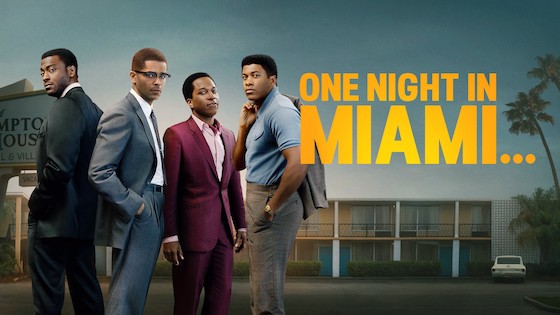
Above : (L-R) Aldis Hodge, Kingsley Ben-Adir, Leslie Odom Jr. and Eli Goree star in “One Night in Miami.” (Photo: Amazon Prime)
Movie review : “One Night in Miami,” directed by Regina King (from a script by Kemp Powers), starring Eli Goree, Kingsley Ben-Adir, Leslie Odom Jr., Aldis Hodge, Lance Reddick, Michael Imperioli, Joaquina Kalukango. Streaming on Amazon Prime.
Note the name Kemp Powers . Not only did he cowrite and codirect the Pixar animated film “Soul,” but he was on the writing staff for the first season of the CBS All Access program “Star Trek: Discovery,” for which he earned credit as writer of the episode “Choose Your Pain.”
All this came after a varied 20-year career as a journalist, which saw him working stints at Reuters and Forbes, Yahoo and AOL. And it came while he labored away on a stage play based on the meeting of four famous black men – Muhammad Ali, Malcolm X, Sam Cooke and Jim Brown – in a Miami hotel room on the same night (Feb. 25th, 1964) that Ali (then known as Cassius Clay) defeated Sonny Liston to claim the world heavyweight title.
Powers had read about the get-together and it stirred his imagination: What might these four men, all leading figures in their various fields, have talked about? The play premiered in Los Angeles in 2013, winning three LA Drama Critics Circle Awards, then had a run three years later in London.
And now it is a movie, adapted by Powers from his play and directed by actress-turned-filmmaker Regina King .
It’s not as if these four personalities had everything in common. Clay was a 22-year-old boxer who had won a gold medal at the 1960 Olympics in Rome. At 28, Brown was a record-holding running back for the Cleveland Browns. Cooke, just 33, was a popular singer/songwriter. And Malcolm X, the oldest of the four at 38, was the public face of the Nation of Islam – and a man, unlike the others, who didn’t smoke nor drink alcohol.
What they did have in common, though, was powerful. All were African-American men who were at or near the top of their chosen fields. And each was at a crossroads in his life: Clay was about to announce that he’d become a member of the Nation of Islam, Brown was on the verge of quitting football for a career in Hollywood, while Cooke – most known as a successful crooner of pop songs such as “You Send Me” and “Twistin’ the Night Away” – had just recorded what would be his single protest song, “A Change Is Gonna Come.”
For his part, Malcom X – who had served as a mentor to Clay and had encouraged him to join the Nation of Islam – was on the verge of quitting that organization and forging his own religious path. He hadn’t yet, though, shared that decision with anyone but his wife, Betty.
Which is the conceit that screenwriter Powers uses to bind his storyline: While the four friends are seemingly gathering to celebrate Clay’s victory – and, yes, there is some truth to that – it gradually becomes clear that, over the course of the evening, all are going to reveal the changes that are about to occur in each of their lives.
And while there is genuine affection among the four, there is rancor, too. The reason for the discord between Ali and Malcolm X becomes gradually clear. But mostly the dispute is between Malcom X and Cooke, with the Muslim minister chastising his singer friend for what he sees as his wasting of his prodigious talents on mere entertainment rather than doing what he can to help in the fight for equality.
The actors that director King and her producers have gathered come close to perfectly matching the characters they portray. Aldis Hodge conveys the quiet power of Brown, Tony Award-winner Leslie Odom Jr. (he played Aaron Burr in Lin-Manuel Miranda’s musical “Hamilton” ) has the vocal talent to pass for Cooke, Eli Goree has much the same mix of size, strength and callow youth as the real Clay and Kingsley Ben-Adir ably conveys the blend of intensity and vulnerability that Malcom X might have shown to those closest to him.
Yet King faces the same problem as does any filmmaker who adapts a stage play into a movie. Any production that depends largely on dialogue spoken by a cast confined to a couple of sets only occasionally translates well to the screen. Sometimes, the director finds a way to open things up – say, the way Mike Nichols did with Edward Albee’s play “Who’s Afraid of Virginia Woolf?” King did add a few extras – a sequence during the Clay-Liston boxing match, a phone call in a telephone booth, a visit to a liquor store – that do take us out of the hotel room.
For the most part, though, she depends on the talents of her cast, which are considerable – including those of such co-stars as Lance Reddick as a possibly duplicitous Nation of Islam bodyguard, Michel Imperioli as Clay’s trainer Angelo Dundee and Joaquina Kalukango as Malcom X’s wife, Betty X. All this, plus the force of Powers’ stage-to-screen storyline, makes King’s film far more than your average stage-to-screen effort.
You could say that “One Night in Miami” is the perfect film for today’s America. It may not exactly capture what really happened that single night in the past, but it may portray a way this country of ours can move toward a better future – when equality truly is something that applies to one and all.
* This story was originally published as a post from the blog "Movies & More." Read all stories from this blog