‘Bridgerton’: a bodice-ripper for the 21st century
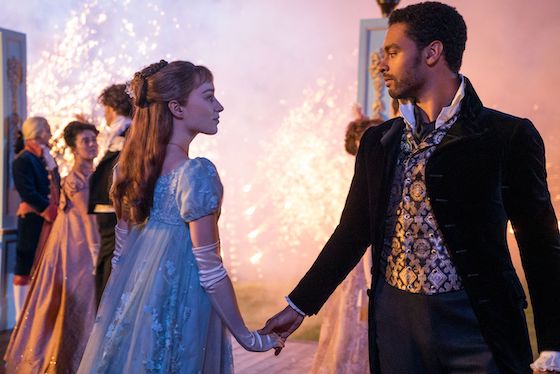
Above : Daphne Dynevor and Regé-Jean Page star in the Netflix miniseries “Bridgerton.” (Photo: Netflix)
Miniseries review : “Bridgerton,” created by Chris Van Dusen, starring Phoebe Dynevor, Regé-Jean Page, Jonathan Bailey, Polly Walker, Ruby Barker, Claudia Jessie, Nicola Coughlan, Julie Andrews. Streaming on Netflix.
My late brother Randy was an anglophile. He could recite the entire succession of British monarchs. What’s more interesting, he could speak at length about the various controversies and scandals that rocked so many of the royal courts.
It was always a pleasure to watch, say, an episode of “Upstairs, Downstairs,” “Downton Abbey” or “The Crown” with him, not to mention any of the films featuring British rulers from Henry the Second to Queen Elizabeth the Second. He could spot immediately both the anachronisms (how characters wore their wigs, for example) and the inaccuracies of fact.
I wonder, then, what Randy would think of “Bridgerton,” the eight-part Netflix miniseries whose first, and so far only, season is set in 1813 during the reign of King George III and Queen Charlotte. Based on one of the storylines adapted from the eight-novel historical-romance series written by Julia Quinn , “Bridgerton” has about as much in common with, say, “The Crown” as “Tom Brown’s School Days” does with the many adventures of “Harry Potter.” The former is an artistic representation of real events while the latter is pure fantasy, however arguably artistic.
The first season of “Bridgerton” focuses on the Bridgerton family, particularly on the eldest daughter, Daphne (played by Phoebe Dynevor ), who emerges as the season’s leading debutante. While her eldest brother, Anthony (played by Jonathan Bailey) seeks to arrange a marriage for her, Daphne resists his initial choice and, instead, is drawn into a “ruse” – that’s the word they use – with Anthony’s BFF, the dashing Simon, Duke of Hastings (played by Regé-Jean Page ).
Daphne and the Duke pretend to be courting. This allows Daphne to attract a number of acceptable suitors, and it takes the pressure off the Duke to marry at all. His own reasons for not wanting to wed have to do with a pledge he made to his dying father, whose harsh treatment of his only heir, not to mention the heir’s late mother, he considers unforgivable. Our line, he tells dear old dad, dies with me.
Here’s where things get complicated, though. Through their play-acting, the couple grows close. And as things happen – sometimes in real life but most assuredly in fiction – the two eventually fall in love, which leads to a compromising situation.
Season one has a number of other plotlines, too. One involves Anthony’s affair with an opera singer, a woman whom a man of his position could never marry. Another follows the Featherington family, whose patriarch is an inveterate gambler and whose matriarch (played by Polly Walker ) has a distant cousin (played by Ruby Barker), who is pregnant yet unmarried – no small problem for a woman, especially then.
Other characters include two more of Daphne’s brothers, one of whom gets acquainted with the secretive side of British society, the other of whom gets targeted in a marriage-of-convenience scheme. Then there is Daphne’s younger sister, Eloise (played by Claudia Jessie), who bridles against any kind of expectation that she should, like her sister, follow societal norms. Eloise, it turns out, is BFFs with one of the Featherington clan, the young Penelope (played by Nicola Coughlan), who is upset at Marina’s plan to entrap Daphne’s brother.
And recording all this is the secretive gossip-monger known only as Lady Whistledown (voiced by the one and only Julie Andrews ). The Regency Period ’s equivalent of the New York Post’s infamous Page Six , Lady Whistledown’s reports both intrigue and horrify members of the court – all the way up to those who wear the crown.
Indeed, it is Queen Charlotte (played by Golda Rosheuvel) who attempts to set up her nephew, Prince Friedrich of Prussia (played by Freddie Stroma) with Daphne, a relationship that threatens to upend the obvious path of love between Daphne and her Duke.
OK, you might say, nothing new to see here. There, though, you would be wrong. Because though this bodice-ripper of a series features a bit of nudity and a fair amount of steamy sex, the overall conceit is similar to that of Lin-Manuel Miranda’s Broadway musical “Hamilton,” in which black actors play famous white characters. “Bridgerton,” too, takes historical liberties by inserting black characters into positions they almost certainly would not have filled in real life.
Not that series creator Chris Van Dusen or his team of screenwriters make race much of an issue. Pointing to the suspicion of some historians that Queen Charlotte herself was of mixed race, Van Dusen told the New York Times that he merely imagined an alternative history in which the queen used her influence to transform the roles that people of color played in English society.
And why not? Imagination is the source of all our myths. If that’s a controversial decision, it’s one that might have made my brother smile. At least I like to think so.
This review was broadcast previously on Spokane Public Radio .
* This story was originally published as a post from the blog "Movies & More." Read all stories from this blog