Grief lurks at the heart of “Pieces of a Woman’
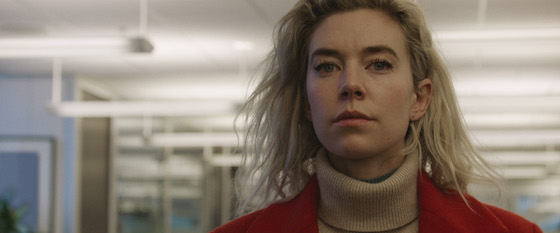
Above : Vanessa Kirby stars in “Pieces of a Woman.” (Photo: Netflix)
Movie review : “Pieces of a Woman,” directed by Kornél Mundroczó, starring Vanessa Kirby, Shia LaBeouf, Ellen Burstyn, Molly Parker. Streaming on Netflix.
No one responds to calamity in quite the same way. Some people rage, some cry, some fall into despair, and some do all three in stages – in some instances even all at once.
In the movie “Pieces of a Woman,” made by the Hungarian filmmaking couple director Kornél Mundroczó and screenwriter Kata Wéber , the character played by Vanessa Kirby goes in a whole other direction: She shuts down emotionally so firmly that those closest to her, from her partner (played by Shia LaBeouf ) to her mother (played by Ellen Burstyn ), are left both bewildered and bereft.
Kirby plays Martha, a woman living in what is supposed to be Boston (but actually is mostly Montreal) with her working-class partner Sean (LaBeouf). Martha and Sean enjoy an easy intimacy, which is good because Martha is about to give birth – and as anyone who has undergone that experience knows, that process can put pressure on the best of relationships.
And pressure comes quickly enough when Martha’s water breaks. Since the couple had planned on a home birth, Sean dutifully calls their midwife – and is informed that she is busy attending another delivery. When the doorbell rings, Sean greets Eva (played by Molly Parker), a substitute midwife, yes, but one who seems perfectly professional. In any event, the birth is happening so it’s too late to do anything about it.
Then for the next 20-odd minutes, in what is captured in a single take – Mundroczó’s camera haunting the couple’s apartment like a nosy guest – we bear witness to one of the most excruciating depictions of birth ever put on film. And while I won’t go into detail, the rest of the movie hinges on the fact that the delivery doesn’t end well. The scene ends with Sean running barefoot out the front door to meet the paramedics whom Eva has ordered him to call.
Following that fateful night, we catch glimpses of the aftermath. Wéber’s script – which is adapted from her own original, two-act stage play – leaves gaps in the narrative, such as the specifics about initial contacts with lawyers and arrangements for lawsuits. But much of that likely is purposeful. Wéber’s primary interest is Martha, and how she responds to the kind of horrific experience that is every potential parent’s nightmare.
So while there is a scene in a lawyer’s office, and “Pieces of a Woman” does include a climactic courtroom scene, the focus stays mostly on Martha. We watch as she returns to work (though it’s never clear exactly what she does; Wéber’s not interested in dotting every i, remember?). We see her watching other people’s children. We see her do pretty much everything that normal people do. Yet there’s no spirit behind any of it. No spark.
Which, of course, is not what either her mother or Sean want. Or need. Mom, who just happens to be a Holocaust survivor, is obsessed with a desire for some sense of justice, as if that will resolve things for her in a way that she can understand. And accept. Sean – as lost in his emotions as Martha is alienated from hers – wants his own sort of resolution, which not to his credit, he translates as a desire for sex.
The acting here is superb. Whatever personal problems that LaBeouf might have, the most recent of which involve charges of domestic violence , he is as natural any actor as anyone working today. And Burstyn, who won a Best Actress Oscar for Martin Scorsese’s 1975 film “Alice Doesn’t Live Here Anymore,” is masterful at portraying a woman whose apparent concerns mask a judgmental nature that is disapproving of anything, or anyone, who doesn’t abide by what she considers to be the right way of doing things.
This isn’t the first film that Mundroczó has given us filled with stunning imagery. His 2014 film “White God” follows packs of dogs running wild through the streets of Budapest. His 2017 film “Jupiter’s Moon” uses a bit of magical realism to fill out a story about government corruption and the immigrant experience. Not all that he does, though, can cover up for problems implicit in Wéber’s script.
For one thing, the staging of a climactic courtroom scene makes even the most melodramatic episode of “Law & Order” seem credible. Furthermore, though its intent as a means of wrapping up Martha’s story is clearly intended to serve as a much-needed catharsis, it feels too contrived, too manipulative to be believable. Same with the closing scene of new-found intimacy between Martha and her mother; lifelong grievances don’t just dissipate overnight.
In the end, though, there’s little doubt that “Pieces of a Woman” tells an important story, about loss, about grief and the myriad ways in which people deal with personal tragedy. As a consequence, much of what director Mundroczó has staged, especially the birthing sequence, may stay with you long after the screen goes dark.
This review was broadcast previously on Spokane Public Radio.
* This story was originally published as a post from the blog "Movies & More." Read all stories from this blog